
International Baccalaureate
Transdisciplinary and Concept-based Learning in the PYP:
From Knowledge to Understanding
For many of us growing up, school may have been a place where knowledge was learned through separate subjects: English at 9am, Mathematics at 10am, Science on Thursdays.
Learning today can sometimes look a little different. The PYP for example does not move away from knowledge; rather, it asks us to consider what students can do with what they know.
This is where transdisciplinary learning comes in. Our world is not divided neatly into subjects. Transdisciplinary learning brings knowledge, concepts and skills from different disciplines together around meaningful ideas, questions and real-world contexts. Students use what they know to make connections, investigate questions and construct meaning.
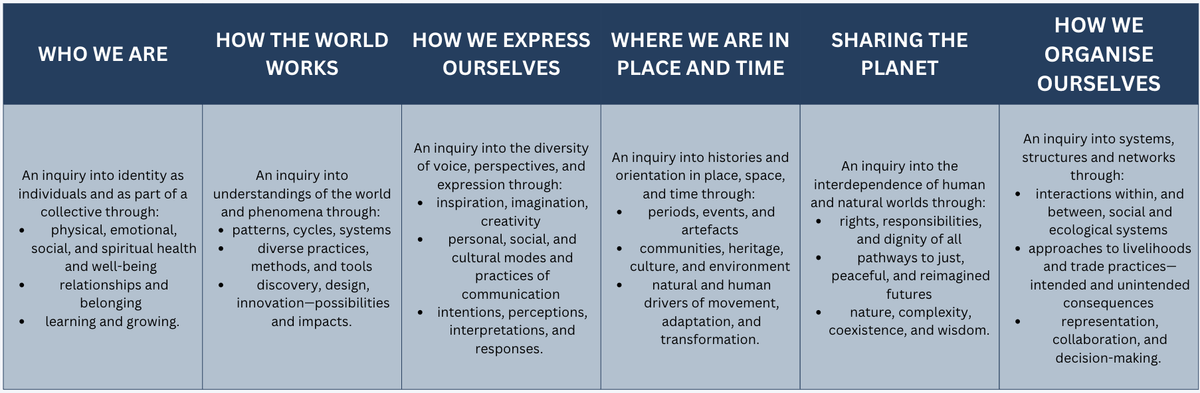
The Big Six – PYP Transdisciplinary Themes
From Facts to Big Ideas
Concept-based learning takes this thinking further. It is not about replacing facts with concepts. Students need knowledge in order to think deeply. Conceptual learning helps students see the bigger ideas, patterns and relationships that sit within individual facts.
A student might learn that bees pollinate flowers. That is knowledge. When they begin to understand interdependence — that living things rely on one another within systems — they can apply that understanding to forests, food systems, oceans, communities and beyond.
Concepts are powerful because they transfer. Students are developing ways of understanding the world that they can use again and again, in different contexts and across different disciplines.
Curiosity as the Catalyst
Our international inquiry consultant, Trevor MacKenzie, places curiosity at the heart of inquiry. Curiosity prompts students to notice, wonder, question and want to find out more.
This is one of the opportunities created by transdisciplinary and concept-based learning. When students encounter connections between subjects, explore big ideas and recognise that what they are learning has relevance beyond a single lesson or unit, new questions begin to emerge.
Knowledge gives us something to think with. Understanding helps us make sense of it. Curiosity makes us want to keep exploring. All of this and more can support young people in finding their voice, creating their place and make a meaningful contribution in this ever-changing world.