
Attendance & Engagement

Every Day and Every Minute Counts
As we move further into the 2026 school year, we continue to closely monitor attendance and punctuality across Saltwater P-9 College.
Regular attendance is about much more than simply recording whether a student is present or absent. Being at school consistently helps students maintain continuity in their learning, build strong relationships with teachers and peers, develop positive routines and feel connected to their school community.
This edition of our Attendance and Engagement update provides families with an overview of our 2026 year-to-date attendance data, including some of the reasons students have been absent. We also explain our Attendance Support Plan process, provide an important reminder about family holidays during the school term, and look at an area that can sometimes be overlooked – the cumulative impact of arriving late to school.
Importantly, attendance data does not tell the whole story. Behind every percentage is an individual student and family, and there can be many legitimate and complex reasons why a child may experience periods of absence or difficulty arriving on time.
Our approach is therefore not simply about identifying an attendance concern. It is about understanding what may be contributing to it and working in partnership with families to determine what support may help.
Our Attendance Snapshot – 2026 Year to Date
Our year-to-date data shows that attendance across Prep to Year 9 currently ranges from 83.4% to 90.9%.
Year Level | Attendance | Tier 1 | Tier 2 | Tier 3 |
|---|---|---|---|---|
Prep | 90.6% | 63.6% | 24.7% | 11.6% |
Year 1 | 89.8% | 55.7% | 26.4% | 17.9% |
Year 2 | 90.2% | 60.8% | 25.6% | 13.6% |
Year 3 | 90.9% | 58.9% | 30.4% | 10.6% |
Year 4 | 90.0% | 57.1% | 28.2% | 14.7% |
Year 5 | 90.6% | 61.3% | 29.0% | 9.7% |
Year 6 | 90.8% | 63.2% | 25.2% | 11.6% |
Year 7 | 89.7% | 55.8% | 29.0% | 15.2% |
Year 8 | 83.4% | 41.3% | 28.7% | 29.9% |
Year 9 | 83.6% | 36.4% | 31.8% | 31.8% |
There are encouraging results in this data, particularly across our primary years, where most cohorts are currently at or around 90% attendance.
At the same time, the data highlights areas requiring further attention. This is particularly evident in Years 8 and 9, where overall attendance has fallen below the levels seen across our younger cohorts, and a greater proportion of students are now within Tier 2 and Tier 3.
Across the College, approximately 56.5% of students are currently within Tier 1, while 27.8% are in Tier 2 and 15.7% are in Tier 3.
This means approximately 43.5% of our students are currently identified within Tier 2 or Tier 3 of our attendance framework.
This does not mean that 43.5% of our students are simply "not attending school". It tells us that a significant number of students have accumulated enough absences across the year that it is important for us to look more closely at their individual circumstances.
As a student's number of absences increases, so does the level of support and follow-up we can provide.
Attendance Support Plans – Working Together
Our Assistant Principals have begun conducting meetings with families of students whose attendance has reached Tier 2 or Tier 3 – generally beginning once a student has accumulated 10 or more days of absence across the year.
These meetings are not intended as a consequence for being absent. Instead, they provide an opportunity for us to sit down together, look beyond the attendance percentage and better understand what may be contributing to a student's absence or late arrival.
During an Attendance Support Meeting, your Assistant Principal may:
- review your child's individual attendance and punctuality data
- identify any patterns of absence or late arrival
- listen to and discuss circumstances that may be affecting attendance
- explain the school's responsibilities regarding regular attendance in alignment with Department of Education requirements
- discuss how absences should be reported and recorded
- clarify school procedures relating to illness, appointments and family holidays
- identify achievable attendance or punctuality goals
- develop an Attendance Support Plan, where appropriate
- discuss strategies that may support your child's regular attendance
- identify school-based or external services that may be able to assist.
An Attendance Support Plan is not about setting the same expectations or strategies for every student. It provides an opportunity to develop a response that considers the individual circumstances of the child and family.
Depending on the circumstances, support might include regular check-ins with a trusted staff member, wellbeing assistance, morning transition support, return-to-school planning following an extended absence, assistance reconnecting with classroom learning, Student Support Services or connections with external organisations.
Where family circumstances are creating additional barriers to regular attendance or punctuality, we may also discuss services such as The Orange Door, which can connect families with a range of practical and family supports.
Most importantly, families do not need to wait until their child reaches Tier 2 or Tier 3 to ask for help. If something is beginning to affect your child's ability to attend school regularly, please reach out early.
Planning a Family Holiday During the School Term
Our attendance data also shows that family holidays continue to be a significant contributor to absence across the College.
Our current data includes 15,007 absence records categorised as Parent Choice – Unapproved Family Holiday.
We don't share this figure to criticise families who travel. Instead, it highlights the importance of ensuring families understand our Family Holiday Notification Process so that we can work together when travel during the school term is necessary.
We recognise that families travel for many different reasons and that sometimes travel during school terms cannot be avoided.
Where possible, we encourage families to schedule holidays during designated school holiday periods. However, if you are planning to travel during the school term, our message is simple: Please speak with us as early as possible so we can plan together.
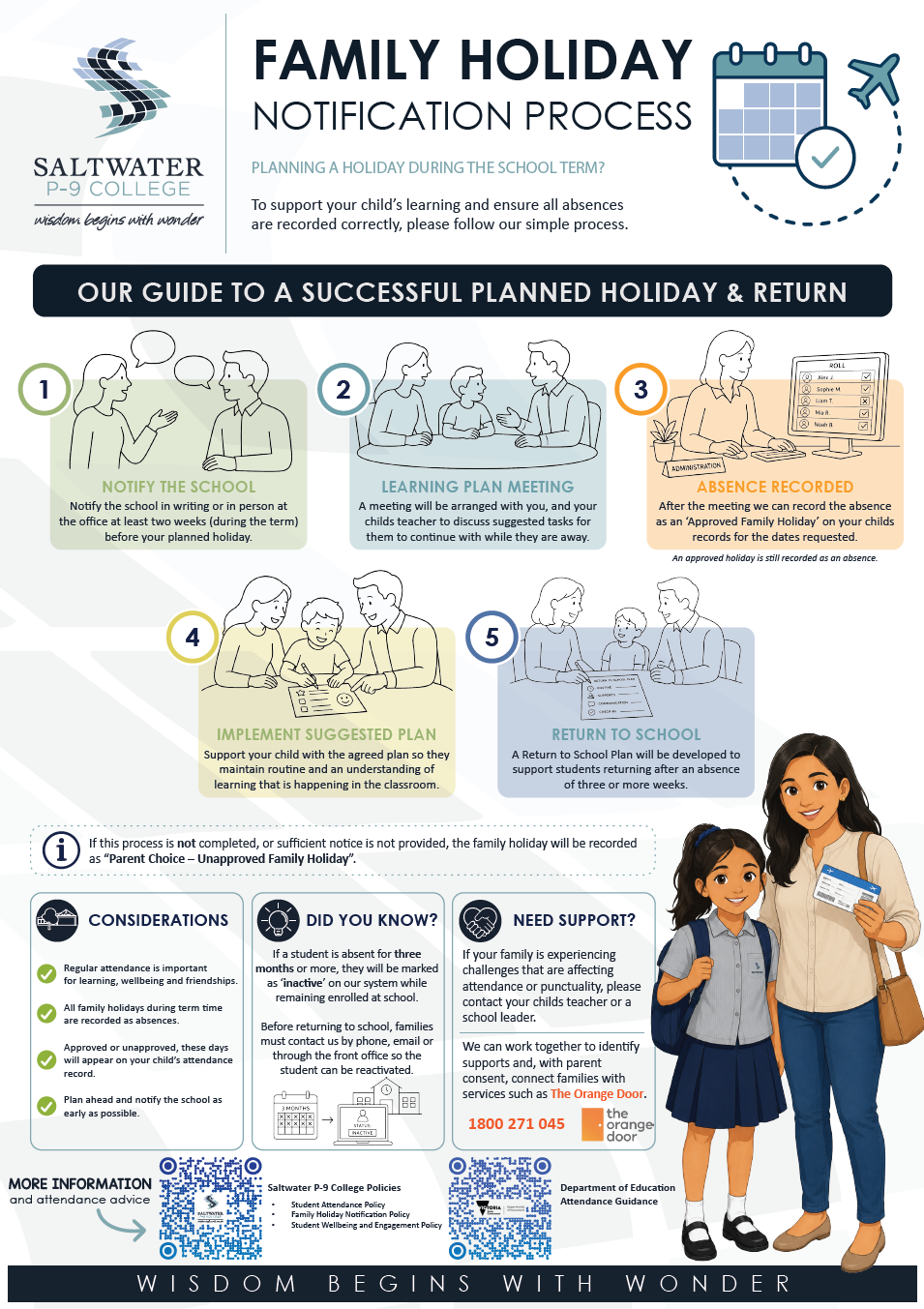
Our Family Holiday Notification Process
1. Notify the school
Please notify the school in writing or in person through the office at least two weeks before your planned holiday during the school term.
2. Learning Plan Meeting
A meeting will be arranged with you and your child's teacher to discuss appropriate tasks and learning that can continue while your child is away.
3. Absence Recorded
Following the process, the school can record the absence as an Approved Family Holiday for the dates requested.
It is important to remember that an approved holiday is still recorded as an absence and will continue to appear within your child's overall attendance data.
4. Implement the Suggested Learning Plan
Families are encouraged to support their child with the agreed learning while away so they can maintain routines and connection with learning occurring in their classroom.
5. Returning to School
For extended absences of three weeks or more, a Return to School Plan will be developed to support the student's transition back into school, classroom routines and learning.
Where sufficient notice is not provided or the Family Holiday Notification Process is not completed, the absence may instead be recorded as Parent Choice – Unapproved Family Holiday.
The purpose of this process is not to make family travel difficult. It gives the school an opportunity to know when your child will be away, record the absence appropriately, consider how learning can be supported and plan for a successful return.
Planning ahead gives us the best opportunity to support your child before, during and after their absence.
Every Minute Counts – Arriving on Time
Attendance isn't only about whole days away from school.
Our data shows that late arrival also requires our attention.
In August alone, 4,027 late arrivals have already been recorded across Prep to Year 9.
Year Level | August Late Arrivals |
|---|---|
Prep | 194 |
Year 1 | 251 |
Year 2 | 320 |
Year 3 | 353 |
Year 4 | 487 |
Year 5 | 308 |
Year 6 | 416 |
Year 7 | 569 |
Year 8 | 529 |
Year 9 | 600 |
These figures do not represent 4,027 individual students. A student arriving late on multiple mornings generates multiple late-arrival records.
What the figures do demonstrate, however, is how frequently students are arriving after the expected commencement of their school day.
This is particularly evident within our secondary cohorts. Years 7, 8 and 9 collectively accounted for 1,698 late arrivals in August alone.
A Few Minutes Can Add Up
Being five or ten minutes late occasionally may not seem significant. When lateness becomes a regular pattern, however, those minutes accumulate.
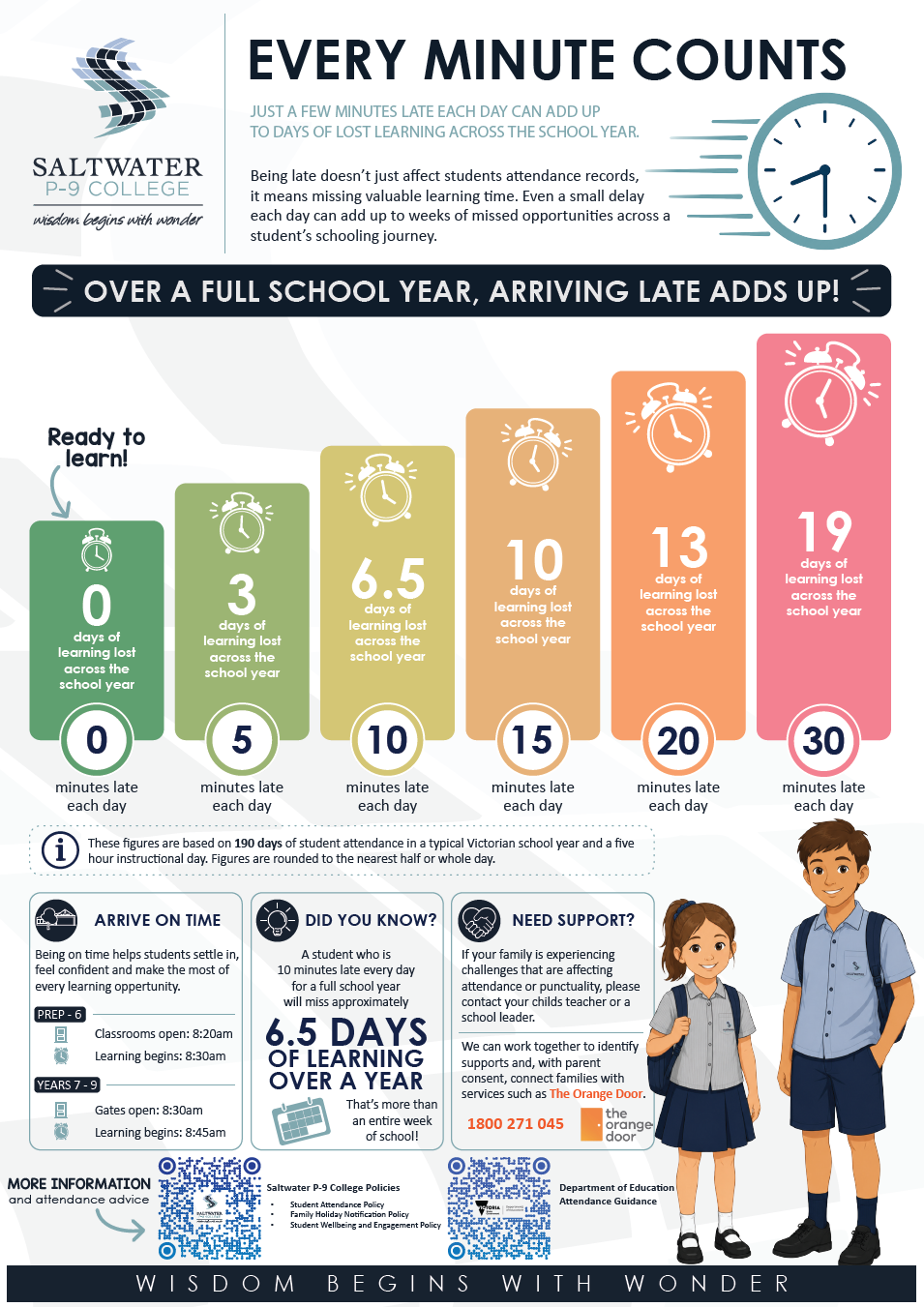
Across a typical 190-day Victorian school year, arriving late every day can equate to approximately:
Arriving Late Each Day | Approximate Learning Time Lost Across the Year |
|---|---|
5 minutes | 3 days |
10 minutes | 6.5 days |
15 minutes | 10 days |
20 minutes | 13 days |
30 minutes | 19 days |
A student arriving just 10 minutes late each day can therefore miss approximately 6.5 days of learning over a school year.
At 15 minutes each day, this increases to approximately 10 days – equivalent to around two school weeks.
Importantly, the impact isn't only measured in minutes.
The beginning of the school day is an important part of establishing a student's readiness to learn. It provides students with an opportunity to:
settle into their learning environment
connect with their teacher and classmates
organise themselves and their materials
hear important information about the day
participate in the introduction to their first learning session
begin their day calmly and alongside their peers.
When students regularly arrive after learning has commenced, they can begin their day trying to catch up rather than being ready to learn.
Ready to Learn
For our Prep–Year 6 students, classrooms open at 8:20am, with learning commencing at 8:30am.
For our Year 7–9 students, gates open at 8:30am, allowing students time to enter the College, organise themselves and prepare for learning.
We understand that occasional delays happen. Traffic, appointments and unexpected family circumstances are part of everyday life.
Our concern is when late arrival becomes frequent or habitual.
Where ongoing patterns of lateness are identified, this may form part of an Attendance Support Meeting. Again, our aim is not simply to identify that a student is late. We want to understand why it is happening and what might help.
Where morning routines, transport, family circumstances, wellbeing or other challenges are affecting punctuality, please speak with us. There may be practical strategies we can put in place at school or additional services we can connect families with.
Every day matters – and every minute matters too.
Working Together
A Final Message
Attendance and engagement are a shared responsibility between students, families, the school and our wider community.
Our responsibility as a school extends beyond simply recording attendance.
We have a responsibility to monitor attendance, communicate with families, understand barriers, provide support and work collaboratively when a student begins to experience difficulties attending school regularly.
Likewise, families play an essential role by supporting regular attendance, communicating with the school when their child is absent, following appropriate processes for planned absences and reaching out when additional support may be required.
Most importantly, we recognise that attendance data never tells the entire story.
Behind a percentage may be illness, medical appointments, family circumstances, wellbeing concerns, transport difficulties, financial pressures, extended travel or other challenges.
This is why our approach is not simply about asking:
"How many days has this student missed?"
We also want to ask:
"What is happening for this student, and how can we work together to support them?"
At the same time, we want our community to recognise how quickly absence and lateness can accumulate. A day here, a day there, or ten minutes each morning can eventually become weeks of missed learning.
Our goal is to have every Saltwater student at school as regularly as possible, arriving on time, feeling connected to their peers and teachers, and ready to make the most of every learning opportunity.
If your child is experiencing difficulties with attendance or punctuality, please don't wait until you receive an invitation to an attendance meeting. Reach out to your child's classroom or homeroom teacher, Year Level Assistant Principal or another trusted member of staff.
Early conversations give us the best opportunity to understand, plan and support together.
Thank you to our families for your continued partnership in supporting the attendance, engagement and wellbeing of our students.
Every day counts.
Every minute counts.
Brent Syme
Assistant Principal – Attendance & Engagement
Saltwater P-9 College