
Numeracy Update
The Power of Patterns in Mathematics
"Mathematics is the science and language of patterns." – Copley (2000)
Patterns are everywhere! From the changing seasons and daily routines to music, art and nature, children are surrounded by patterns every day. Recognising and creating patterns helps students make sense of the world around them and is an important foundation for learning mathematics.
In our junior classrooms, students have been exploring a wide variety of patterns using objects, pictures, colours, shapes, movements, sounds and numbers. Through hands-on activities, discussions and investigations, they are learning to identify, describe, continue and create patterns while beginning to explain the mathematical rules they notice.
Learning about patterns is much more than simply copying a sequence. It helps children:
- recognise relationships and make predictions;
- develop problem-solving and reasoning skills;
- understand how numbers work; and
- build the foundations for algebraic thinking in later years.
A strong understanding of number patterns also supports students in developing confidence with counting and number operations. Throughout the primary years, students investigate:
- Counting patterns – recognising how the numbers 1–9 repeat throughout our number system and using this knowledge to count forwards and backwards confidently.
- Skip-counting patterns – counting by 2s, 5s, 10s and beyond to discover patterns that support multiplication, division and place value.
- Growing and shrinking patterns – identifying patterns that increase or decrease by a set amount and predicting what comes next.
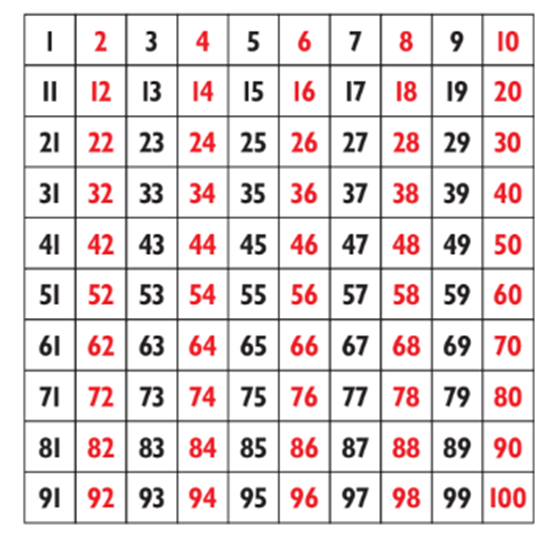
- Hundreds chart patterns – exploring visual number patterns that help students understand place value and make connections between numbers.
As students become more confident in recognising patterns, they begin to make generalisations about how mathematics works. These experiences help them see that mathematics is not simply a collection of facts to memorise, but a connected system where numbers follow predictable and logical patterns.
How you can help at home
You can encourage your child to look for patterns in everyday life by:
- noticing patterns in nature, clothing, tiles or artwork;
- clapping or creating repeating rhythm patterns;
- practising skip counting while walking, driving or climbing stairs;
- looking for patterns on a hundreds chart; and
- asking questions such as, "What do you notice?", "What comes next?" and "How do you know?"
By exploring patterns together, children develop the confidence and mathematical thinking that will support their learning for years to come.
Numeracy Leader | Colleen Monaghan