Grade 3 Community News
Text-Level Reading
Students are continuing to engage in our text 'Storm Boy,' where we will read about the bravery of Mr Percival as he helps save the crewmen and captain of a ship in the middle of a storm. We will also learn about Mr Percival's caring nature as he warns off the ducks in the sanctuary later in the book during hunting season, and we will learn that sometimes there is a cost to being courageous. The students will continue to develop their comprehension throughout the reading of our text over the next two weeks. They are also engaging in some supplementary readings: 'Ngarrindjeri Aboriginal People' and 'Flora and Fauna ', which are helping inform students’ background knowledge about the Coorong. Our supplementary readings are especially helpful in supporting students in identifying important information for note taking and writing their information reports during writing time.
Sentence-Level Writing
Students are focusing on summarising what they have read into a Single Paragraph Outline (SPO), focusing on using the 5Ws (Who, What, When, Where, Why) and How to help them include only the important information. They need to have a topic sentence, 3-4 supporting details, and a concluding sentence in their SPO. Students will also be continuing to develop their note taking skills by using shorthand and symbols to become quick and efficient at taking notes.
Text-Level Writing
Over the next two weeks, students will focus on completing SPO body paragraph two for their information report about the Coorong and using direct speech in their writing. Direct speech is when a character is talking in text. Students are developing the skills to include this in their own writing using the correct punctuation, including speech marks appropriately and the speech tag (person/character speaking). They will then practice putting direct speech into an SPO paragraph about our text ‘Storm Boy.’
Mathematics
Over weeks 5 and 6, students will continue developing their measurement and problem-solving skills. They will learn to estimate and compare lengths using different units and solve difference problems by finding how much more or less one amount is than another. Students will also investigate patterns made with sticks, using their observations to identify patterns and solve a range of problems.
In Week 6, students will explore fractions on a number line, building their understanding of where fractions are located and how they relate to one another. They will also investigate nets of 3D objects and use nets to create three-dimensional objects. Students will further develop their multiplication skills by learning to use vertical multiplication with regrouping.
Humanities
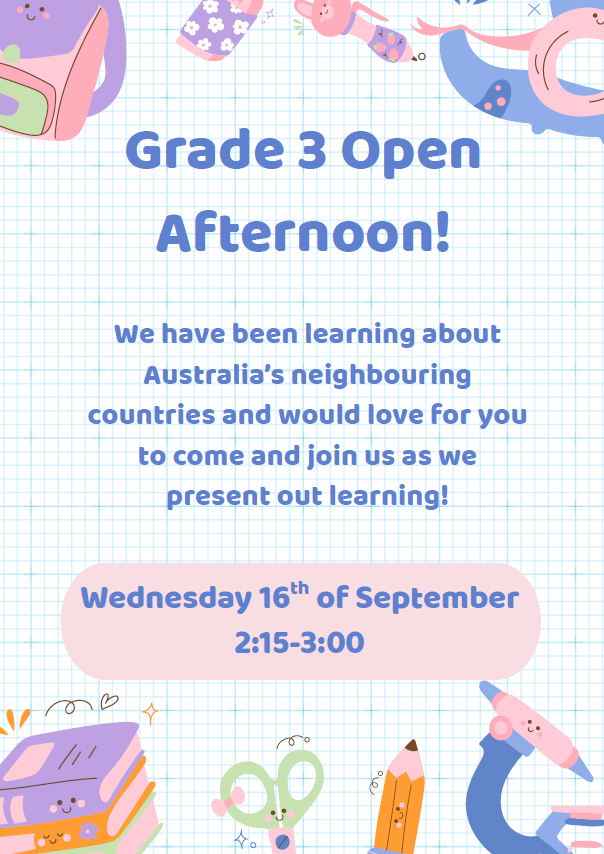
This fortnight, students will continue exploring Australia and its neighbouring countries. They will be introduced to Indonesia and Papua New Guinea, locating these countries on a map and learning about some of their natural and geographical features. Students will consider what makes each country unique and how their environments are similar to and different from Australia.
Students will investigate and compare natural features, such as mountains, rivers, islands, forests and coastlines, across Australia and neighbouring countries. They will also explore managed and constructed features, including places and environments that have been changed or developed by people, such as farms, roads, buildings and parks.
As they compare Australia with a neighbouring country, students will develop their geographical vocabulary and practice identifying similarities and differences between places. They will use maps, images and other sources to help them describe the features of each country and build their understanding of the diverse environments and communities in our region.
Reminders for upcoming weeks:
- Monday 24th - Friday 28th August – Book Week
- Book Fair will be open before and after school every day in Pod 1, Room 6
- Wednesday 26th August – Book Character Dress-Up Day