Anecdotes from the Archives
Mrs Margaret Rootes, Heritage Officer
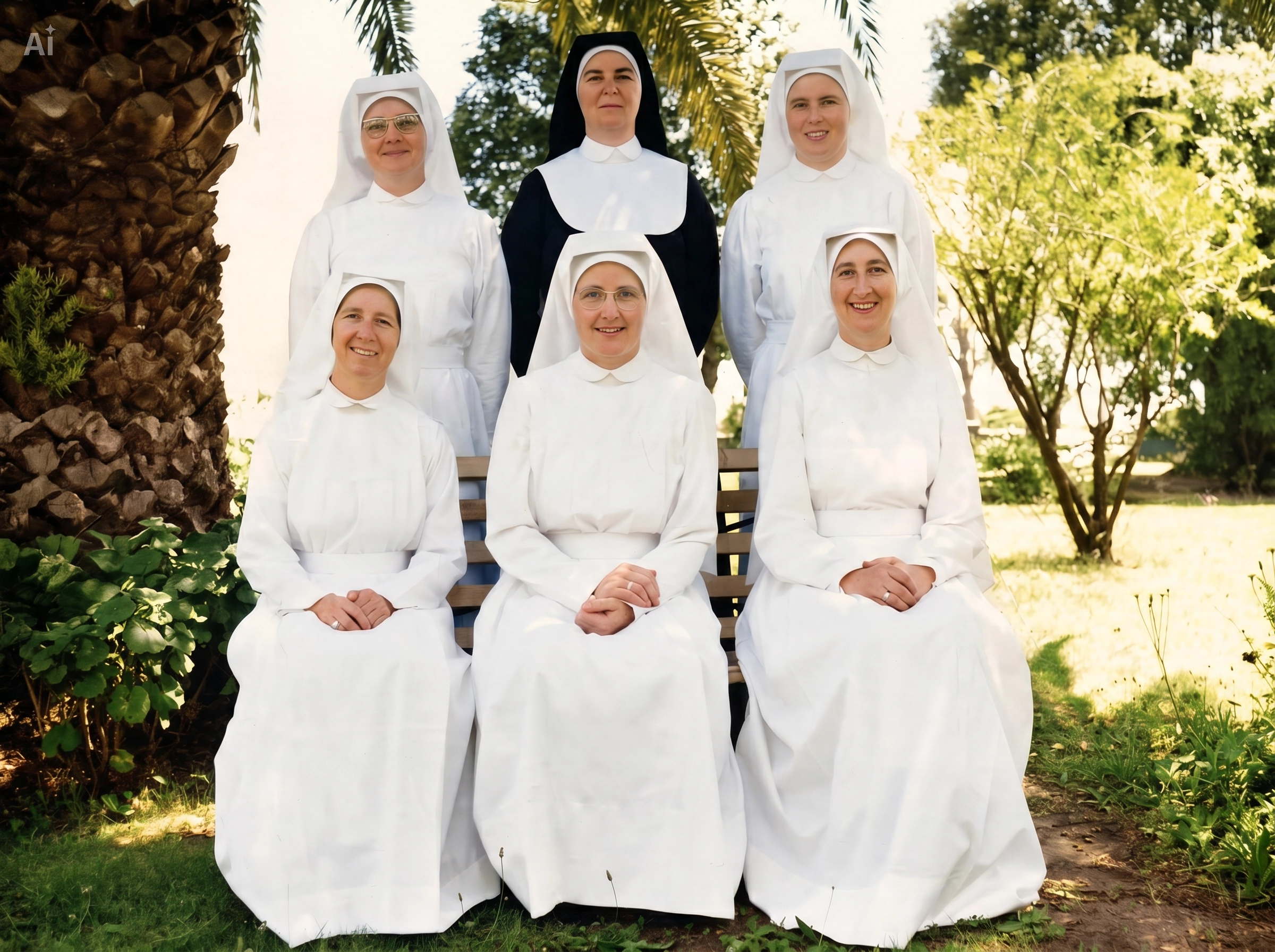
Pictured: The first party of the Tasmanian Presentation Sisters to travel to Papua New Guinea, with Sister Patricia McNeil seated at the centre.
Anecdotes from the Archives
Mrs Margaret Rootes, Heritage Officer
Pictured: The first party of the Tasmanian Presentation Sisters to travel to Papua New Guinea, with Sister Patricia McNeil seated at the centre.
In the last several issues, I have written about the missionary work of the Tasmanian Presentation Sisters, on both King and Flinders Islands. The missionary work in Papua New Guinea is another story altogether, being their first outside Australia in another country: here they faced vastly different challenges and difficulties, not the least being the climate, terrain, inaccessibility and languages.
In 1966 the Society of Presentation Congregations decided to celebrate the 100th anniversary of the Sisters’ arrival in Hobart by taking the huge step of establishing a foreign mission. This was in response to a cry for help from the Franciscan Fathers who had pioneered a mission in Aitape in 1947.
The new mission was to be set up in Ningil, which was situated in very rough and almost inaccessible terrain, and consisted of about 40 villages hard up against steep mountain ridges. The people of Ningil had not previously been in contact with Europeans, and the Franciscans were looking for religious women to teach the women and girls.
It was decided that Ningil would be established by a group of Presentation Sisters, one from each of the Australian Congregations. Sister Patricia McNeil volunteered and was accepted as the Tasmanian missionary. In early 1966 the party set out on the long and arduous journey to Ningil in Papua New Guinea, by several ships, by air and on foot.
Stopping in Aitope, our Sisters took a week off their travels to stay with some Franciscan Sisters: they learnt as much as they could from these kind women about the treatment of tropical diseases, burns, ulcers, dysentery, yaws and malaria. Sister Patricia always valued these lessons, as she applied them in practice countless times at Ningil and later in Malol.
After a final jolting flight, the Sisters were delivered to Ningil. Here there was a rough convent building, made of local timbers with a thatched roof. The house was already inhabited by all sorts of reptiles, bats, spiders and scorpions. The acquisition of a cat helped to despatch these unwelcome visitors. The house consisted of seven tiny bedrooms, a chapel, storeroom, kitchen, dining room, verandah and two shower cubicles. At first there was no running water or electricity.
Miraculously Sister Patricia was able to rise to every practical challenge, and soon she had built kneelers and seating for the chapel, shelves, cupboards and a kitchen table!
Regardless of the difficulties, the Sisters were ready to start work within a couple of weeks of their arrival, welcoming 181 students ranging in age from five to 19 years. At the end of each school day, they ran a clinic for babies as well as for the school students. By the end of 1966, the Sisters were teaching in five classrooms, training catechists, caring for the sick and going on patrol. Patrol meant that the Sisters travelled to neighbouring villages, on foot, by bikes and in canoes. It was not for the faint of heart, as they had to wade through swamps, slash their way through the jungle and climb steep mountain ridges.
Poor Sister Patricia, a Tasmanian native, found the climate oppressively hot, made even more unpleasant by the torrential daily rains which reduced the place to sticky mud. The weather conditions meant that fresh supplies could not always be flown in and Sister Patricia became adept at making nice meals from unappetising resources.
It must have been a relief when in 1970 a second Presentation mission was started at the coastal village Malol and Sister Patricia was one of the founding Sisters. While the weather remained hot, it was tempered by sea breezes, especially at night. There were, however, troubles with light and water supplies, the Sisters having neither on many days.
At Malol, Sister Patricia taught sewing and hygiene to adult classes each morning and ran a clinic in the afternoon for the many sick babies, as well as adults suffering with malaria, ulcers, dog bites, leprosy and tuberculosis. In 1977, she returned to Ningil, resuming her teaching, clinics and long energy-sapping treks through the jungle to outlying villages.
When Papua New Guinea was granted independence in 1975, the Sisters were no longer allowed to teach in the schools, nor to draw salaries. The future for them looked uncertain, but they turned their attention to teaching religious programs and preparing the materials for these classes, as well as continuing their clinics and patrols. After these many years, Sister Patricia was such an asset in the clinics and on patrols. Calling on her building skills, she produced carefully drawn plans for a new convent at Ningil as well as a pastoral centre at Aitape.
Sister Patricia witnessed the trauma of the tsunami which swept through the coast from Ranok to Aitape in July 1998, sweeping all before it. As always, she threw herself into the work of compassionate friend and helper to the injured and grieving people.
Another Tasmanian Sister, Monica Shelverton, had long felt a call to mission, and in 1983 she travelled to Ningin and began to live her dream. Perhaps in her dream she did not envisage falling down buildings with tin rather than glass for windows! At the same time as she was teaching and supervising the girls who boarded at the mission, Sister Monica had to get permission from her superiors and the local chiefs for a more substantial building. In an unexpected but welcome development, a Dutch company pledged the money for the new building, and Sister Monica made up the rest from gifts she had received shortly before at the celebration of her diamond jubilee.
Monica recalls a 'Nano Nagle moment' at Ningil, when she was anxiously awaiting the arrival of some of her girls from the mountain, standing out in the stormy night, her lantern casting fingers of light into the darkness. Monica suffered malaria a number of times at Ningil, an illness which was to revisit her after her return to Tasmania in 1989.
The number of local women who expressed a desire to become Presentation Sisters is a mark of the impression made on them by the Australian women. When the first three made their profession in 1992, it was Sister Patricia who handed them the lantern. Since then, their numbers have grown and continue to flourish.
In February 2006, the Sisters celebrated the 40th anniversary of the foundation of the Presentation Papua New Guinea mission, a memorable day for Sister Patricia, still living at Ningil and the last of the original Sisters.