Wellbeing
















 Bairnsdale Secondary College

-----------------------------------------------------------------------------------------------------------------------------
PRACTICAL STRATEGIES FOR MANAGING EXAM STRESS (tips for parents/carers)
In their final years of school, your teen might be struggling to manage the intense pressure that comes with exams, especially if they feel like their whole future depends on their results. Constant, unmanaged stress can take its toll on your teen’s mental and physical health, and lead to burnout, all of which can impact their performance and wellbeing. It’s really normal for your teen to feel stressed during this time, but there are lots of things you can do to support them.
LEADING UP TO EXAMS
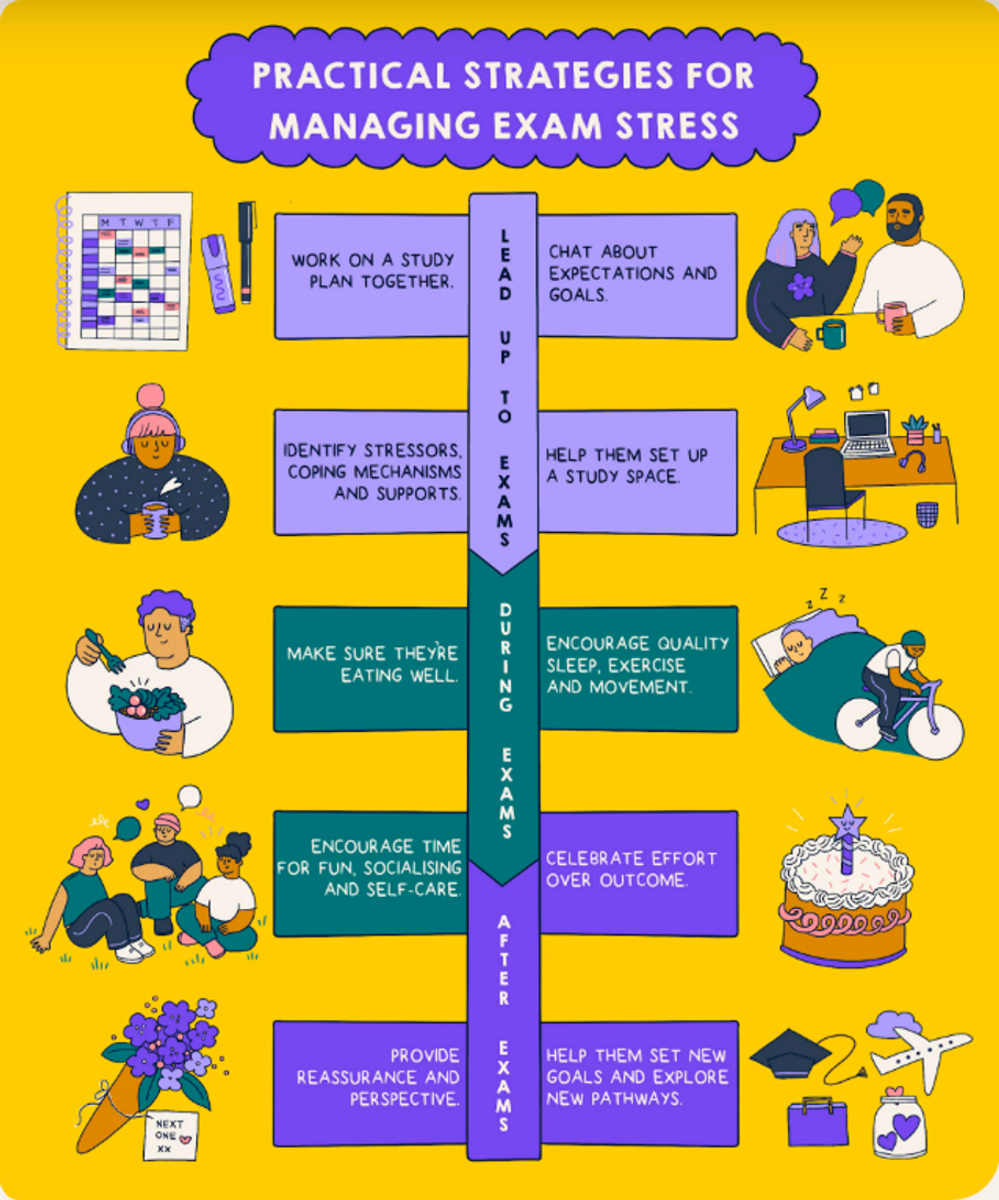
Work on a study plan together
Creating a study plan early on will help your teen feel organised and reassured that they’re giving themselves enough time to cover all their study materials. Even if they haven’t managed to get started early, a structured approach that clearly lays out what and when they need to study can help make the process feel a lot more achievable. Check out our guide to creating a study schedule with your teen.
Chat about expectations and goals
Does your teen have a specific result they’re hoping for? Together, you could look through the grades your teen has received so far throughout the year – not in order to judge their previous marks, but to think about what’s realistically achievable in their final exams. It’ll give you both a clearer idea of the work your teen needs to put in to get there. An ATAR calculator might be helpful for estimating their marks.
Identify stressors, coping methods and supports
Certain things might make your teen feel extra stressed while studying, like hearing about how older relatives did in their exams, comparing their progress with that of their friends, or staying up late to study. These stressors might not always be preventable, but it’ll help to be prepared with some coping methods if ever they come up.
Chat to your teen about what relaxation techniques or self-care they could practise and who they could talk to for support. This might be a friend or another family member, or if they’re really struggling, they could chat to a teacher, a school counsellor or an anonymous counselling service like Kids Helpline.
Help them set up a study space
Find a space at home where they can be away from everyone else, ideally with a door they can close and natural lighting for better concentration. Set it up so that the space is clear of clutter and has everything they need to study and none of the things that could sidetrack them. You could even hang up a vision board for extra motivation.
While they’re studying, ask other members of your household to respect your teen’s space and privacy, so they can remain focused. If you don’t have a quiet space at home, work with your teen to figure out a solution. Maybe they can wear headphones and listen to white noise or soothing music while they study, or they might prefer to study somewhere outside the home, such as at the library.
DURING EXAMS
Make sure they’re eating well
Like the rest of the body, the brain needs a balanced diet to be at its best. The right foods can help your teen go into their exams feeling energised, with a clear mind, good memory and focus. Some particular food groups to focus on include protein, fruits and vegetables for antioxidants, and Omega-3s. Read this article for a more detailed list of exam-friendly foods.
Encourage quality sleep, exercise and movement
Getting enough sleep is also important for thinking clearly during exam time. Your teen may be tempted to stay up late to study the night before an exam, but young people need 8–10 hours of sleep for proper brain function.
Regular exercise can help with sleep quality, as well as relieve tension and stress. But when your teen is consumed by thoughts of exams, it can be hard for them to find the drive. Not all exercise has to be a hardcore workout, though, and all movement has benefits.
Encourage time for fun, socialising and self-care
Taking breaks from study to have some fun will help sustain your teen emotionally during their exams. Hanging out with friends and family or doing an activity they enjoy as a form of self-care, will boost your teen’s mood and help them feel refreshed and energised.
It can also serve as a good distraction from their worries and give them the opportunity to check in with their mates and be there for each other.
AFTER EXAMS
Celebrate effort, not just outcomes
Don’t wait until your teen gets their results before celebrating! Finishing exams is an achievement in itself. Regardless of whether or not they got their desired results, they will have worked hard and learnt new things along the way.
You could plan a celebration in advance so they have something to look forward to. It doesn’t need to be a huge party; it could be a small dinner with their favourite people, or a trip to the cinema to see a movie they’ve been excited to see.
Provide reassurance and perspective
Remind your teen that it’s not the end of the world if they don’t get the score they wanted. They’ve probably heard it all before, but hearing it from you can be really reassuring.
It’s okay to feel disappointed, especially if they had their heart set on a specific university course, but in the grand scheme of life their score won’t matter. Life keeps going and there will be more opportunities for different kinds of achievements later on.
Help them to set new goals and to explore future pathways
There are plenty of pathways your teen could pursue after leaving school. Regardless of whether or not they achieved what they wanted in their final exams, creating new goals will help them look forward to the future, especially if they’re questioning what’s next. Here are some ways to support them. If they didn’t get the ATAR required for the uni course they want but they still want to study, they could:
- do a different course for a year, then try transferring to their preferred course the following year
- do an undergraduate certificate, which is the first four subjects of a related bachelor’s degree
study at TAFE or a private college.
If they’re keen to start working or to gain work experience, they could:
- find an entry-level job they’re interested in
- do an apprenticeship or traineeship
- do an internship
connect with their careers adviser for support and guidance.
If they want to do something different, or they’re really unsure of what to pursue, they could:
- go travelling – whether as a short holiday, as a longer backpacking trip, or as a stint living overseas on a working holiday visa
- volunteer at an organisation to support a cause they’re passionate about
keep exploring their hobbies while they study or work.
Article Credit # Practical strategies for managing exam stress | Exams & teens
--------------------------------------------------------------------------------------------------------------------------------------
ONLINE GAMBLING – Teens and Young People
The legal age for public gambling is 18 years in Australia, but research shows that most Australian teenagers have gambled in some way. Teenagers often take part in informal types of online gambling like buying ‘loot boxes’ in video games. Unlike public gambling, informal online gambling has less regulation in Australia. All forms of gambling can be addictive and hard to stop. Types of gambling and gambling-like activities for young people include:
- Smartphone games with in-app purchases (microtransactions)
- ‘Loot boxes’ in video games
- Horse and dog races
- Raffle tickets
- Sports betting
- Card games
- Lottery tickets and scratch cards
Arcade games and claw machines
Gambling in advertising
Young people learn about gambling from an early age. They visit arcades and play games to risk money for prizes. They turn on the television and see gambling ads. They watch social media videos sponsored by betting companies. By the time they are teens, many view gambling as a normal part of life.
Gambling companies must follow rules about when and how they can advertise in Australia. For example, gambling ads cannot be shown during children’s tv shows or at certain times of day; however, these rules do not apply to news or sports.
Gaming and gambling
Young people may see gambling and gambling-like elements in video games and other forms of digital entertainment. Many popular games prompt players to spend real money on unknown outcomes and take risks to improve their in-game experience.
What is gamblification?
Gamblification refers to gambling-like features in video games and other types of digital entertainment. These elements could be small and rare, like spinning a roulette wheel for an in-game bonus, or they could be the focus of the game. Examples of common gambling-like features include:
- Tokens are bought with real money and can be exchanged in a game for specific items or packs with random contents – from performance boosts to weapons.
- ‘Loot’ boxes are mystery boxes bought using tokens or real money. They usually hold in-game items, upgrades and ‘skins’ to change the look of avatars (characters).
Simulated gambling elements mimic the look, sound and actions of traditional gambling but do not involve winning or losing real money.
Loot boxes are common in online video games as they make a lot of money for gaming companies. Like traditional gambling, loot boxes encourage players to risk money without knowing the outcome. If they are unhappy with the items in a loot box, they may want to ‘chase their losses’ and keep buying more until they feel they have won – no matter the cost.
Why is gambling bad for teens?
The decision-making parts of the brain are not fully formed until around age 25. This means that teens may find it hard to understand the dangers of gambling, making them more impulsive. They can lose control of their actions and struggle to stop gambling. Gambling in childhood increases the chances of gambling problems in adulthood. Aside from losing money, teens who gamble may also:
- feel shame and guilt
- develop mental health problems, such as depression and anxiety
- have problems with alcohol and other drugs
- perform poorly at school
- skip school
have relationship problems with family and friends.
Signs that my child has a gambling problem
Teens and young people may not admit to gambling. In some cases, they may not even know their actions count as gambling. It is important to note that not every young person who gambles will develop gambling problems. Warning signs of problem gambling could include:
- changes in spending habits, such as asking for money more often
- a drop in school marks and taking multiple days off school
- less interest in usual activities, such as after-school sports
- acting sad, distracted or withdrawn
- low energy levels and poor sleep patterns
- sudden interest in professional sports and sporting results, including checking scores for multiple sports at once
use of gambling terms in conversation, such as ‘line’ and ‘spread’.
How do I talk with my child about gambling?
Talking with your child about gambling is the best way to teach them about the risks. It is important to have an open discussion free from judgement. Lecturing your child may build resentment and push them into riskier behaviours. The goal is to make them feel supported – whether they have gambled before or not. Timing is the key to a helpful conversation. Teens and young people are more likely to talk freely when relaxed and not focused on anything else. For example, your child may not want to chat while they are playing a video game. You could also start a conversation when your child asks for money to buy game tokens or when a gambling ad comes on television. Asking questions such as ‘Tell me about why you want to buy tokens’ and ‘Where have you seen ads like this before?’ will prompt a discussion without putting pressure on your child.
For more information:
- Speak to your teen's doctor (doctors can make referrals to other services if needed, such as psychology)
- RCH National Child Health Poll: Gambling and teens: Concern among parents
- Kids Health Info: Taking risks - teens and young people
- Gambler’s Help: Gambling help for under 25s
- Gambling Help Online: Gambling and under 18s
- Victorian Responsible Gambling Foundation
- Raising Children Network: Pre-teens: gaming and gambling
- Children and Media Australia: Children and Gambling Watch List
- eSafety Commissioner: Gaming
- Kids Helpline
- Headspace
Article Credit # Royal Children’s Hospital Melbourne - Kids Health Info: Gambling - teens and young people
-------------------------------------------------------------------------------------------------------------------------------------

IMPROVE YOUR SELF-ESTEEM
What is self-esteem?
Self-esteem is the opinion you have about yourself and your abilities. It can be influenced by factors like your confidence, your identity, and your sense of belonging. Self-esteem can be high, low or somewhere in-between.
Low self-esteem
Having low self-esteem might mean you aren’t confident in your abilities, your personality, or the value you bring to others in your life. Low self-esteem might be caused by:
- not feeling a sense of security in life
- doubts about your gender, sexuality, or body
feeling like you don't belong with your family, friends, or colleagues.
Good self-esteem
On the contrary, having good self-esteem means you have positive beliefs about your abilities and your place in the world. It can be caused by:
- being confident in your ability to create change and withstand challenges in your life
- a sense of confidence and pride in your identity
- feeling like you belong in your family, school, or group of friends.
What are the 4 components of self-esteem?
Your self-esteem is made up from four attitudes you have about yourself: your confidence, your sense of identity, feeling a sense of belonging and being self-assured in your abilities.
Your self-confidence
Self-confidence is all about your sense of security you have in yourself and in your life. You can only branch out and grow if you feel secure that your needs are being met. Having your needs met means you have things like a place to live, physical health, and stable finances.
Your identity
Your sense of identity is important to your self-esteem because it is the knowledge you have about yourself. This can include your confidence in your body, your gender, your sexuality, your job, your beliefs, your culture, or anything else about yourself. It’s helpful to be confident in these things because they can help you understand what you need and what you want in life.
Feeling like you belong
Belonging is all about feeling welcome and an active part of where we actually are in life, whether that’s in your school, your workplace, your family, or the other groups you’re a part of. Sometimes, if you don’t feel belonging in one group you’re in, like your workplace, you can find your sense of belonging in another group, like your family or friends.
Feeling confident in your abilities
It’s important to feel confident in your abilities so that you can control what happens to you in life. If you’re confident in what you can do, you can handle big challenges and make the changes you need to make to respond to them. However, being confident in your abilities isn’t just about succeeding. It’s about learning from your mistakes and being resilient in the face of failure.
Why is self-esteem important?
Self-esteem is important because it is the underlying foundation supporting everything you do, from everyday chores and activities to long-term goals. While everyone occasionally has doubts about themselves, low self-esteem can leave you:
- feeling insecure
- lacking motivation
- unable to respond to challenges in your life
- anxious or depressed
- with negative thoughts and feelings about your body image.
Tips for improving your self-esteem:
- Be nice to yourself: That little voice that tells you you’re killin’ it (or not) is way more powerful than you might think. Make an effort to be kind to yourself and, if you do slip up, try to challenge any negative thoughts. A good rule of thumb is to speak to yourself in the same way that you’d speak to your mates.
- You do you:Comparing yourself to other people is a sure-fire way to start feeling crummy. Try to focus on your own goals and achievements, rather than measuring them against someone else’s. Nobody needs that kind of pressure!
- Get moving! Exercise is a great way to increase motivation, practise setting goals and build confidence. Breaking a sweat also cues the body to release endorphins, the feel-good hormones.
- Nobody's perfect: Always strive to be the best version of yourself, but it’s also important to accept that perfection is an unrealistic goal.
- Remember that everyone makes mistakes: You’ve got to make mistakes in order to learn and grow, so try not to beat yourself up if you forget to hit CTRL+S on a super-important assignment. Everyone’s been there.
- Focus on what you can change: It’s easy to get hung up on all the things that are out of your control, but it won’t achieve much. Instead, try to focus your energy on identifying the things that are within your control and seeing what you can do about them. Read more about how you can accept things that are out of your control.
- Do what makes you happy: If you spend time doing the things you enjoy, you’re more likely to think positively. Try to schedule in a little you-time every day. Whether that’s time spent reading, cooking or just conking out on the couch for a bit, if it makes you happy, make time for it.
- Celebrate the small stuff: You got up on time this morning. Tick. You poached your eggs to perfection. Winning. Celebrating the small victories is a great way to build confidence and start feeling better about yourself.
- Be a pal: Being helpful and considerate to other people will certainly boost their mood, but it’ll also make you feel pretty good about yourself
- Surround yourself with a supportive squad: Find people who make you feel good about yourself and avoid those who tend to trigger your negative thinking.
Article credit# ReachOut - 10 tips for improving your self-esteem and self-worth