
Careers
Understanding the ‘Hidden Job Market’

Careers
Understanding the ‘Hidden Job Market’

When looking for work, most people head straight to online job boards. But here's something worth knowing: not every job vacancy is advertised.
The "hidden job market" refers to employment opportunities filled through personal connections, referrals, direct approaches to employers and word of mouth rather than formal advertisements.
For students hoping to secure an apprenticeship, traineeship or employment after school, this means your job search should extend beyond scrolling through SEEK.
Start talking.
Tell family members, friends, neighbours, sporting coaches, teachers, current employers and other people in your community what type of work you are looking for. Someone may know an employer who is recruiting—or planning to recruit soon.
You can also approach businesses directly. Research employers in industries that interest you and introduce yourself professionally. Ask whether they anticipate employing school leavers, apprentices or trainees and offer to leave your résumé.
Networking isn't about knowing "important people". It's simply about making connections and letting people know what you're interested in.
With Year 12 rapidly moving towards the end of school, now is the time to become visible to potential employers.
Don't wait for the perfect advertisement to appear.
Sometimes the opportunity you're looking for hasn't been advertised yet.

You've submitted your résumé or job application and heard nothing.
Now what?
Following up with an employer can feel awkward, but done professionally, it can demonstrate initiative and genuine interest in the position.
Start by checking the job advertisement. If the employer provided a recruitment timeline or specifically asked applicants not to make contact, follow those instructions.
Otherwise, after allowing the employer reasonable time to review applications, consider sending a short, polite email. Introduce yourself, mention the position you applied for and confirm that you're still very interested in the opportunity.
Keep it brief. You're not demanding an answer—you're simply reminding the employer who you are and demonstrating your enthusiasm.
If you attended an interview, following up afterwards with a short thank-you email is also a great habit. Thank the interviewer for their time and reiterate your interest in the role.
Most importantly, don't become the applicant who emails every second day asking, "Have you made a decision yet?"
There is a difference between being proactive and being pushy.
As school-leaver recruitment increases throughout Term 3, keep track of your applications, including when you applied, who you contacted and when it might be appropriate to follow up.
Professional communication now can help you build a positive reputation before you've even started the job.

University Open Day season is well underway, and if tertiary study is on your radar, attending an Open Day can be one of the most useful things you do before submitting or finalising your course preferences.
But don't just turn up, collect a free tote bag and go home!
Before attending, look at the program and identify the course information sessions, facilities and accommodation options you want to see. Some popular sessions require registration, so plan ahead.
Most importantly, ask questions.
Speak with academics about course content, placements, prerequisites and career outcomes.
Talk to current students about what studying there is actually like. If you may need to move away from home, investigate accommodation, transport, living costs and student support services.
And pay attention to how the campus feels.
Can you imagine yourself studying there? Is it somewhere you would be comfortable spending the next three or four years?
If you're comparing universities, ask similar questions at each Open Day. It will make comparing your options much easier later.
Term 3 becomes incredibly busy for Year 12 students, with applications, Early Entry, scholarships and course preferences all competing for attention.
An Open Day isn't just a day out. Use it as a fact-finding mission to help answer one important question: Could I see myself here next year?
At the start of the term I shared Applying to Uni Term 3 ChecklistMake sure you read through what you should be doing before the end of the term
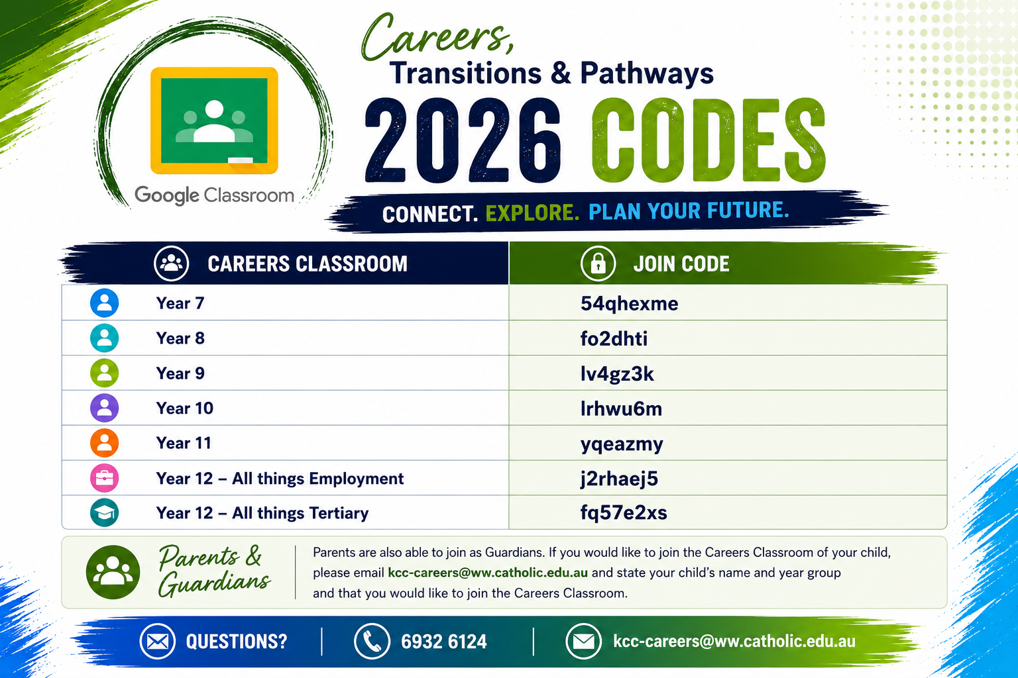
Scholarship research - Now is the perfect time to begin identifying scholarships you may be eligible for and noting application requirements. Check your Classroom for detailed information
Open Day season is coming - University Open Days begin soon. Start planning which institutions you would like to visit. Check your Classroom for detailed information
Karen Murray | Careers Adviser
6932 6124
kcc-careers@ww.catholic.edu.au (please note change of email address)