
Principal
The Messy Path to Mastery
At our College assemblies last Friday, I spoke to the boys about what I described as “the messy path to mastery”—the idea that improvement, growth and eventual success rarely happen in a straight line.
I shared with them a well-known story about an art teacher who divided a class into two groups and gave each a very different task. One group was asked to make as many clay pots as possible. The other was asked to produce just one pot—but it had to be perfect.
The students seeking perfection spent their time researching, planning and carefully considering what the ideal pot should look like. The other group simply began. They worked with the clay, made mistakes and started again. Some pots were crooked. Others collapsed. Some were too tall or too thin. Each time something went wrong, however, they learnt something.
By the end of the experiment, the best pots were produced not by those who had spent their time thinking about perfection, but by those who had made hundreds of imperfect attempts. Their hands had become more skilful, their judgement had improved and what was once difficult had gradually become more instinctive.
It is a simple story, but it contains an important lesson for our boys: mastery is often messy.
This was particularly relevant as so many of our boys reached semi-finals and grand finals across our winter sports. When we watch a young man take the field or court in a final, it can be tempting to see only that moment—the result, the performance and the opportunity in front of him. Yet the performance we see at the end of a season did not begin in the week of the final.
It began months earlier.
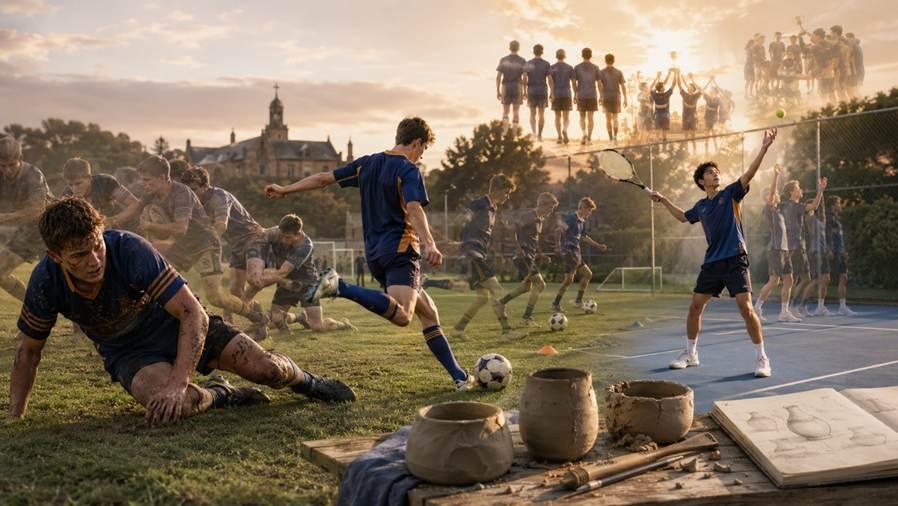
It began on cold afternoons at training. It was built through the passes that went behind a teammate, the tackles that were missed, the shots that sailed over the crossbar, the serves that hit the net, the combinations that did not quite work and the games that did not go according to plan. Those moments were, as I told the boys, their “messy pots”. Every training session, every correction from a coach, every disappointment and every moment when they realised, I need to do that differently next time, was shaping them.
Reaching a semi-final or grand final is therefore not simply the product of talent or one strong performance. It represents countless repetitions, setbacks, corrections and moments of perseverance that may never be seen by those watching from the sideline.
And even when the big occasion arrives, perfection is not the goal. A ball may be dropped. A tackle may be missed. A pass may go astray. A point may be lost. What matters is what happens next. The best players are not those who never make mistakes; they are those who reset, recover, encourage the teammate beside them and get back into the contest.
The same principle applies far beyond sport.
As parents and educators, we naturally want young people to experience success. Yet one of the most valuable things we can help them understand is that success rarely arrives neatly or immediately. Competence is built through repetition, correction, disappointment, perseverance and the willingness to try again.
A boy may hesitate to attempt a difficult Mathematics problem because he is worried about being wrong. He may decide that he is simply “not good” at a particular subject. He may avoid auditioning, trialling for a team, debating, performing or trying something new because he does not want others to see him struggle.
Yet, as I reminded the boys at assembly, we do not become good at something and then begin. We begin, and through beginning, struggling, practising and persevering, we become good.
This is an important message in a world in which young people are often presented with polished versions of other people's achievements. They see the performance, the result or the finished product, but rarely the hundreds of imperfect attempts that preceded it.
There is an important role for us as adults in this. When a young person encounters difficulty, our instinct can sometimes be to remove the obstacle or solve the problem for him. At other times, the more valuable response may be to encourage him to remain with the discomfort a little longer: Have another go. Ask for help. Listen to the feedback. What did you learn from that attempt? What might you do differently next time?
In doing so, we communicate something powerful: struggle is not evidence that you cannot do something. Often, it is evidence that you are in the process of learning how to do it.
At St Patrick's, we want our boys to aspire to excellence, but excellence should never be confused with perfection. Excellence is built through effort, courage, humility and persistence. It requires young people who are willing to take appropriate risks, accept correction and make the messy first attempt—and then another.
For our boys who reached the final stages of their sporting seasons, the achievement was not only appearing in a semi-final or grand final. As I said to them, the deeper achievement was everything they had to become along the way—through all the imperfect practices, difficult afternoons, disappointments and mistakes that shaped them.
That is true for every young person.
The mistakes, setbacks and imperfect attempts along the way are not interruptions to learning.
Very often, they are the learning.
Help us Bring the New Breen Oval Scoreboard to Life
We are delighted to share the exciting news that our Development Application for the new Breen Oval Scoreboard has now been determined by Strathfield Council.
This is a significant milestone and means we are officially on our way to delivering a new scoreboard for the College community.
The scoreboard and associated electrical works have now been tendered, with construction scheduled to commence and be completed during the Term 3 holiday period, between September and October 2026.
Thanks to the incredible generosity of our community, we have raised $41,500 towards the project. While we are extremely grateful for this support, we still have a long way to go towards the estimated project cost of $300,000.
As we move into the construction phase, we are seeking any final contributions to help bring this exciting project to completion.
Every donation, no matter how large or small, will make a meaningful difference and help deliver a facility that will benefit students, families, staff, alumni and visitors for years to come.
We are sincerely grateful for the support already received and for any contribution you may be able to make. Together, we can help make the new Breen Oval Scoreboard a reality.
The link to make a tax-deductible donation is: Donation-Breen Oval Scoreboard
Thank you for your ongoing support of St Patrick's College and our students.
Staffing News
I wish to advise parents that our Deputy Principal, Mr Adrian Byrne, will be on leave for the next two weeks as his father-in-law is gravely ill and he needs to support and care for his family at this difficult time. I am sure our College community will keep him, his wife and their extended family in their thoughts and prayers during this challenging period. We thank parents for their understanding and ask that the family’s privacy be respected. Mr Byrne’s class is going to be taken by Mrs Cupac, a very experienced teacher of Economics, and his role in managing and dealing with pastoral issues will be delegated between Mr Simpson and Mr Sinadinos.
This week we welcomed Mr Joshua Richards to our Performing Arts department, replacing Ms Zhong, who left last Friday. Mr Richards joins us from All Saints Catholic College, Liverpool, where he taught Music and Religious Education and served in several pastoral leadership roles, most recently as Year 8 Leader of Wellbeing. He brings extensive experience teaching Music across Years 7-12, including HSC courses, as well as leading co-curricular music initiatives, ensembles, performances and liturgical celebrations. Mr Richards is passionate about music education and student engagement, and we are delighted to welcome him to our community as he inspires students through both classroom and co-curricular opportunities.
Mr Michael Pilkington remains on leave from the College. Mr Pilkington is comfortable with me now sharing that he has been battling a serious cancer diagnosis and that the surgery and subsequent therapies he has undergone have, at this stage, left him unable to return to his teaching duties. Mr Pilkington remains positive and is very grateful for the care and support he has received. He welcomes the prayers, good wishes and encouragement of our College community as he continues his treatment and recovery.
I congratulate Mrs Maria Alvaro (nee Marrapodi) on the birth of Valentina Rosa on 6 August.
Dr Vittoria Lavorato
Principal
SPC boys can do anything!
**except divide by zero