
Child Safe & Wellbeing News
Safety, Respect and Learning

Child Safe & Wellbeing News
Safety, Respect and Learning
Domestic & Family Violence
Domestic and family violence remains one of the most serious challenges facing communities across the world. While it often occurs behind closed doors, its impact reaches far beyond the home, shaping the emotional wellbeing, learning and sense of safety of many young people. For some students, school may be the most stable and secure environment in their lives.
Domestic and family violence is not limited to physical harm. It can include emotional abuse, coercive control, intimidation, financial restriction and technology-facilitated abuse. Children do not need to be directly harmed to feel its effects. Witnessing conflict, living with fear or experiencing instability can influence brain development, concentration, behaviour and relationships. Research consistently shows that a significant number of children grow up in households where domestic violence occurs, increasing the risk of anxiety, depression and ongoing trauma.
Schools play a vital role in recognising the signs, creating safe spaces and modelling respectful relationships. Prevention requires more than responding to harm; it involves shaping attitudes early, promoting empathy, equality and healthy boundaries. By raising awareness, encouraging open conversations and providing clear pathways to support, school communities can strengthen protection around young people. When families and educators work together with clarity and compassion, we take meaningful steps towards breaking the cycle of violence and safeguarding the wellbeing of every child.
If you or someone you know needs support, the following trusted services are available:
Please learn more by watching the video on our SchoolTV website:
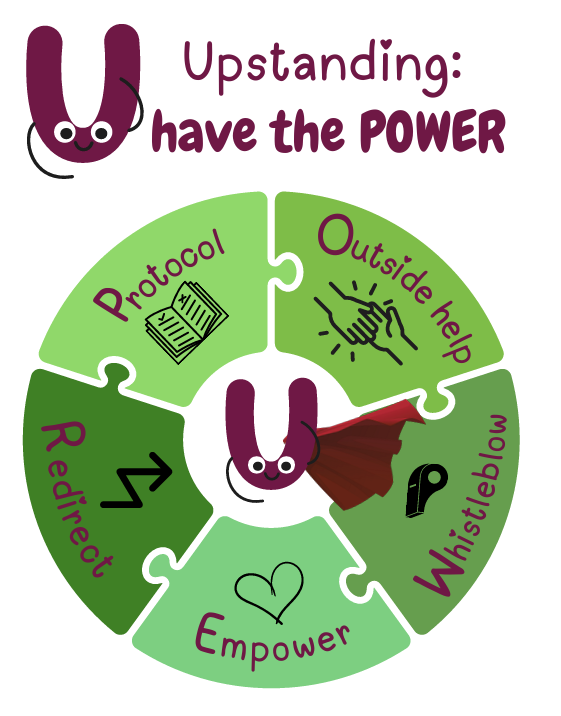
Over the past six weeks, students across St Thomas the Apostle have revisited our “Upstanding U: Have the POWER” framework. Through classroom learning, discussion, Scripture, practical scenarios and reflection, students explored what it means to be an upstander and how each of the POWER strategies can help them respond safely, respectfully and responsibly.
To conclude this learning, each year level brought the framework to life in a different way.
Foundation students created a poster that reflected the POWER learning they had revisited through Religious Education and Social and Emotional Learning.
Grade One students consolidated their understanding of the framework through classroom learning and discussion.
Grade Two students created a display in Damascus, with each class contributing something different to represent their learning. They also continued to revisit the POWER language through paired fluency activities.
Grade Three students unpacked the language of being an upstander through social stories, examples and class discussions. They created a class story based on the POWER framework to demonstrate how an upstander might respond in different situations.
Grade Four students created short videos showing different POWER scenarios. These videos were shared across the school to help other students recognise and apply the framework in real-life situations.
Grade Five students drew on their Religious Education learning to create freeze frames representing each letter of POWER. Their photographs and captions explained the strategy being demonstrated and how it connected to being an upstander.
Grade Six students explored each POWER strategy in depth by considering what it is, what it looks like, sounds like and feels like, before applying their learning to different scenarios. They then used their understanding to support the school-wide launch and presentation of the POWER framework.
These activities gave students the opportunity to demonstrate their learning in creative and practical ways while reinforcing our shared responsibility to build a safe, respectful and inclusive school community.
Through this learning, students developed a deeper understanding that being an upstander is not simply about knowing the POWER strategies, but having the courage and confidence to put them into action when someone needs support.
We were proud to celebrate and share the learning of our students as they demonstrated what it means to Have the POWER and be an active upstander at St Thomas the Apostle.