
Teaching & Learning

Balanced Use of Digital Devices
Updated Policy Advice - 2027 Department of Education
At Whittlesea Primary School, our approach to Digital Technology is centred on enhancing learning while maintaining a healthy balance. The intent is not to limit students’ opportunities to learn with or about digital devices, but to provide clear guidelines that prevent overuse and support student wellbeing and engagement.
Student use of devices is carefully managed across the school. In the early years (Foundation–Year 2), device use is kept to a minimum. For students in Years 3–6, use is generally limited to less than 90 minutes per day, except in cases where the Victorian Curriculum 2.0 specifically requires it. At our school, this primarily includes learning in STEM, Inquiry and units focused on Cyber Safety.
In addition, students may use digital devices for targeted purposes when there is a clear and significant learning benefit over non-digital alternatives. Devices are also used to support diagnostic and formative assessment (online testing), allowing teachers to better understand student progress and tailor instruction to meet individual learning needs.
This balanced approach ensures technology enhances teaching and learning while supporting students in developing safe, purposeful and healthy 'tech' habits.
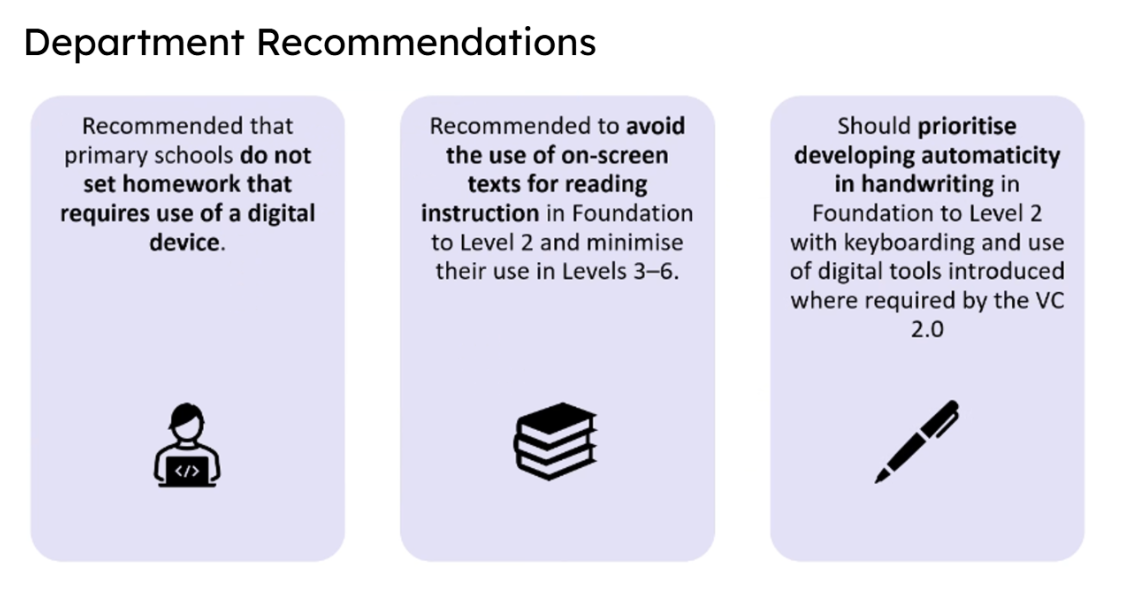
Schools should avoid:
- Using digital tools that prioritise engagement over learning or rely on attention-capturing game mechanics
- Using multiple digital tools at once
- Setting tasks where content is simply copied or replicated
- Using digital tools unnecessarily to replace teacher explanations, modelling or guided practice
Frequently Asked Questions
Q. What if a student is suspended and is using a device to complete their work?
A. The external suspension should avoid device use where possible. The intent for this is to reduce unsupervised device use. Internal suspensions should follow the same guidelines as normal, i.e., minimal use for F-2 and less than 90 minutes for 3-6.
Q. Is using a TV/ interactive Whiteboard covered under this policy?
A. The limits do not apply to these teaching aids; however, reasonable adjustments should be made to ensure that the use of the smart TV and whiteboard is giving a clear and significant benefit over traditional methods.
Q. Will these guidelines be irrelevant with a change of government?
A. The shadow minister has indicated he is in support of these recommendations and guidelines, and so it is unlikely to change.
Q. Will this impact devices being used in the background of learning, such as passive video watching and the like?
A. This kind of device use falls under the same guidelines. Limited and only when it shows a clear benefit to the learning.
Q. A student uses their device as a disability support (funded students). Is this usage restricted too?
A. Device use for accessibility is not limited as long as care is taken to ensure appropriate use is maintained.