Respectful Relationships
Respectful Relationships at Karoo Primary School
Respectful Relationships at Karoo Primary School
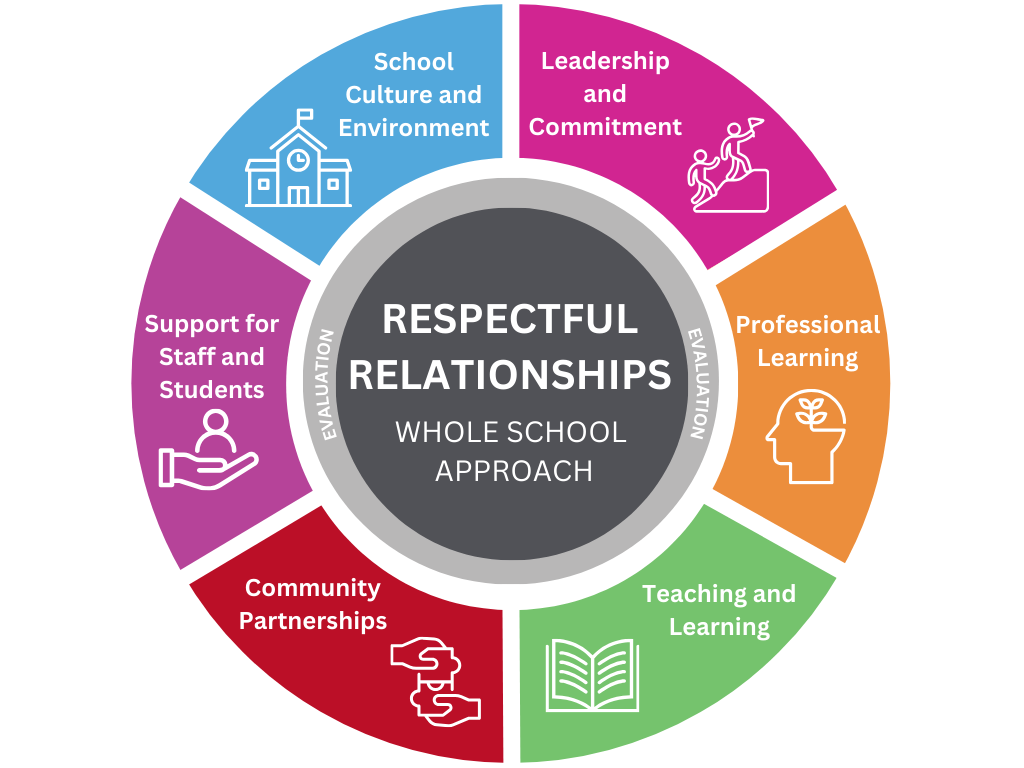
At Karoo Primary School, we believe that learning how to build respectful, safe and positive relationships is an important part of every child's education.
Our Respectful Relationships program supports students to develop practical skills such as understanding emotions, showing empathy, communicating respectfully, resolving conflict, respecting personal boundaries, recognising stereotypes and understanding that people can have different experiences and perspectives.
The Respectful Relationships framework encourages students to consider how their identities and experiences, including experiences of power and inequality, can influence their relationships and their lives. These concepts are explored in ways that are appropriate to students' age and stage of development.
Importantly, the focus is not on telling students what to think. It is about helping children develop the knowledge and skills to treat others with respect, make safe and positive choices, understand differences and build healthy relationships.
This work strongly reflects our Karoo Values of Kindness, Tenacity and Personal Excellence. By explicitly teaching these skills, we are helping our students to develop the confidence and understanding they need to navigate relationships positively, both at school and beyond.
Respectful Relationship Myths
Myth: It is inappropriate to teach young children about consent
Fact: For younger children consent education includes an age-appropriate focus on what it can look or sound like to ask for permission or consent, to refuse permission or consent and to understand that consent can’t be obtained by pressuring people to do something they don’t want to do. For example, giving or denying permission to borrow a pencil.
Consent education also includes learning activities that support prevention of child sexual abuse, by teaching about bodily autonomy, body boundaries, the difference between ‘safe’ and ‘unsafe’ secrets and the importance of seeking help from trusted adults if children’s ‘early warning signals’ are sending a message that they might not be safe.
Research shows significant increases in knowledge and improved self-protective behaviours occurs when students are taught their rights to be safe from abuse and their right to say no or to tell, even when someone in authority over them abuses them.
Myth: Respectful relationships education will mean less time for literacy and numeracy
Fact: The Victorian Government is committed to improving literacy and numeracy outcomes for our students which is why we have recently launched our Literacy and Numeracy
Strategy. It provides greater investment and support for teachers through teaching resources and professional development opportunities.
Source: Respectful Relationships, https://www.vic.gov.au/respectful-relationships

RRRR information is available on the Arc platform. Please scan the QR code above.
Keep an eye on future newsletters to learn more about what your child’s year level is exploring through the RRRR curriculum.
If you have any questions or concerns please do not hesitate to reach out via the Compass protal.
Mrs. Karen Corrales