
Student Wellbeing


Meet Our Term 4 Let's TALK Buddies (see below)
During Term 2, students from Years 3 to 6 completed the Buddy Training for the "Let's TALK Program" in their classrooms as a part of their SEL (Social and Emotional Learning). The aim of the training was to give students an appreciation of the fundamental need to be ‘seen, heard & valued’ and learn the ‘TALK’ steps to be comfortable and confident to support another student, or reach out for support when they have a concern. Creating a safe environment to share experiences is key to ensure that the concepts and topics of the program are understood and resonates with the students.
They were all then given the opportunity to volunteer to become "Let's TALK Buddies" if they wished.

We wish to thank ALL students who volunteered to be 'Let's TALK Buddies' during the Term 4 Recesses and Lunchtimes. They showed tremendous care and commitment to their role and many wished to continue to give up their time during Term 4 to help.

We will introduce our Term 4 Buddies next Monday 12th October at Assembly at 2.30pm.
Firstly, a special THANK YOU to our
TERM 3 LET'S TALK BUDDIES :
Emme, Bel, Chloe L, Tong Tong, Levi, Henry, Ivy, Zara A, Zara B, Maggie, Dallas, Max, Annika, Willow, Billie T, Heidi, Oliver, Alex, James, William, Arlo, Hamish B, Vesper, Isabella, Eddie, Riley. Special efforts were demonstrated by Levi M, Vesper, Isabella, Tong Tong, Alex, Henry, Zara B and Zara A. Congratulations to these students who, as a result of their high levels of commitment to the program and jumping in to fill in for others for extra duties when needed, will be invited to star in a 'Let's TALK Podcast' that will be filmed during Term 4 (pending parent permission) to be shown to students from schools across Australia as a part of the online program resources. They will also receive a special 'Let's TALK Buddy Badge for their commitment and care demonstrated through their role.
INTRODUCING OUR NEW TERM 4 LET'S TALK BUDDIES :
Hugo S, Kirra, Indiana, Chloe G, Winnie, Frankie, Hazel, Flynn, Hao Hao, Indie, Skyla, Noah, Kai, Saoirse, Edie, Hamish M, Hugo Cr, Leo, Aleesha, Lillianne and Goldie, as well as continuing volunteers from Term 3 : Eddie, Dallas, Ollie, Alex, Max, William, Henry, Levi M, Tong Tong, Vesper, Isabella, Zara B, Annika, Willow, James and Hamish B.
We will meet this Wednesday and again across the term to further discuss their role, what is expected and to practise using the 'Let's TALK Framework' through role play situations.

Looking forward to seeing 'Let's TALK Buddies' in action and making a difference around our schoolyard and in our classrooms!
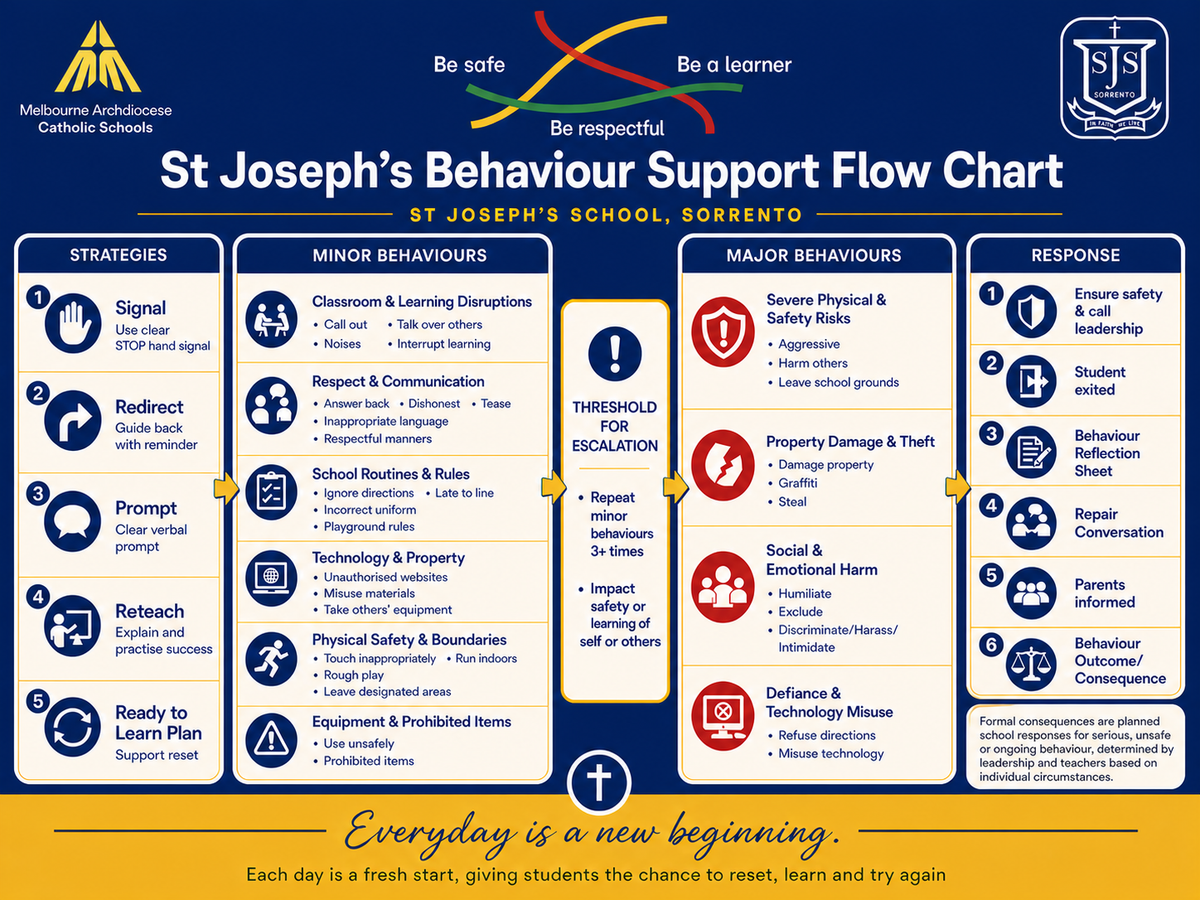
Introducing St Joseph's NEW Behaviour Support Flowchart
This year, our staff have collected behaviour data, reviewed student feedback, and researched best practices from leading educational institutions. In consultation with specialists in Positive Behaviour Support (PBS), we have developed a clear, school-wide Behaviour Support Flowchart.
This framework establishes a consistent, transparent approach to behaviour support, fostering a strong partnership between staff, students, and families. It outlines minor and major behaviours alongside the specific strategies and responses each will warrant.
Our Educational Philosophy
At St Joseph's, we view behaviour as a form of communication that often reflects unmet needs. For the past few years, our teachers have been trained in the trauma-informed, positive education principles of the Berry Street Education Model (BSEM). This approach emphasizes:
- Unconditional Positive Regard: Maintaining unwavering care and respect for every student while understanding the underlying intent behind their actions.
- Proactive Support & Clear Boundaries: Prioritizing student wellbeing while reinforcing that major behaviours impacting safety, learning, or mutual respect carry consistent consequences.
- Reflection & Restoration: When major behaviours occur, students complete a Reflection Phase to consider their actions. Crucially, this is followed by a Repair Conversation with the teacher involved to restore trust and rebuild relationships.
Escalation Process - Minor and Major Behaviours
For minor behaviours, teachers focus on gentle redirection, reteaching expectations, and guiding students to use their personal 'Ready to Learn' Plan to self-regulate and re-engage with the class. However, if a minor behaviour is repeated multiple times (3+ instances) and continues to impact learning or safety, it is escalated to a major response. In these instances—as with any major behaviour—parents are promptly contacted and consulted, and leadership works alongside teaching staff to determine the most supportive outcome.
Above all, our guiding commitment is that every day is a new beginning—offering every student the opportunity to reset, learn and grow.
Feedback & Inquiries
We invite you to review our new Behaviour Support Framework. If you have any questions or feedback, please feel free to reach out to Mrs O'Shannassy or directly to myself at jennyt@sjsorrento.catholic.edu.au.
Kind regards,
Jenny Todd
(Mental Health and Wellbeing Leader)