
From Dr. Judith Locke

Parent Engagement Evening
A reminder that Dr. Judith Locke will be speaking at our Semester 1 Parent Engagement Evening coming up on Thursday 21 May.
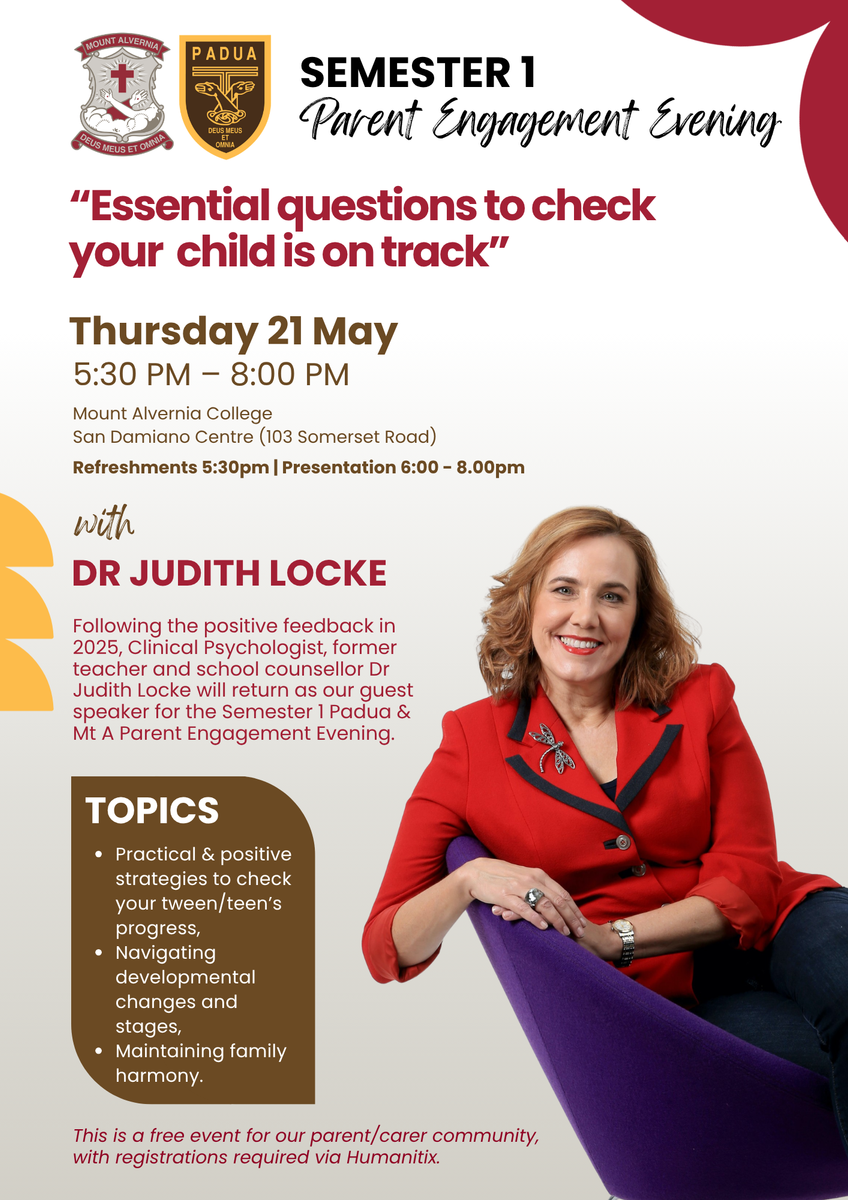
Judith has shared the below article on confidence as a preview of the information you will hear in her session: "Essential questions to check your child is on track".
Confidence misunderstandings
Confidence is an essential quality in people as it enables them to face the typical tasks of a day. Without it, people tend to shrink from challenge, and live reduced lives.
Many parents want to actively improve their child’s confidence. They do this in many ways, including praising their child more, giving them lots of affection, and stepping in a little to ensure their child experiences success.
Unsurprisingly, I get a lot of questions about building children’s confidence when delivering sessions for parents. Many are concerned about their child not seizing life as much as they should. They might describe their child not wanting to do an activity because they don’t think they’ll do well at it. Or explain their child’s tendency to hold themselves back in social situations.
I find that some parents misunderstand what true confidence is. Additionally, many parents build their child’s confidence in ways that only work for a short time. So let me clarify confidence, by describing it more accurately than what many understand it to be.
Confidence isn’t certainty of success. Your child can’t do well at everything. At best they occasionally win, occasionally do pretty well, and occasionally do poorly. Those statistics suggest that if their confidence depends on their sureness of victory, then they aren’t going to feel confident as they begin many activities.
Actual confidence is feeling capable of coping with whatever outcome befalls them as they face events. Their belief of being ok then isn’t about what their result is, or what happens. Rather their self-assurance lies in their ability to face a range of results, and an understanding they’ll manage regardless.
You can’t teach them this skill in an isolated fashion. The only way to do it comes from your child facing a range of challenges and learning to cope with all outcomes. Support them, but don’t protect them from experiencing good, so-so and bad results.
Confidence isn’t shown by being loud and outgoing. There are many extraverts who are confident but there are also introverts who are equally confident.
If someone’s gregariousness is to gain attention, then they are dependent on others giving them that focus. When not accomplishing that goal, they’re likely to become quite insecure.
What really determines a person’s confidence is them feeling they can broadly show their true personality in different environments, within reason and what’s broadly acceptable in the space. Not feeling they must live up to certain extreme standards, or be a certain way, to be acceptable to the people around them would be a good indicator of self-assurance here.
Confidence isn’t typically given by other people. Early on, a child feels confident because they’re loved and valued by the people most important to them. This gives them their first positive experience with social exchange and eventually enables them to go further afield than the family unit.
But over time, a child’s confidence shouldn’t be dependent on other people’s reassurances. If they only feel confident when they are hearing praise, then their sureness is somewhat slippery. It will take a dive the moment someone in their orbit ceases to reassure them via endless admiration and attention.
True confidence is not being overly reliant on on regular external encouragement via praise and acknowledged success. Those with an inner strength can keep going regardless of dips and turns in the road. They persist when the going gets tough or when they don’t succeed the first time.
Additionally, truly confident people feel pride for their efforts rather than seek external approval of their work. This makes them less prone to the whims and reactions of others.
Confidence isn’t given instantly. True self-assurance comes slowly over time. It starts with loving relationships, and some success. But to keep it on the right track it needs to involve hard work, occasional highs and lows, as well as praise and criticism. This keeps building their preparedness for whatever will come tomorrow and their belief in their ability to persist and cope regardless.
True confidence is tricky to get right. But, rest assured, once it’s there – it often tends to stick around.
Takeaway for parents
Here’s some tips to develop your child’s confidence.
- Spend time with your child and show them you enjoy their company.
- Give them affection – be it a high five or an affectionate statement.
- Praise their efforts and vary the way you do this.
- Over time, become more truthful in your praise, including some constructive criticism.
- Encourage them to self-assess their efforts, rather than offer your judgement all the time.
- When they lack confidence, reassure them of their ability to cope with any outcome, rather than bolster them with potentially false promises of success.
- Talk of life as being an adventure with unknown outcomes and that it is always more interesting if it is a bit unpredictable.
© Judith Locke
Dr Judith Locke is a Clinical Psychologist and registered teacher who presents sessions for parents and teachers at schools around Australia and internationally. For more of Judith’s work read her parenting books, The Bonsai Child (also available in Mandarin) and The Bonsai Student. Judith’s latest book is Raising Anxiety, co-authored with Dr Danielle Einstein. You can also follow Judith’s Facebook page Confident and Capable.