Year 5/6 News
Sean and Precious
Year 5/6 News
Sean and Precious
Students have been expanding their vocabulary and developing their creativity through poetry, spelling, and grammar.
In Spelling, students have been exploring the Greek root “spir” and the suffix “-an/-ian”. They have been breaking words apart to understand how these word parts contribute to their meanings, while also learning and revisiting a range of new morphemes. This has helped students become more confident in investigating unfamiliar words and making connections between words they already know.
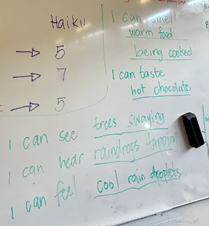
Students have also been diving into poetry writing, experimenting with different poetic forms including limericks and haiku. They have been exploring rhyme and rhythm while expanding their vocabulary by finding more interesting and precise alternatives to familiar verbs. Students have also used their five senses to create vivid and meaningful poetry, thinking carefully about what they can see, hear, smell, taste, and feel to bring their writing to life.
In Grammar, students have been polishing their understanding of verb tenses, working on using past, present, and future tense accurately and consistently in their writing.
It has been wonderful to see students play with language, experiment with new words, and discover how small changes in word choice can make their writing more powerful and expressive.
Students have been developing their comprehension and discussion skills through whole-class reading and Reading Clubs
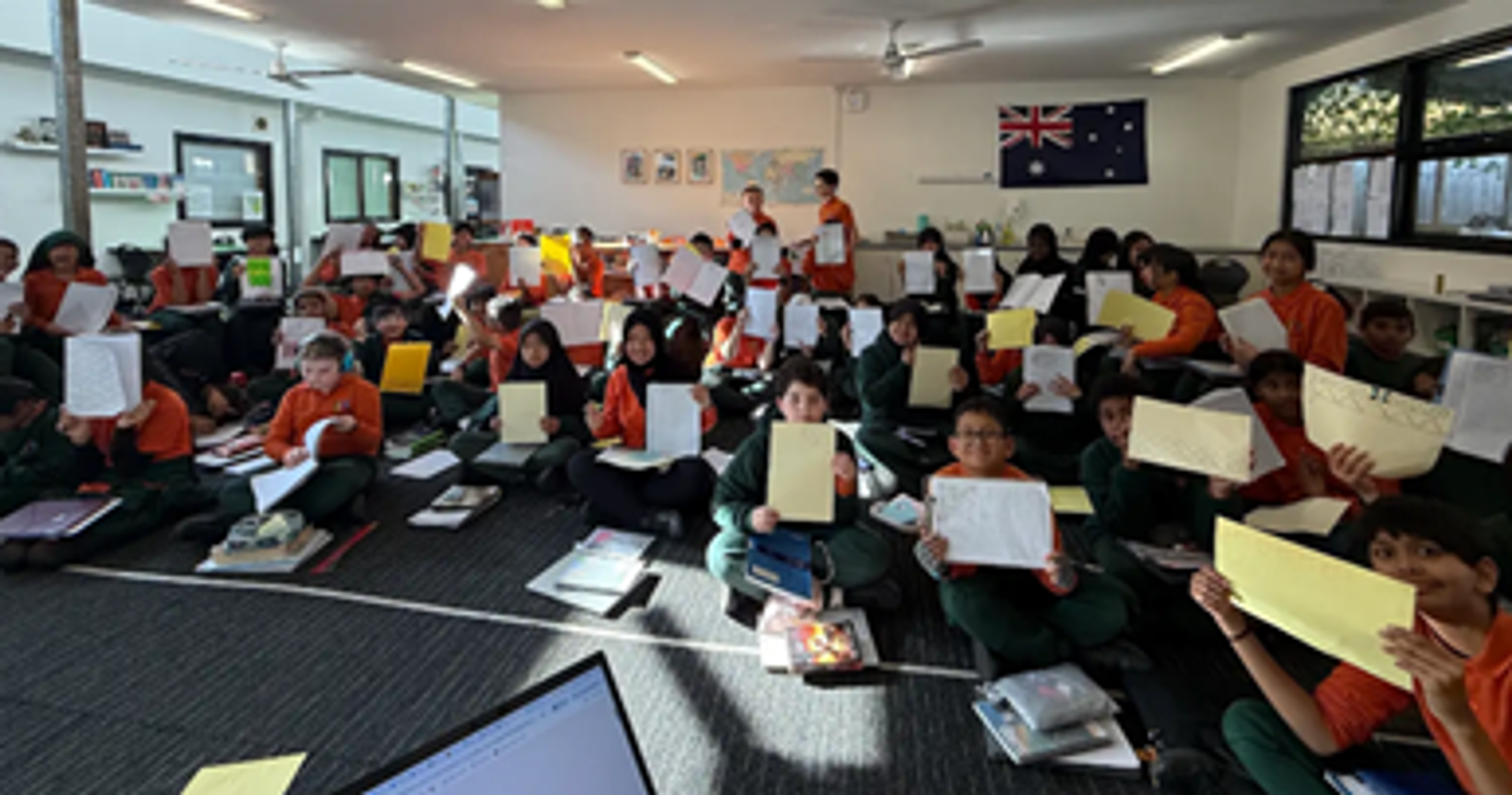
As a class, students have been exploring Sister Heart by Sally Morgan. Through the novel, students have been engaging with the experiences of the characters and developing their understanding of themes, perspectives, and the author's use of language. Students have also explored the unique free-verse poetry style of the text and discussed how the structure and language choices contribute to the story.
Alongside our whole-class novel, students have been participating in Reading Clubs, where they read and discuss texts in small groups while taking on different roles. These roles encourage students to approach texts from different perspectives, ask thoughtful questions, make predictions, identify important ideas, and contribute meaningfully to group discussions.
Through these activities, students are becoming more confident in expressing their ideas, listening to different interpretations, and using evidence from texts to support their thinking. It has been wonderful to see students build their enthusiasm for reading while learning that stories can be explored and understood in many different ways.
This term in Mathematics, Year 5/6 students have been developing their understanding of transformations and measurement through practical and hands-on learning experiences.
Students have been exploring different types of transformations, including translations, reflections, and rotations. They have been learning how shapes can be moved and transformed while maintaining their size and shape, and have been describing the changes using mathematical language and positional reasoning.
Students have also been learning how to measure and order objects using appropriate units. They have been selecting suitable units of measurement depending on what they are measuring and developing their accuracy when comparing and ordering measurements. Through practical activities, students have been strengthening their understanding of how measurement is used in everyday situations.
These learning experiences have encouraged students to reason mathematically, explain their thinking, and apply their knowledge to practical problems. It has been wonderful to see students become more confident in using mathematical language and making connections between mathematics and the world around them.
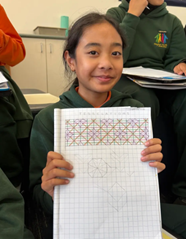
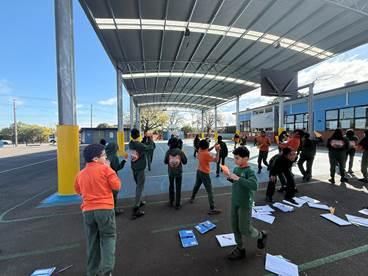
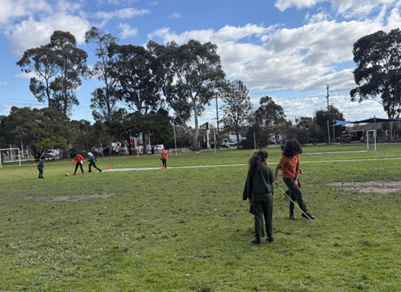
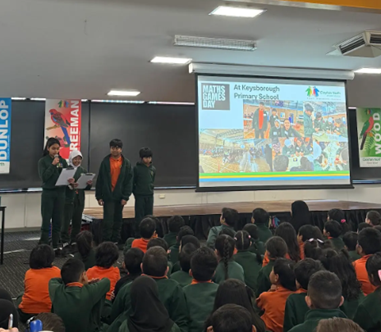
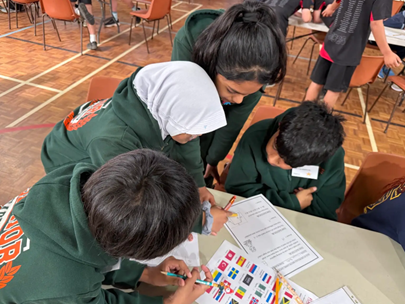
Last Friday, Naura, Amika, Kamasean, and Kabya represented our school at the Maths Game Day in Keysborough, competing against about 50 teams from other schools. Students participated in a range of challenging mathematical games that tested their problem-solving, strategic thinking, and mental maths skills.
Amika also represented our school in the Mental Maths Giant competition, where she made it all the way to the semi-finals! It was a fantastic achievement and a wonderful opportunity for our students to challenge themselves, work as a team, and experience the excitement of mathematics beyond the classroom.
In our Mathemagicians Club, congratulations to our Week 3 champions: Ale and Ibrahim from Year 5/6, and Venky from Year 3/4! Ibrahim took on the role of team leader as the group worked together to tackle the week's mathematical challenge. It was wonderful to see students across different year levels collaborate, share strategies, and put their mathematical thinking to the test. This week, our Mathemagicians will face a new challenge as they put their logic and problem-solving skills to the test with Sudoku! We look forward to seeing which team will emerge as our next champions.
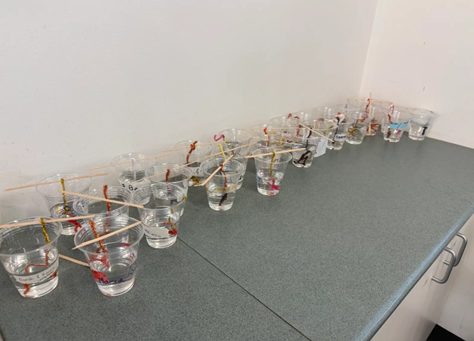
As part of Science Week, Year 5/6 students conducted a hands-on experiment exploring how crystals form. Students created snowflake shapes using pipe cleaners and placed them into an Epsom salt solution, observing as crystals gradually formed around the pipe cleaners. They investigated how this process occurs and explored the science behind the chemical reactions that cause crystals to develop, making connections to the way crystals can naturally form in real snowflakes. It was an exciting opportunity for students to observe a scientific process firsthand and use their observations to build their understanding of how and why crystals form.
Students also investigated the fascinating world of biofluorescence, exploring reports of animals such as wombats and platypuses glowing under ultraviolet (UV) light. They considered how scientists investigate these claims and, importantly, how scientific information can be verified using evidence and reliable sources. Students explored how scientists design investigations, collect evidence, and evaluate whether information is supported by scientific research. These activities encouraged students to remain curious, ask questions, and think critically about the scientific information they encounter.