Principal's News
Sue Simadri
Principal's News
Sue Simadri

We are past the halfway mark of Term 3 with Spring around the corner, and hopefully, warmer temperatures!
In the last newsletter, I shared some of the positive outcomes from our 2026 NAPLAN results. While NAPLAN provides us with an important snapshot of student achievement, the real value of the data lies in what we do with it next.
Over recent weeks, our teaching teams have spent time carefully analysing the results using a Notice, Wonder, Do process. Rather than simply looking at overall scores, staff have been asking: What is the data telling us? What might be contributing to these results? Which skills are students finding difficult? And, most importantly, what changes or refinements to our teaching will make the greatest difference?
Our analysis has highlighted two particular areas for further attention: Year 3 Reading and Year 5 Grammar and Punctuation.
For Year 3 Reading, our focus is on strengthening the explicit teaching of reading and phonics, identifying specific skill gaps and misconceptions, and using assessment more consistently from Foundation to Year 3 to monitor progress.
For Year 5 Grammar and Punctuation, students performed above similar schools and close to the state average. Our next steps are to provide more explicit and regular teaching of grammar and punctuation, revisit key concepts through retrieval practice, provide targeted support where needed, and extend students already achieving strongly.
This is an important part of how we use assessment at the school. Collection of data is not simply to measure learning, but to improve learning by refining our teaching, providing targeted support where it is needed and ensuring that students who are already doing well continue to be challenged.
A key focus this term has been strengthening consistency in classroom practice. While teachers bring their own strengths and personality to their teaching, students benefit from clear and familiar routines and expectations wherever they are in the school.
Staff have now been progressively implementing Positive Classroom Management Strategies (PCMS) #1 & #2: Classroom Expectations & Classroom Procedures and Routines as agreed school-wide practices. The aim is for these routines to become familiar and predictable for students, reducing unnecessary cognitive load, supporting smoother transitions and maximising time for learning.
This week, staff were introduced to PCMS #3 & #4: Encouraging Appropriate Behaviours and Discouraging Inappropriate Behaviours. The focus is on consistently noticing andreinforcing positive behaviour, while responding to inappropriate behaviour in a calm, consistent and predictable way.
Our goal is that, regardless of which classroom your child walks into, they experience clear expectations, purposeful teaching and an environment where every student is expected and supported to learn.
Our work with the PCMS ties in strongly with The CNPS Way, including our recently updated Behaviour Matrix and Behaviour Response Chart. Together, these provide a consistent whole-school approach to explicitly teaching what it means to be Respectful, Responsible and Resilient.
Regular attendance and punctuality are also important conditions that enable learning. Students who arrive at school on time are able to settle into the day, participate in morning routines and begin learning alongside their classmates. Even short periods of lateness can mean missing important instructions, explanations and the opportunity to connect prior learning with what comes next.
Similarly, regular attendance gives students the best chance to build knowledge progressively, maintain strong learningroutines and feel connected to their classand peers. Learning is cumulative, and repeated absences can create gaps that become increasingly difficult to recover.
We greatly appreciate the support of families in ensuring children are at school every day, on time and ready to learn, unless they are unwell or there is a genuine reason for absence. In addition, whenever possible, parents are encouraged to organise appointments outside of school hours. This shared commitment between home and school helps us create the consistency and continuity students need to make strong progress.
Each year, schools conduct an opinion survey with the school community. The survey is designed to assist schools in gaining an understanding of families’ perceptions of school climate, student behaviour, and student engagement. I invite all families (one parent per family) in the Clayton North community to provide us with your feedback as your opinion is important to us, and will contribute to identifying areas for improvement and professional development needs in the school, to target school planning and improvement strategies.
The online survey is available in English and 10 other languages and will take about 20 minutes to complete and can be accessed at any convenient time on desktop computers, laptops, tablets or smartphones. Please be assured that your responses are completely confidential, and the school never sees your responses.
The Parent Opinion Survey is now open and will be available online until Friday 18 September 2026.
Please check Compass Newsfeed for the survey link and login details.
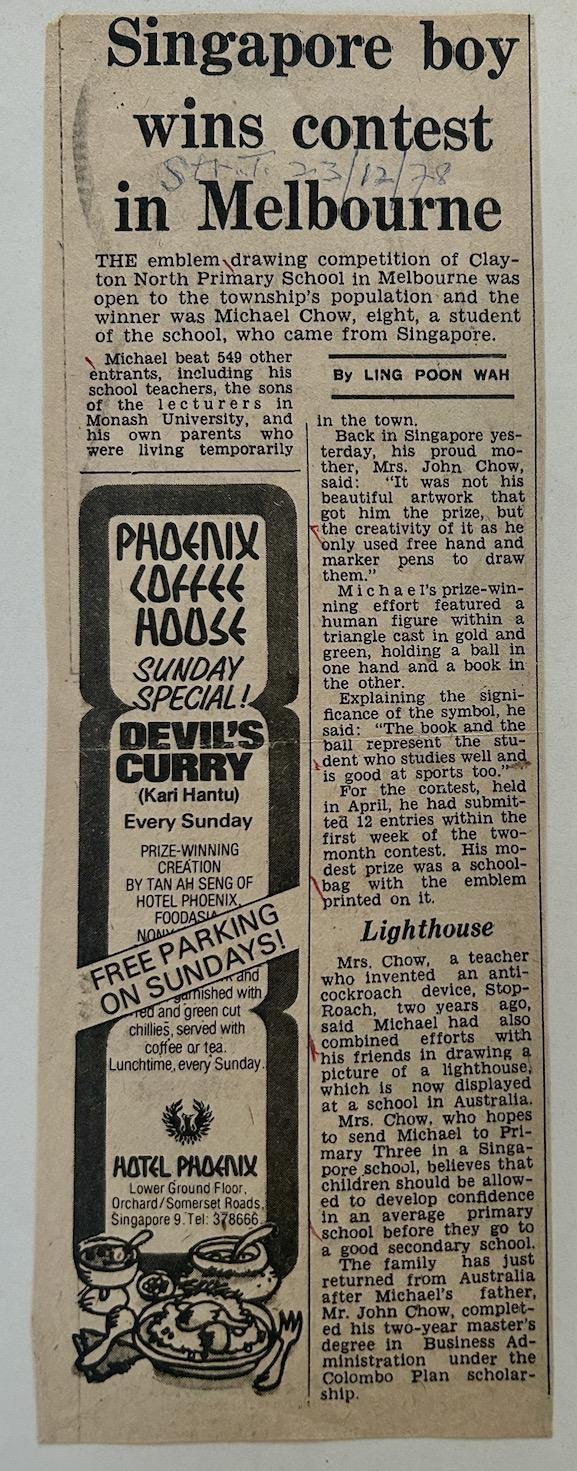
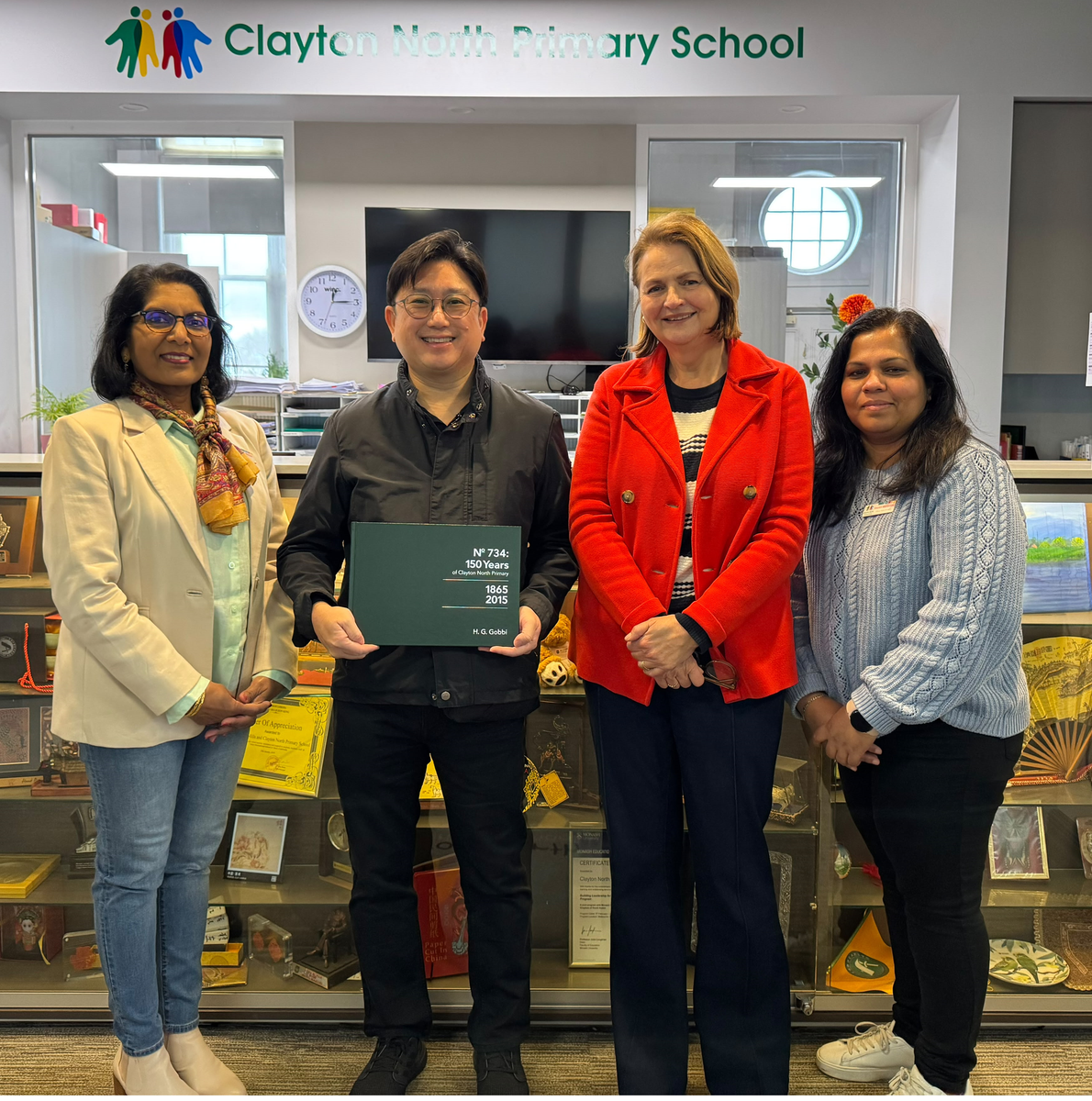
We had a very special visitor to Clayton North Primary School today — Michael Ewing-Chow, who attended CNPS in 1977 and 1978.
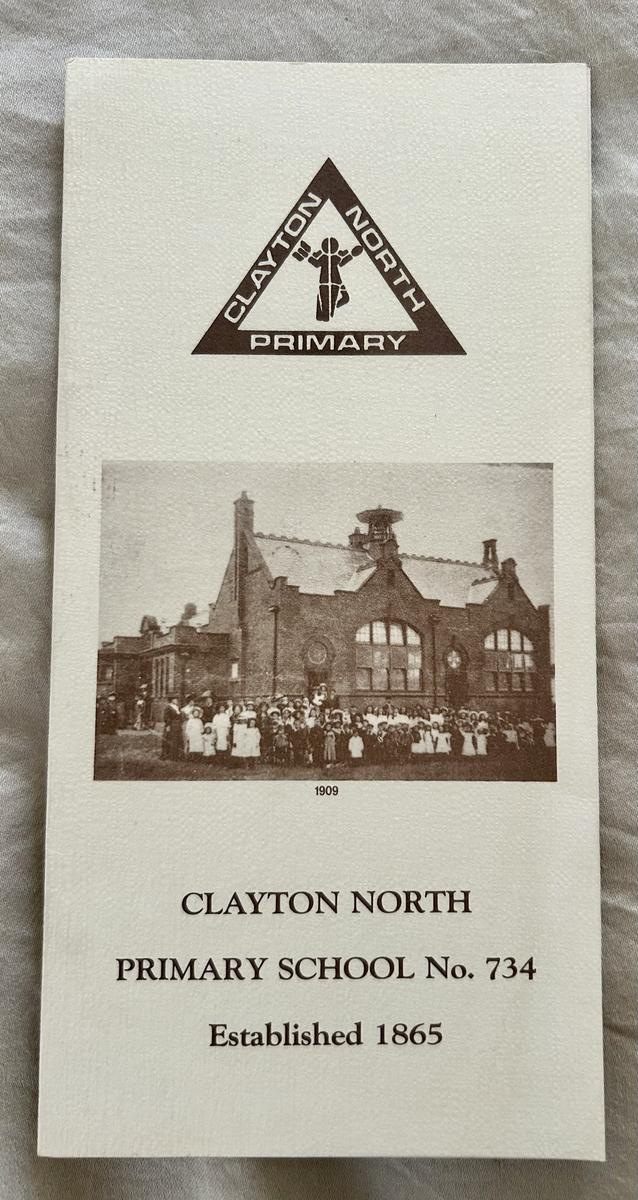
Michael shared many fond memories of his time at the school, including the remarkable fact that, as a student, he designed the former CNPS emblem. The design incorporated symbols of sporting and academic excellence within a triangle representing the roads surrounding the school.
Since leaving CNPS, Michael has gone on to an impressive career as an international lawyer and tenured Law Professor at the National University of Singapore, and is now focused on green energy investment and his family’s property business.
It was particularly moving to hear Michael reflect on the important role his time at Clayton North played in shaping his life and future success. Returning to the school after almost 50 years was clearly an emotional experience for him — and a wonderful reminder for us that the experiences children have at primary school can stay with them for a lifetime.
We were delighted to welcome Michael back to CNPS and to reconnect a small but very special piece of our school’s history.
Sue Simadri