Year 5/6 Bulletin






 Armadale Primary School
Maths in Action: Making Playdough!
Learning Intention
To convert between units of measurement and apply these conversions when following a recipe.
Overview of the Lesson
This week, our Grade 5/6 students put their mathematical skills to the test with a fun, hands-on Playdough Maths Investigation!
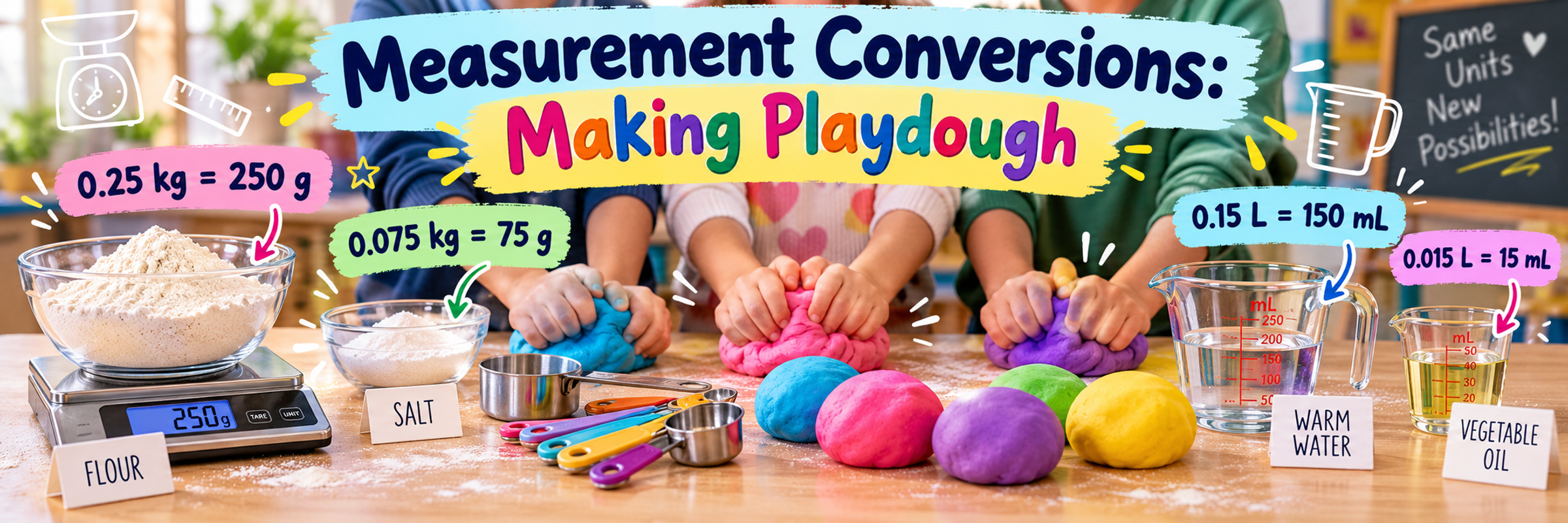
Students were challenged to convert recipe measurements from kilograms to grams and litres to millilitres. We began by revising metric conversions, focusing on the relationship between units of measurement and how multiplying by 1,000 allows us to convert larger units into smaller units.
Working collaboratively in small groups, students applied their knowledge to convert ingredient quantities before putting their calculations into practice. Using digital scales, measuring jugs and other equipment, they carefully measured their ingredients to create their very own playdough!
Along the way, students explored the importance of accuracy, problem-solving and teamwork. They recorded any adjustments made to their mixtures and discussed how small changes in ingredient quantities could affect the final product.
To extend their thinking, students were challenged to double and halve the recipe, calculating new ingredient quantities and explaining the mathematical reasoning behind their conversions.
The lesson was a wonderful opportunity for students to see how mathematics connects to everyday life. Best of all, everyone got to take their homemade playdough home!
Continuing the Learning at Home
Families can help reinforce these important measurement skills through simple, everyday activities.
- Get cooking together! Encourage your child to read a recipe, measure ingredients and convert quantities between grams and kilograms or millilitres and litres.
- Double or halve a recipe. Challenge your child to adjust ingredient quantities when preparing a meal or baking something at home.
- Explore food packaging. Look at the measurements on everyday grocery items and discuss how they could be expressed using different metric units.
- Estimate, measure and check. Ask your child to estimate the mass or capacity of household items before checking their predictions using kitchen scales or measuring jugs.
- Explain the maths. Encourage your child to explain how they calculated a conversion and why their answer makes sense.
A question to ask your child:
“If our recipe needs 250 g of flour, how much would we need to make three batches? Can you express your answer in both grams and kilograms?”
These simple conversations help students build confidence, strengthen their mathematical reasoning and recognise that measurement is a valuable skill beyond the classroom.
Year 5/6 Team
Allira.Zeneli@education.vic.gov.au