Learning Partnership-Maths Bulletin












 Armadale Primary School

Growing Mathematical Thinkers Through Feedback
Traditionally, we have often viewed mathematics as a subject where answers are either right or wrong. While recalling mathematical facts quickly is important, developing a strong understanding of mathematical concepts requires much more than finding the correct answer.
At Armadale Primary School, our Learning Model supports both the development of automatic recall and a deeper understanding of mathematical concepts.
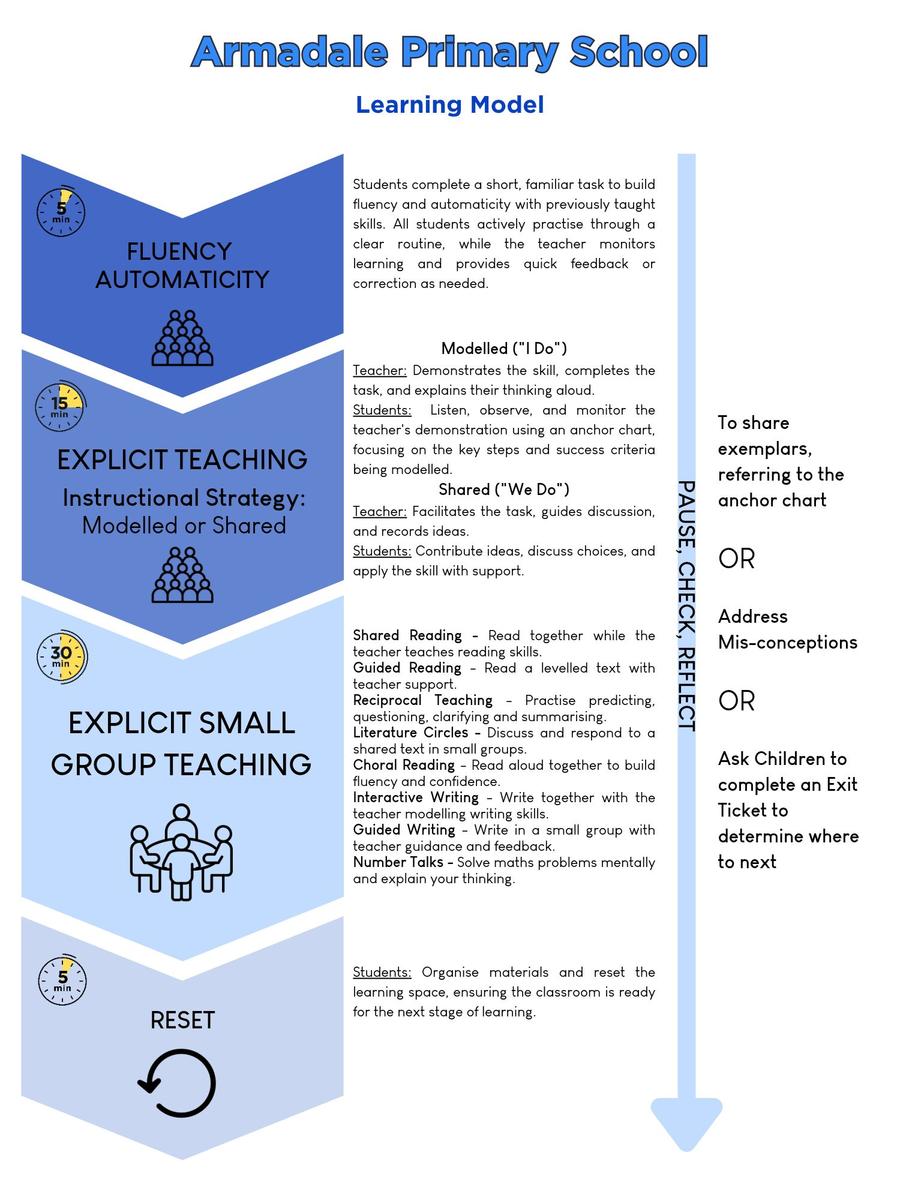
At the beginning of each session, children practise recalling essential facts in addition, subtraction, multiplication and division. Regular practice helps children build fluency and confidence.
The explicit teaching component of our Learning Model is designed to develop children’s understanding of a particular mathematical concept. Through problem-solving, children are encouraged to explore different strategies, explain their thinking, make connections and learn from their mistakes.
This is where effective feedback plays an important role. Rather than simply marking answers with ticks and crosses, we want to encourage children to think about their learning. Feedback should prompt children to reflect, explain their reasoning, try another strategy and consider how they might approach a problem differently.
These same principles can be supported through home learning. When children complete maths tasks at home, the focus does not always need to be on whether an answer is correct. Instead, families can encourage children to explain how they worked it out, why they chose a particular strategy or whether there is another way to solve the problem.
Practical examples of feedback families can use at home:
- When a child gets an answer correct: “Can you explain how you worked that out?” or “Could you solve it another way?”
- When a child makes a mistake: “Talk me through your thinking. Where might you try something different?”
- When a child is unsure how to begin: “What do you already know that might help you solve this problem?”
- When a child uses a strategy: “Why did you choose that strategy? Would it work for a different problem?”
- When a child is finding a task challenging: “You have tried one approach. What else could you try?”
The aim is not for families to provide all the answers, but to help children reflect on their thinking and decide on their next steps. This encourages children to become more independent, rather than relying on an adult to tell them whether their work is right or wrong.
Our goal is to develop children who can think independently, make informed decisions and take increasing ownership of their learning. When children are encouraged to explain their thinking and act on feedback, both at school and at home, they develop the confidence and agency to tackle more challenging problems.
At APS, we want our children to see mathematics as more than getting the right answer. We want them to become curious, capable and confident mathematical thinkers who understand how and why mathematics works.

Assistant Principal