
Banner Photo

Wellbeing Corner

By Ryo Sugihara
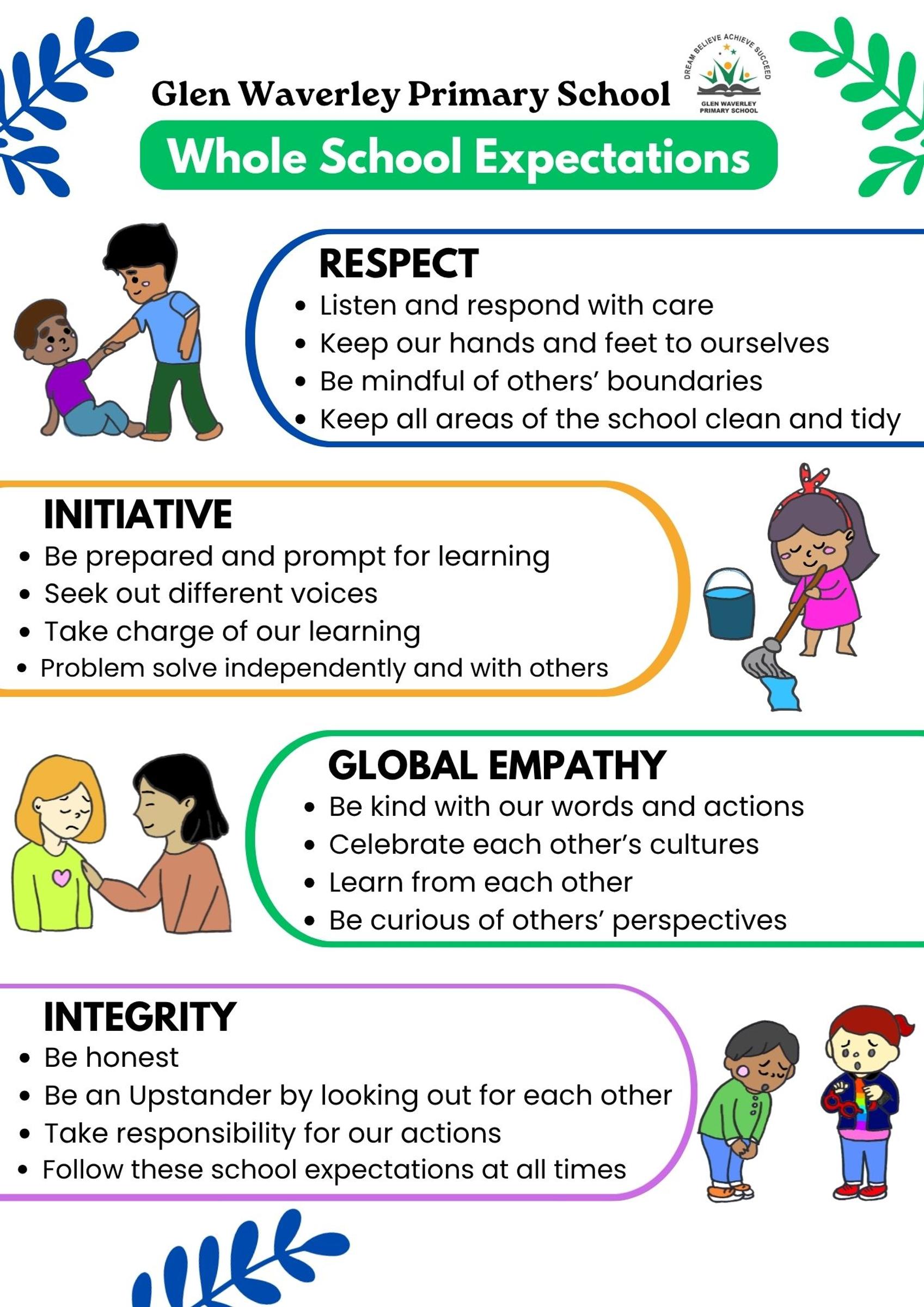
Introducing Our Whole School Behaviour Expectations

These past few days, your child may have come home talking about our new Whole School Behaviour Expectations which we showcased during assembly this week. We're excited to share this with our families, as they set out the shared values that guide how every student, staff member and visitor is expected to behave at Glen Waverley Primary School. These expectations were developed not only by the staff but with consultation with the students, to give our whole community a clear, consistent language for talking about behaviour, whether that's in the classroom, in the yard, or on excursions. 
Gallery Image

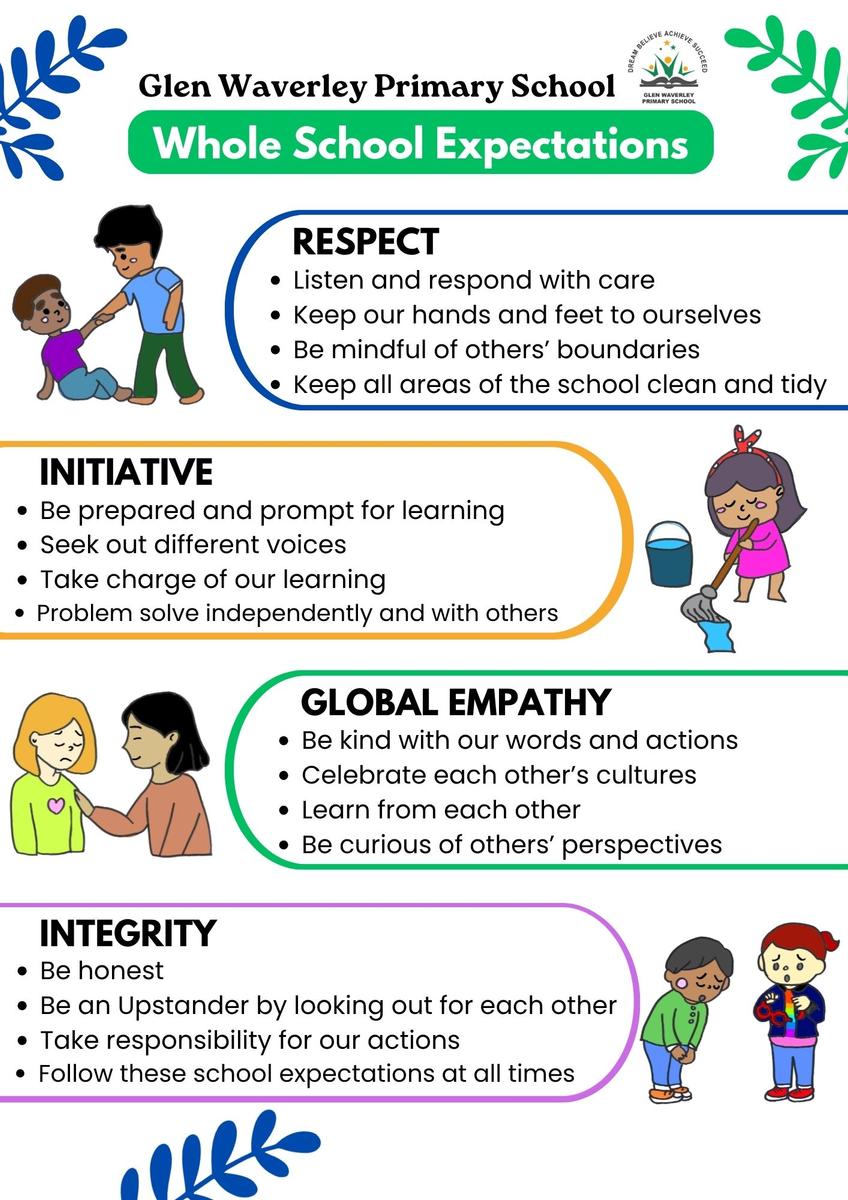
They sit under our four key School Values, with four associated expectations that apply in all areas of school life:

Respect:

  • Listening and responding to others with care, 
  • Keeping our hands and feet to ourselves, 
  • Being mindful of others' boundaries, and 
  • Keeping all areas of the school clean and tidy.


Initiative:

  • Being prepared and prompt for learning, 
  • Seeking out different voices, 
  • Taking charge of our own learning, and
  • Problem-solving independently and with others.


Global Empathy: 

  • Being kind with our words and actions, 
  • Celebrating each other's cultures, 
  • Learning from one another, and 
  • Staying curious about others' perspectives.


Integrity:

  • Being honest, 
  • Acting as an Upstander by looking out for one another, 
  • Taking responsibility for our actions, and 
  • Following these expectations at all times.


Teachers will be explicitly teaching and reinforcing these expectations with students in classrooms and during assemblies over the coming weeks and through Term 4, so children become familiar with what each value looks like in practice.


How you can help at home

You don't need a poster on your fridge to bring these values into everyday family life! Simple conversations can go a long way — try asking your child:

  • “What does it mean to be an Upstander?”
  • “Can you tell me about a time today you showed initiative?”
  • “How did you show respect to a friend or teacher today?” 
  • “Tell me about a challenge you encountered today and how you problem solved.”

Or perhaps encourage these expectations at home, for example:

  • Engage in conversation at the dinner table to practice listening and responding with care,
  • Encourage your child to pack their own bags or even their lunches so there are prepared for school,
  • Model curiosity by actively seeking your child’s perspectives and opinions,
  • Set up a reward system at home that is linked to the expectations to encourage positive behaviour.


Reinforcing this shared language at home helps students see that these aren't just "school rules," but values that matter everywhere.
Gallery Image