Student Wellbeing

Attendance Matters
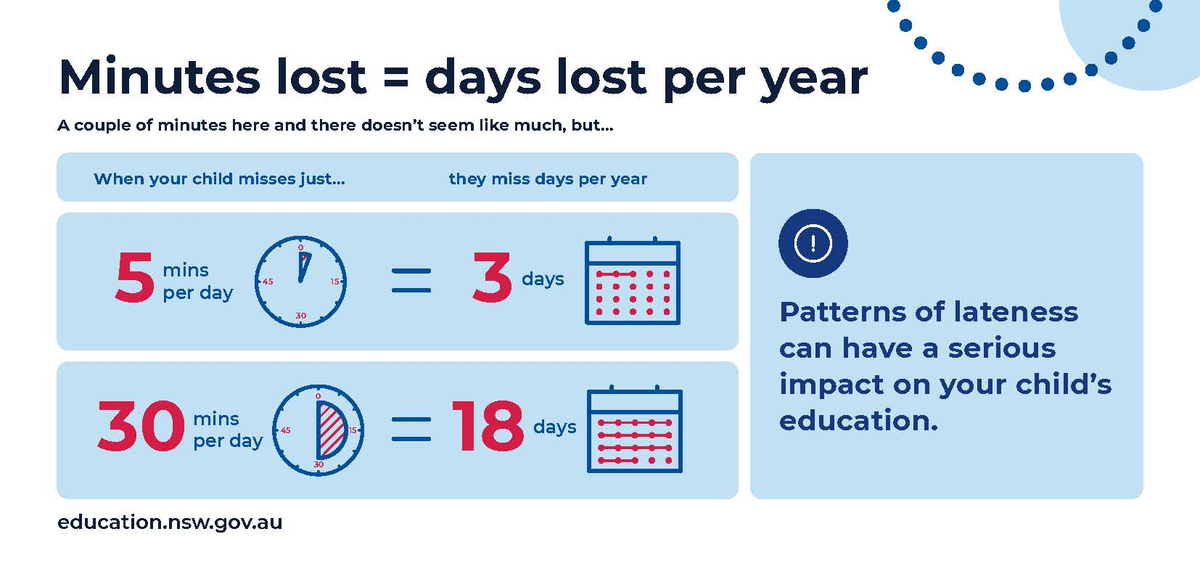
A simple way to improve your child’s academic success and engagement with their learning is for your child to be at school on time every day.
You can easily check your child’s record of attendance using the COMPASS App.
We encourage parents and carers to check in with your child to make sure they are arriving on time to school.
Research highlights a clear correlation between student attendance and the achievement of quality academic, socio-economic and health outcomes. This research tells us that students with an attendance rate below 90% are educationally at risk.
Below are the six key risk factors the Department of Education NSW highlights:
1. Lower scores and poorer academic outcomes
2. Increased likelihood of dropping out of school earlier
3. Decreased likelihood of engaging in vocational education
4. Poorer long-term mental health and social outcomes
5. Increased likelihood of involvement with criminal activity
6. Increased likelihood of requiring social assistance
If your child is struggling to get up in the morning to arrive to school on time, try any of the following strategies:
Ask your child to –
· Pack their school bag the night before
· Check their uniform is ready
· Pack their lunch the night before
· Set their alarm to wake up 10 to 20 minutes earlier
· Catch the earlier bus
As well, you can contact your child’s Leader of Student Care by email or phone for further support.
Wellbeing Program: The Body Project
We are pleased to introduce "The Body Project" at MCC, a wellbeing program designed to help students improve their body image and boost self-esteem. Facilitated by Mrs June Vella and Mrs Tamara Shoemark, this evidence-based program consists of four interactive, small-group workshops.
Rather than focusing on appearance, students will learn practical skills to challenge unrealistic beauty standards, navigate social media pressures, and build a healthier, more positive relationship with their bodies. Through honest conversations and supportive activities, participants will gain strategies to feel more confident and focused. It’s a safe, non-judgmental space for students to be themselves and support one another.
Currently Year 10 girls have been invited to participate. We will be expanding the program later this year into other year groups. For further information please contact mccthrive@arm.catholic.edu.au.
Social Media News - from the eSafety Commissioner
https://www.esafety.gov.au/
Why regular online safety conversations matter
As families settle into Term 3, it’s a good time to have a conversation with your child about their online experiences and digital habits.
New research shows parents and carers are doing an incredible job supporting their children online, with over 90% talking about online safety!
But the online world is changing so quickly and some of the biggest emerging risks aren’t being discussed as often. The eSafety Commissioner found:

1 in 4 parents talk about how algorithms influence what children see online

1 in 10 discuss how generative AI can be used and misused

Fewer than 1 in 10 have talked about sextortion.
There isn’t one conversation that prepares children for every online experience. What matters most is creating an environment where they know they can come to a trusted adult if something doesn’t feel right and keeping those check-ins going as they grow.
Whether it’s talking about social media, AI or how and why online content ends up in their feeds, even small, regular chats can make a real difference.
If you’re not sure where to start, we’re here to help
Having regular conversations about online experiences can feel challenging, especially when technology and online trends are constantly evolving. Our parents hub offers practical advice, support and conversation starters to help you understand your child’s online world.
Dive deeper and sign up for our free webinars. Covering the latest online safety issues, they’re designed to help parents and carers build the knowledge, skills and confidence to support children online. Current topics include:
- Influencers, ideology and impact: how algorithms influence and reinforce harmful beliefs
- AI-generated images and videos: navigating the deepfake threat
- The trust trap: navigating friendships, pressure and manipulation online
Sharon Stuart
Leader of Student Wellbeing
sstuart@arm.catholic.edu.au