Inclusion News
At CSPS equity is upheld and diverse needs are respected in policy and practice.
Inclusion News
At CSPS equity is upheld and diverse needs are respected in policy and practice.
How to Read Your Child's IEP
If your child has an Individual Education Plan (IEP), you might wonder how to make sense of it. An IEP is a working document that helps us plan the right support for your child's learning - built together with you, your child and our staff. Here's a quick guide to what's inside, using a sample plan as an example.
The basics
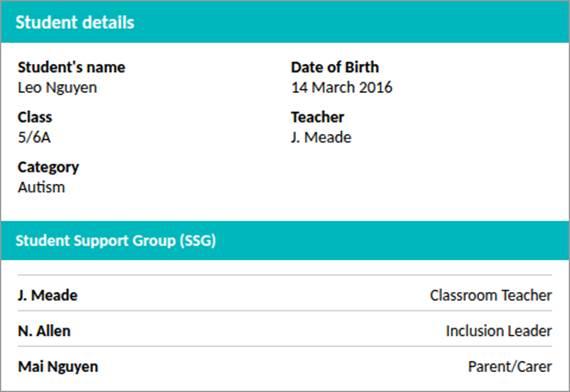
Your child's details, class, category of support and Student Support Group (SSG) members.
At the top of the plan you'll find your child's details, their class and teacher, and the category of support they receive. It also lists everyone on your child's Student Support Group — including you.
Strengths first
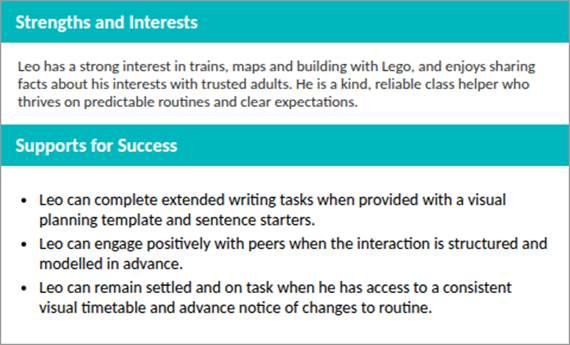
Every plan starts with strengths, not just challenges.
Every IEP starts with what your child does well. We describe what they can achieve when the right support is in place, not just what they find difficult — strengths shape everything that follows.
SMART goals
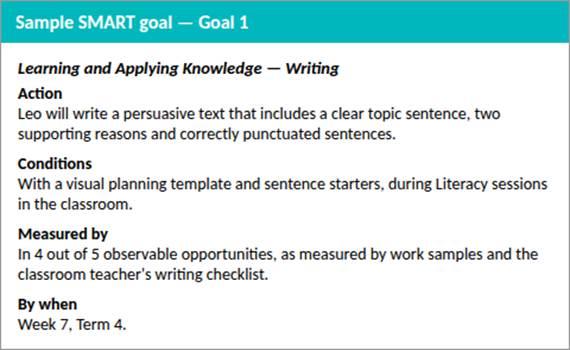
One goal from a sample plan, showing the SMART structure.
Each goal is Specific, Measurable, Agreed, Relevant and Time-bound. You'll see exactly what your child is working towards, the support they'll have, how we'll know they've succeeded, and by when.
How we'll help
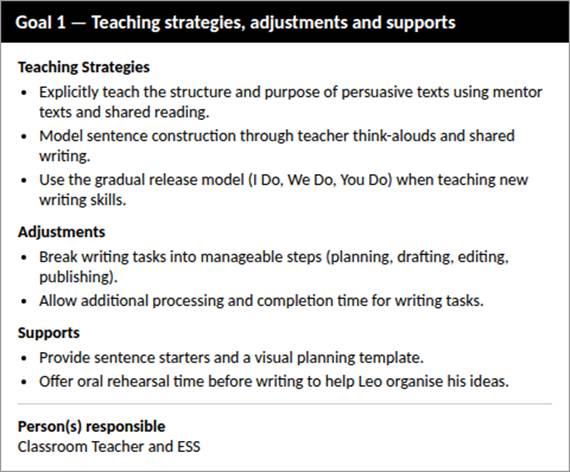
The teaching strategies, adjustments and supports linked to that goal.
For every goal, we outline the teaching strategies, classroom adjustments and supports we'll use — and who's responsible for them, so everyone is clear on their role.
Any questions?
IEPs are reviewed and updated regularly as your child grows. If you'd like to talk through your child's plan, please reach out to their classroom teacher or a member of our Inclusion Team — we're always happy to chat.
Note: the example shown above uses a fictional student, created for illustration only.