
Mathematics

┌─────────────────────────────────┐
🧠 𝙻 𝙴 𝙰 𝚁 𝙽 𝙸 𝙽 𝙶 𝙻 𝙾 𝙶 ─── ○
└─────────────────────────────────┘
Year 9
Year 10 Standard
Year 10 Advanced
Year 9
Year 10 Standard
Year 10 Advanced
Students are mastering mathematics by using structured Learning Logs to decode complex concepts, set goals, and build independent revision habits.
Mathematics is often called a language of its own. For many students, translating complex symbols, equations, and abstract terminology into understandable concepts can be a significant hurdle. This is where the Learning Log’s come in. Far more than a simple notebook for scribbling down calculations, these logs serve as a personalised, active learning toolkit that students build, own, and rely on daily.
A Powerful Dual-Purpose Tool
Students utilise their Learning Logs in two distinct, equally vital ways:
As an In-Class Learning Tool: During lessons, the log acts as a workspace for actively decoding complicated mathematical vocabulary and theories.
A Personal Revision Guide: Outside the classroom, it transforms into a highly structured, tailored textbook that guides their home study and exam preparation.
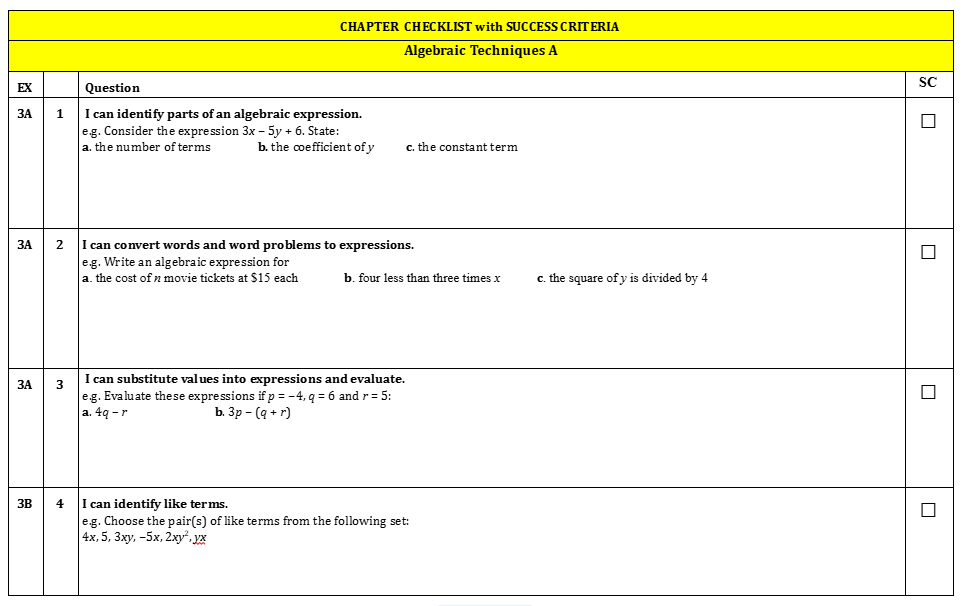
What Makes a Learning Log Effective?
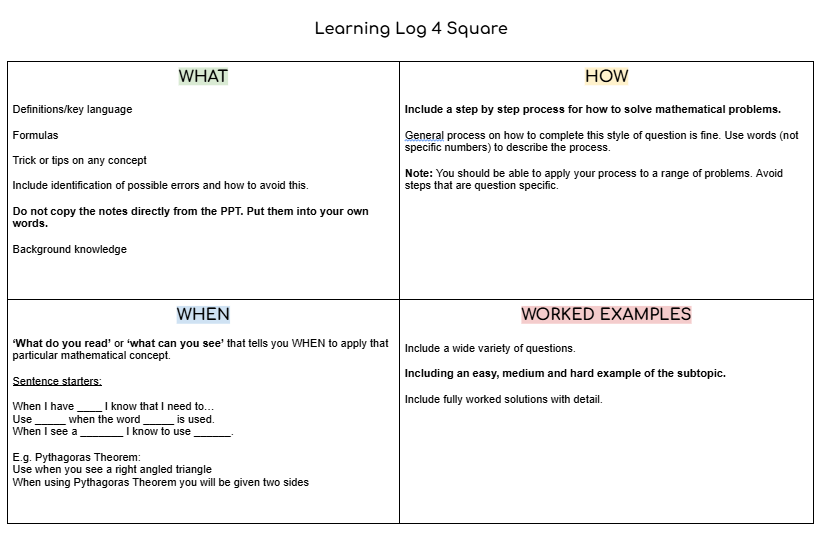
The true magic of the Learning Log lies in its meticulous structure. Students do not just copy notes from the board; they systematically organize their thoughts into several critical components:
Strategic Goal Setting: At the start of each new term, students clarify what they want to achieve, identifying specific steps they need to perform to reach that goal.
Comprehensive Chapter Reviews: At the conclusion of a unit, students synthesize the material, reflecting on their strengths and areas that require further practice.
Proactive Revision Schedules: Students map out what areas they need to work on, when they are going to complete this and in what form they will complete the revision.
Step-by-Step Problem Solving: Complex equations are broken down into granular, sequential actions. Students write the mathematical steps alongside written explanations of why each step is taken.
Conceptual Boundaries: Knowing how to solve a problem is only half the battle. Logs include explicit sections detailing exactly when to apply specific formulas and concepts based on clues within a question.
How Parents Can Support at Home
Parents/carers can easily support this initiative at home by asking your child to walk you through their Learning Log. Have your child explain a step-by-step process from a recent topic or show their revision schedule for upcoming assessments. Celebrating the organisation and effort they pour into these logs is a fantastic way to reinforce their mathematical growth!
Mr Kurt McPherson | Mathematics KLA Leader