
Principal's Message
Responding to Antisemitism and Discrimination
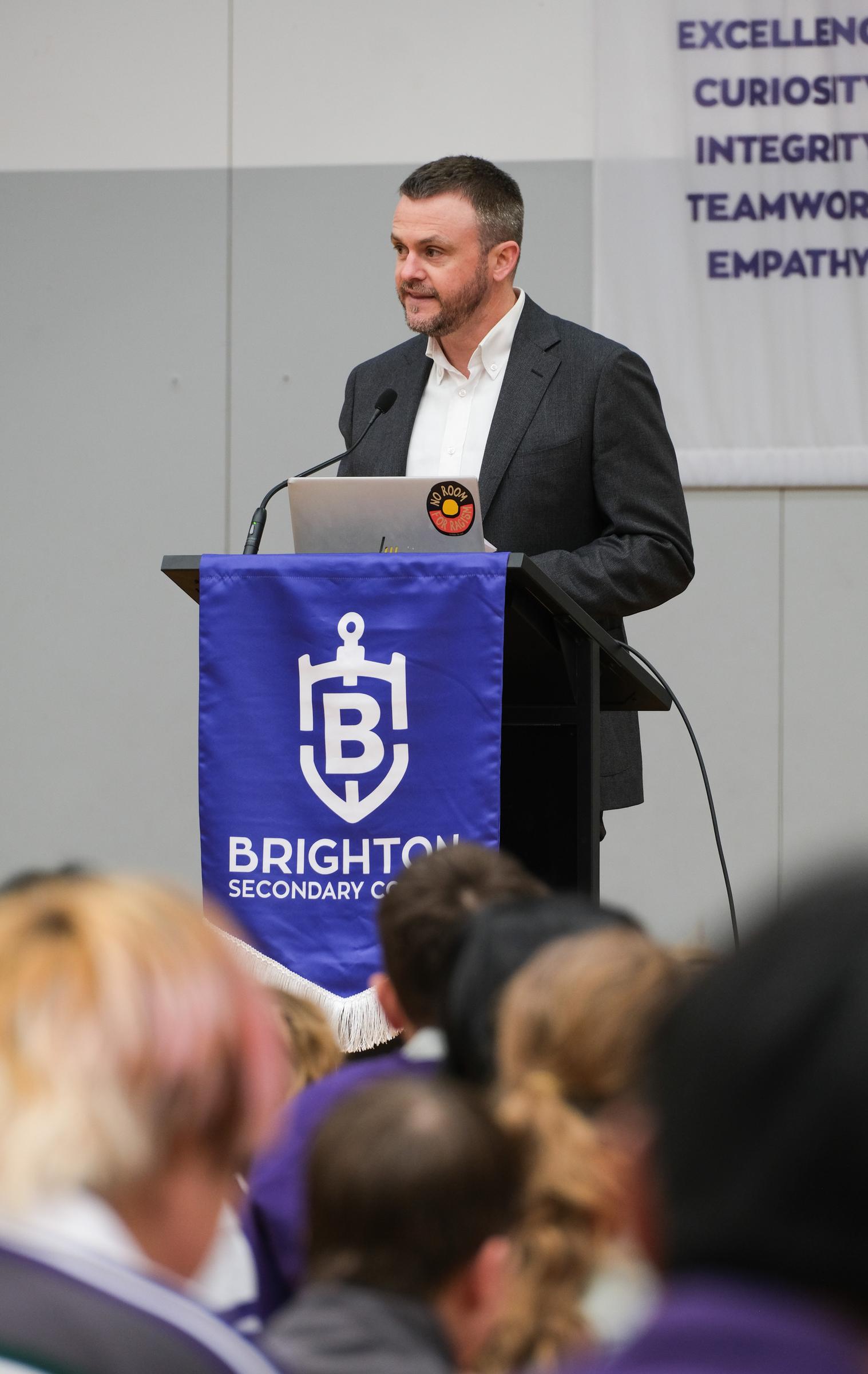
Principal's Message
Responding to Antisemitism and Discrimination
When I accepted the opportunity to lead Brighton Secondary College, I was conscious that an important part of my responsibility would be supporting our school community to acknowledge our history and, importantly, to ensure that antisemitism and all forms of discrimination are actively challenged.
This is work that requires more than responding when an incident occurs. It requires creating a culture in which students and staff feel confident to speak up, know what to do when they experience or witness discrimination, and understand that we all have a role to play in creating a safe and respectful school.
Our student-led Upstander campaign has been an important part of this work. The campaign has been featured in several editions of Highlights and at school assemblies, and we have seen an increase in reporting of discrimination. This increased reporting is important because it allows us to better understand what is occurring, respond appropriately when incidents arise, and provide targeted education and support where it is needed.
I want to use this article to share some of the impact we are seeing within our school, as well as some of the ways our work is now contributing to broader conversations about responding to antisemitism and discrimination in schools.
To be clear, discrimination still occurs at BSC. Our work is not finished. However, the evidence available to us indicates that incidents are occurring less frequently, are less severe, and are being identified and managed more effectively.
Internal impact
One of the key ways we measure the impact of our work is through the Attitudes to School Survey, which is completed by students across Victorian government schools each year. The survey allows us to look at changes within our own school over time and compare our results with those of similar schools and with the state.
For the survey statement, “I have not experienced racism at this school in the past 12 months,” BSC was the most improved school in the Bayside Peninsula Area. This area includes government secondary schools from Port Melbourne through to Rosebud. We are now also performing above both the similar-schools group and the state for this measure.
This result is particularly encouraging because it speaks to students’ experiences of safety and belonging at school.
I was also very pleased to see the results for the statement, “I know what to do if I experience racism.” Our result is now 7 percentage points above the similar-schools group and 6 percentage points above the state result.
While the Department does not provide the same level of analysis for this question as it does for the question about experiencing racism, I believe this result is an important indication that our focus on Upstanding is helping students understand that they can speak up and, importantly, know what to do when they experience or witness racism.
The Upstander campaign cannot, by itself, eliminate discrimination. What it can do is help create a culture in which discrimination is more likely to be recognised and reported. Increased reporting gives us greater opportunity to respond, educate and support our students.
Sharing our learning
Earlier this year, members of our leadership team participated in pilot training with UNESCO focused on addressing antisemitism in Australian schools. The training provided an opportunity for us to reflect on our existing work, consider additional approaches, and learn from the experiences of other schools.
As part of the pilot, UNESCO, ASECA and the Department of Education sought feedback from participating schools. Our history and the work we have undertaken meant that we were able to contribute practical insights about our current approach, what we believe has been effective, and areas where the training could be strengthened.
It has been encouraging to see that some of our learning is now being shared more broadly. The UNESCO training materials are expected to include a one-page overview of the work we are undertaking at BSC, so that other schools can consider how aspects of our approach might be relevant to their own contexts.
I have also had the opportunity to provide feedback on the curriculum of the UNESCO course, and there may be further opportunities to share our experiences with Department of Education principals and school leaders.
For me, the significance of this is not about recognition for our school. It is about contributing to the broader work of ensuring that schools are better equipped to recognise and respond to antisemitism and other forms of discrimination.
Our response is not finished, and we should not lose sight of the fact that every incident of discrimination matters. However, it felt timely to share an update on the positive changes we are seeing within our school and the opportunity we now have to contribute to this important work beyond BSC.
Finally, I want to acknowledge our students and staff. The progress we are seeing would not be possible without a community that is willing to embrace a culture of Upstanding. Every time a student speaks up, reports something that is not right, supports another student, or challenges discriminatory behaviour, they contribute to making our school safer and more respectful.
This is a responsibility we share, and it is through our collective actions that lasting change will occur.
I wish everyone a safe and restful Term 3 break.
Peter Langham
Principal