Online Safety Hub























 John XXIII College

Online Safety Hub
The Hub includes expert advice on the most pertinent cyber safety issues and frequently asked questions around platforms like TikTok, Fortnite, Instagram, and more. There are app reviews with age and safety recommendations, a range of guides and resources to help ensure healthy boundaries around screen time and gaming, and step-by-step instructions for using parental controls and filtering out inappropriate content.
A parent’s guide to random video chat apps

Being connected, live and unscripted, has been a part of teenage online culture since even the early mainstream days of the internet. If you were a teen in the early 00s, you might cringe when remembering the “thrill” of opening a new window and hitting up strangers with “a/s/l?” in random chatrooms. Talking to strangers online has been a rite of passage since the 90s – and because of this, we know it doesn’t come without significant risk.
The difference today is that these interactions don’t just take place on obscure forums and chatrooms with basic text chat – children can now be brought face-to-face with strangers in just a few clicks, through fast, unmonitored, one-on-one live video. Random video chat sites and apps are no further away than a simple Google search, and you don’t need an account or verification to get started. In this guide, we’ll cover what today’s random video chat apps look like, why they’re attractive for children and teens, and how to talk to your child about the risks.
What are random video chat apps?
The name exactly fits the description: random video chat apps connect two users (or more), in real-time, with a stranger through live video. Your child doesn’t need any mutual friends to connect with them, or even an account on the platform in many cases – they can simply tap a button, and come face-to-face with someone they’ve never met.
Most random video chat apps fall into one of three formats:
The “classic” model, made famous by now shut-down Omegle, launched in 2009. This type of platform pairs two users in a one-to-one video call, with a “next” button that allows them to skip to someone new any time they like.
Swipe-based platforms, where there’s an element of “matching”: blending elements of Omegle and swipe-based dating app Tinder, users can browse profiles before they decide to connect with another person.
Group chat platforms, where multiple strangers come together by random video chat to speak in a shared space.
Since Omegle’s closure, a wave of alternatives has been competing to replace it. Some of the most widely used random video chat services are Chatroulette, OmeTV, and Monkey. While some of these platforms claim to have improved moderation and implemented safety features, the premise is the same: real-time video with a complete stranger, paired with minimal barriers to access chats like this.
Why are random video chats so popular with kids and teens?
For many children and teens, the appeal of random video chat has more to do with what these platforms offer that everyday social life might not: spontaneity, anonymity, and the thrill of not knowing who you’ll meet next. Some of the most common reasons children are drawn to random video chat include:
- The thrill of the unknown – not knowing who they’ll meet next provides a sense of excitement and boundary-pushing that feels relatively low-stakes from the comfort of their own bedroom.
- A sense of freedom and authenticity – for children who feel overprotected or restricted offline, random chat can feel like a rare space to be unscripted and unjudged.
- The social element – these apps frequently circulate as dares or trends among friend groups, making them feel like a shared experience or rite of passage rather than a solitary risky activity.
- Simple boredom – “I had nothing better to do” is a legitimate and common reason.
- The desire for new connections – some children are genuinely looking to expand their social circle, practice social skills, or find people who share their interests, particularly if they feel isolated at school or at home.
- Romantic curiosity – some teens, including those who are LGBTQIA+, may be looking for romantic connection in a space that feels anonymous and therefore safer to explore.
Is random chat safe?
The short answer: no. The longer answer is that random video chat apps simply aren’t designed with children’s safety built in mind. Many promote themselves as a way to connect romantically, which means a significant amount of these platforms require users to be 18 and up to use their services, but very few actually have any type of meaningful age verification. These are some of the risks parents need to be aware of:
Exposure to explicit content
Because users are anonymous and interactions are live, there’s no barrier to stop adults exposing younger users to sexual or otherwise inappropriate content, from the very moment a chat begins. Unlike social media platforms which – for all their flaws – still have content review systems, live video through random chat platforms is unfiltered and unpredictable. Users exposing themselves on live-streaming websites has become somewhat normalised: some users deliberately engage in sexual behaviour from the moment they connect, without caring who is on the other side of the screen.
Grooming and predators
Random chat platforms almost seem like a dream creation for adults seeking to make contact with minors. The combination of anonymity, real-time interaction, and nothing to connect a user to who they are in “real life” makes them an easy entry point. Predators don’t always make their intentions obvious from the start – exchanges typically begin by building trust and rapport, which can be easier to do over live video rather than in text form.
Omegle, the most widely known random chat platform, shut down in 2023 citing the financial and psychological burden of moderating the platform – the same year it settled a lawsuit brought by the family of an 11-year-old girl who had been connected to an adult predator through the site. The platforms that have emerged to replace Omegle, such as OmeTV, operate on the same basic model, and while some claim they’ve improved moderation, it’s difficult to truly enforce across millions of live video chats between users across the world.
Privacy risks
Many random chat apps require no account or personal information to use, which, from a data privacy perspective, might sound safer – but it comes with its own risk. There’s nothing stopping another user from recording a call without the child’s knowledge, screenshots and screen recordings can be taken and shared, and children may not realise that what feels like a throwaway interaction could leave a lasting digital trace. Sharing a name, school, location, or even a distinctive background in the video can reveal more than children might want to really share.
Sextortion and coercion
A pattern that has become increasingly common is sextortion – where a child is persuaded or manipulated into sharing an intimate image, which is then used as leverage to demand more. This can happen quickly, and the fear of images being shared with friends or family can make children feel unable to tell a trusted adult. It can start on a random chat app and move to another platform, making it harder to trace.
Cyberbullying and distressing content
Not every negative experience on random chat platforms involves an adult predator. Children can easily encounter peers who use the mask of anonymity to say things they would never say face to face, and they can frequently stumble across distressing content – violence, self-harm, or content that is simply not age-appropriate – without any warning.

Talking to your child about random video chat
If you discover your child has been using a random video chat app – or suspect they might be – how you approach the conversation is just as important as actually having it.
Approach any conversation about these apps with an open and non-judgmental attitude:
Don’t jump to conclusions: Keep in mind that your child may not be seeking out this kind of app for negative, risky or dangerous reasons. They may have come across it by accident or through peer pressure, or they genuinely want to explore other social avenues
If you know they have used an app like this already, talk to your child about what they liked about the app in question, how they’ve used it, and invite them to consider both the pros and cons of this kind of technology
Use this as an opportunity to discuss broader rules around downloading new apps – what kinds of apps are and aren’t appropriate, and why. Adding these boundaries to your family’s digital agreement gives them more weight and makes them easier to revisit as your child gets older.
These rules may range from you deciding to ban them completely on the one hand, to allowing them with certain restrictions on the other. Where you stand will depend on factors like your child’s maturity level, your family values, and the current levels of trust and communication between you and your child.
Is there a way to block random video chat apps?
With so many random video chat apps out there, keeping up with all the names and monitoring them can feel like a game of whack-a-mole. OmeTV, HOLLA, Monkey, Chatroulette, Azar, OmeFree, and CamSurf are just some of the more popular apps – but there are hundreds out there, making it difficult to keep track of every single one. A layered approach helps keep children safe as they explore: combining open, frequent communication with parental controls and safety settings.
1. Using parental controls to monitor random video chat apps
Qustodio allows parents to limit access to dangerous websites, block risky apps, and receive alerts whenever a new app is downloaded. This makes it easier to manage random chat apps in different ways: the inbuilt web filtering will automatically detect the majority of these platforms, blocking them at browser level, while app monitoring allows parents to block access to dangerous apps – whether they’re already on your child’s device, or if they’ve just downloaded one.
2. Talk about the risks of random chat apps
Parental controls work best as part of a broader approach that includes talking to your child about why these kinds of platform carry risk – because even if you’ve blocked access to random video chats at the device level, trends still circulate at school, teens will visit friends’ houses, and other children may not have access blocked on their own devices. Teach your child how to communicate when they don’t feel comfortable participating in something risky, and remind them that they can always come to you when something doesn’t feel right.
3. Look for the signs
Some signs your child might be using a random video chat app include quickly closing a tab or app when you walk in a room, or they mention “talking to a stranger” in a way that seems to have become a habit. If Qustodio detects a new or flagged application on your child’s device, it’s a useful prompt to open up that conversation rather than jumping straight to conclusions.
What are safe alternatives to random chat?
No random chat applications are safe for children, because they aren’t designed with young people in mind. Any app or platform where children and adults can mix in anonymity, live and unfiltered, is incompatible with child safety by design. We should be highly sceptical of any random chat app that positions itself as a “safe” version for teens or children.
If your child uses random chat, or you’ve found that they’ve engaged with platforms like this, it’s important to come from a place of understanding and intrigue. Random chat apps can often be appealing because they offer something children can struggle to find elsewhere, like spontaneous connection, a sense of independence, and being able to talk to someone new outside of their social circle. For some children, particularly those who feel isolated or who are navigating their identity, these apps offer a real appeal of “connection”, however false that might be in reality. For others, random chat apps are simply a social trend – something friends are all doing, a dare that’s going round the school, or a way of feeling part of the group.
In either case, it’s key to understand the motivations so you can explore alternatives that will meet their needs, and tackle safety in a layered approach:
Structured online social experiences: multiplayer games, creative platforms, or school-sanctioned forums, for example, which can offer social experiences with more moderation and built-in safety.
- Talking to other parents in your child’s school or local community can help you understand whether random chat apps are a trend that others are participating in, so you can coordinate a shared response and work with the school if needed. If it’s a dare or a group activity many children are participating in, approaching it collectively helps all parents get on the same page and feel supported.
Random video chat has been part of the teen internet experience for longer than it might seem, which is why it’s important to understand what motivates and engages teens as they explore online. Platforms will continue to emerge, rebrand, and find new audiences – and children will continue to be curious about them for all the same reasons they always have been. Keeping the conversation open, understanding what draws them to these platforms, and having the right tools in place means you’ll be better placed to respond when something comes up – helping you tackle the risks along with your child, rather than working against them.
Reference: A parent’s guide to random video chat apps | Qustodio
Influencers, ideology and impact: how algorithms influence and reinforce harmful beliefs
This webinar explores both the benefits and risks of recommender algorithms and offers practical strategies to help parents and carers to support young people build more positive and safer online feeds.
You will learn about:

- the role of algorithms and recommender systems in driving engagement and shaping online experiences
- how platforms and online communities keep young people engaged, expose them to harmful content and reinforce gendered stereotypes
- strategies to shape algorithmic feeds and build more positive and safe online experiences
- how eSafety can support people experiencing serious online harm.
Term 3 (AEST)
4 August 2026, 12:30pm
Register here.
Exploring the online experiences of boys and young men
For boys and young men, the internet can be a place where they seek connection, validation and guidance as they explore what it means to be a man today. However, it also exposes them to risks like harmful content, online exploitation and the growing influence of misogynistic ideologies.
This 45-minute webinar will help parents and carers understand:
- social and cultural influences shaping boys and young men
- how boys engage online, build relationships and how they may be vulnerable to manipulation or exploitation
the impact of social media, gaming, and influencers on their attitudes, behaviours and sense of identity.
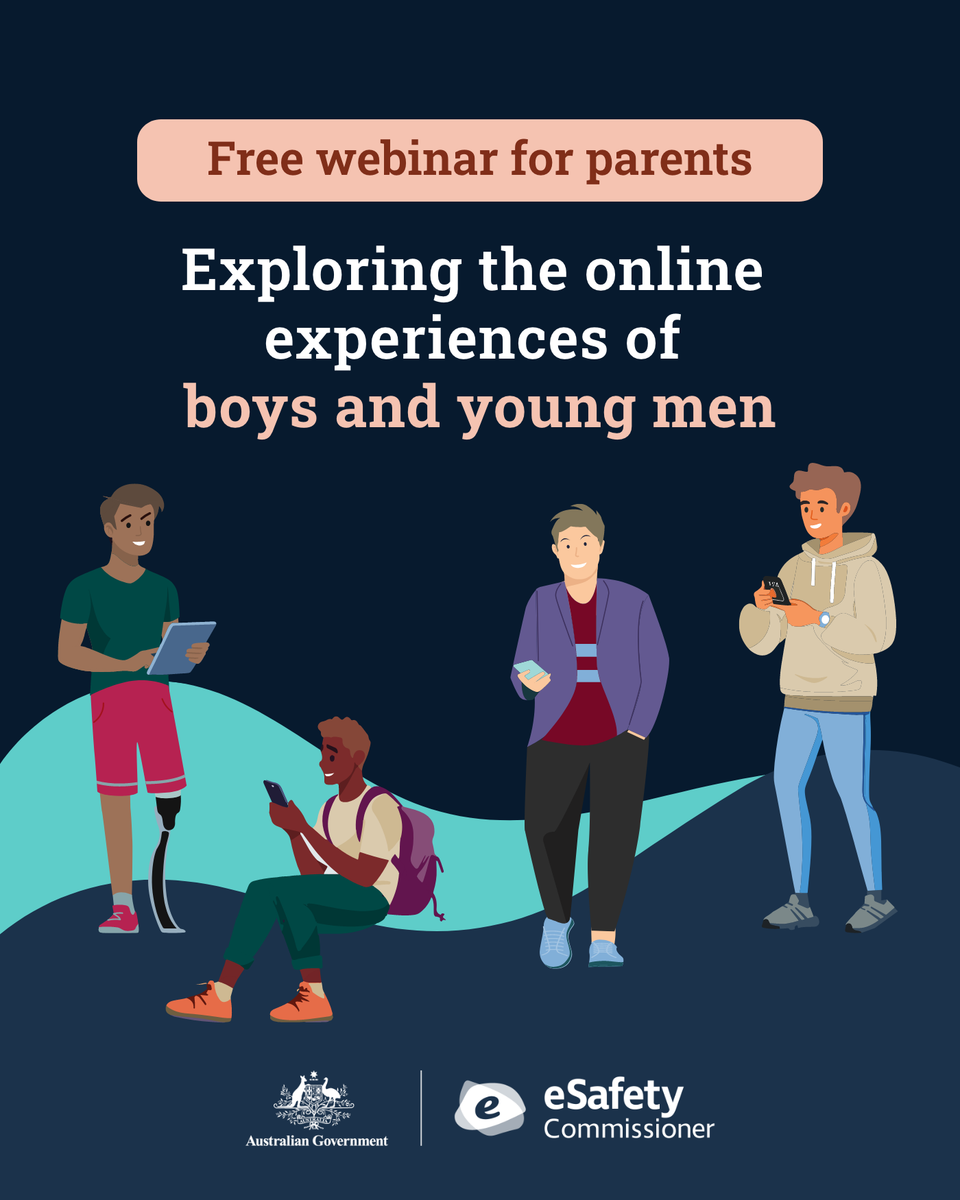
This presentation will share practical strategies to build critical thinking, challenge harmful narratives, and create open conversations that empower boys and young men to navigate the online world safely and respectfully.
Suitable for parents and carers of young people in upper primary and secondary school.
Term 3 (AEST)
13 August 2026, 12.30pm
Register here.