1/2A
Mr Tyson, Miss Jenni and the wonderful ES support team
1/2A
Mr Tyson, Miss Jenni and the wonderful ES support team
We’re continuing our work with Mallee Sky by Jodi Toering this week, looking at the different ways authors bring their descriptions to life. We’ve been exploring similes, comparing two things using like or as, and we’ve started playing with personification, where writers give human qualities and actions to things like the wind, sun, dust or rain.
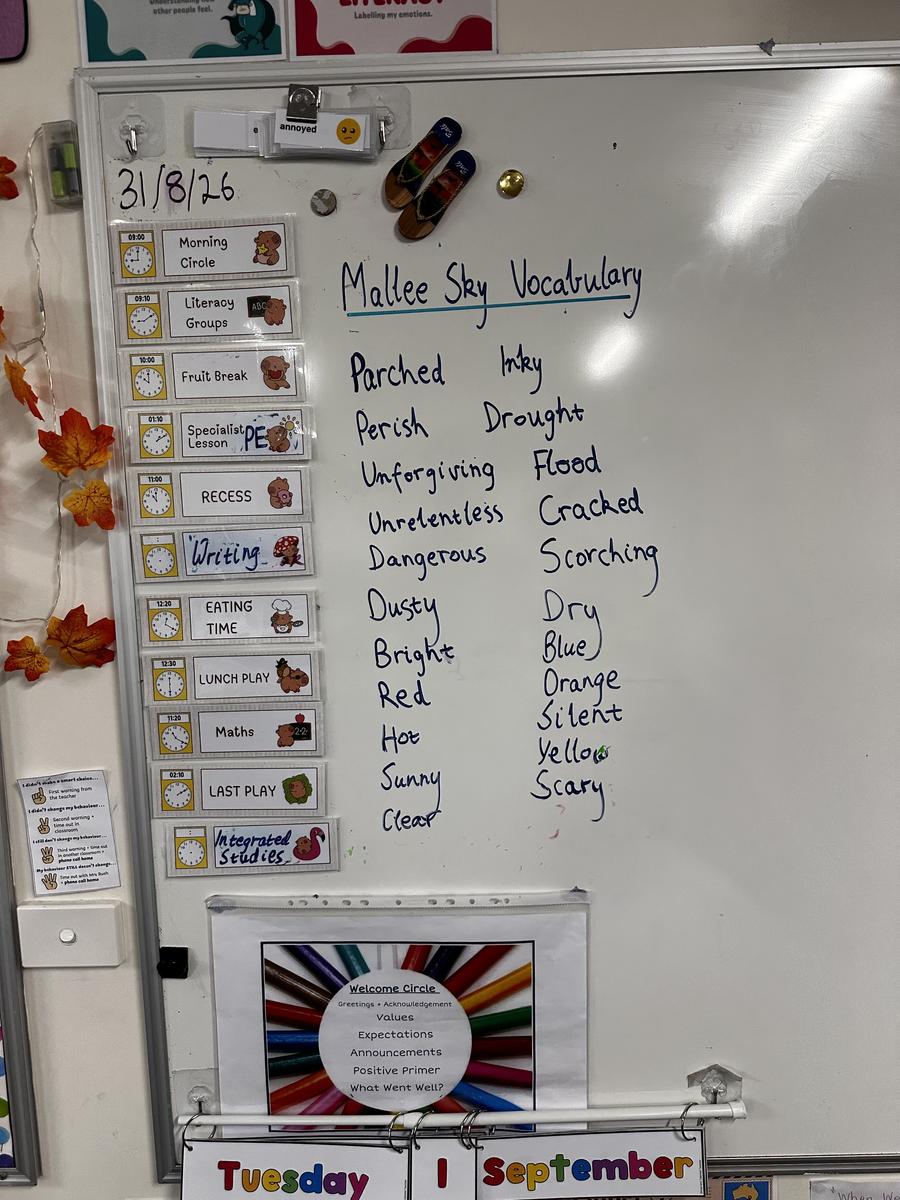
Building our Mallee Sky vocabulary to support descriptive writing.
The children have been comparing the very different moods of drought and rain, and gathering sensory vocabulary for what they might see, hear and feel out in the Mallee. Later in the week, they’ll pull all of this together to write their own descriptive sentences and short pieces inspired by the landscape.
In Phonics Plus, we’re reviewing spelling patterns, high frequency words, morphology and sentence construction, as well as building reading fluency through regular partner reading.
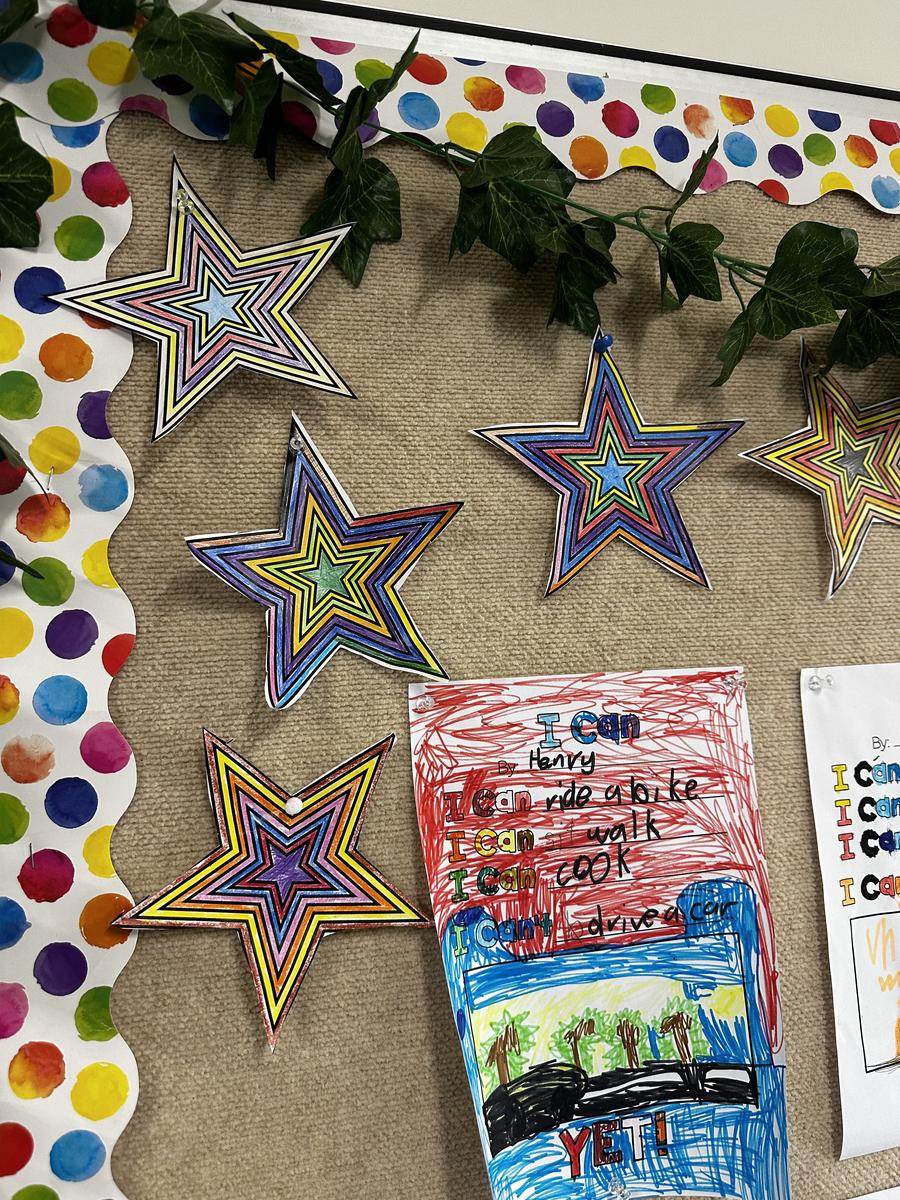
Some colourful student work on display in our classroom.
We’ve wrapped up our recent work on number patterns, repeated addition and the beginnings of multiplication, and we’re now moving into 2D shapes and 3D objects.
The children will be naming familiar 2D shapes such as triangles, squares, rectangles, pentagons and hexagons, and describing them using words like sides and corners. From there we’ll explore common 3D objects such as cubes, cuboids, cylinders, cones and spheres, and start talking about their faces, edges and vertices.
A lot of this learning will happen through hands on activities, including sorting, shape hunts around the classroom and spotting shapes in the world around us.
Our unit Places and Our Connection to Them continues. Having looked at local places, natural and built environments, weather, seasons and geographical questioning, the children are now thinking more deeply about what makes a community work.
We’re talking about the places and services people rely on, including schools, parks, shops, health services and libraries. The children will soon start planning their own community spaces, explaining why certain places matter and how they help the people who live there.