Music
Welcome back to Term Four! I hope you had a relaxing and restful holiday with your family and friends. In our final term for the year we will be focusing on music notation and instrument techniques, including guitar, ukulele, drums and singing
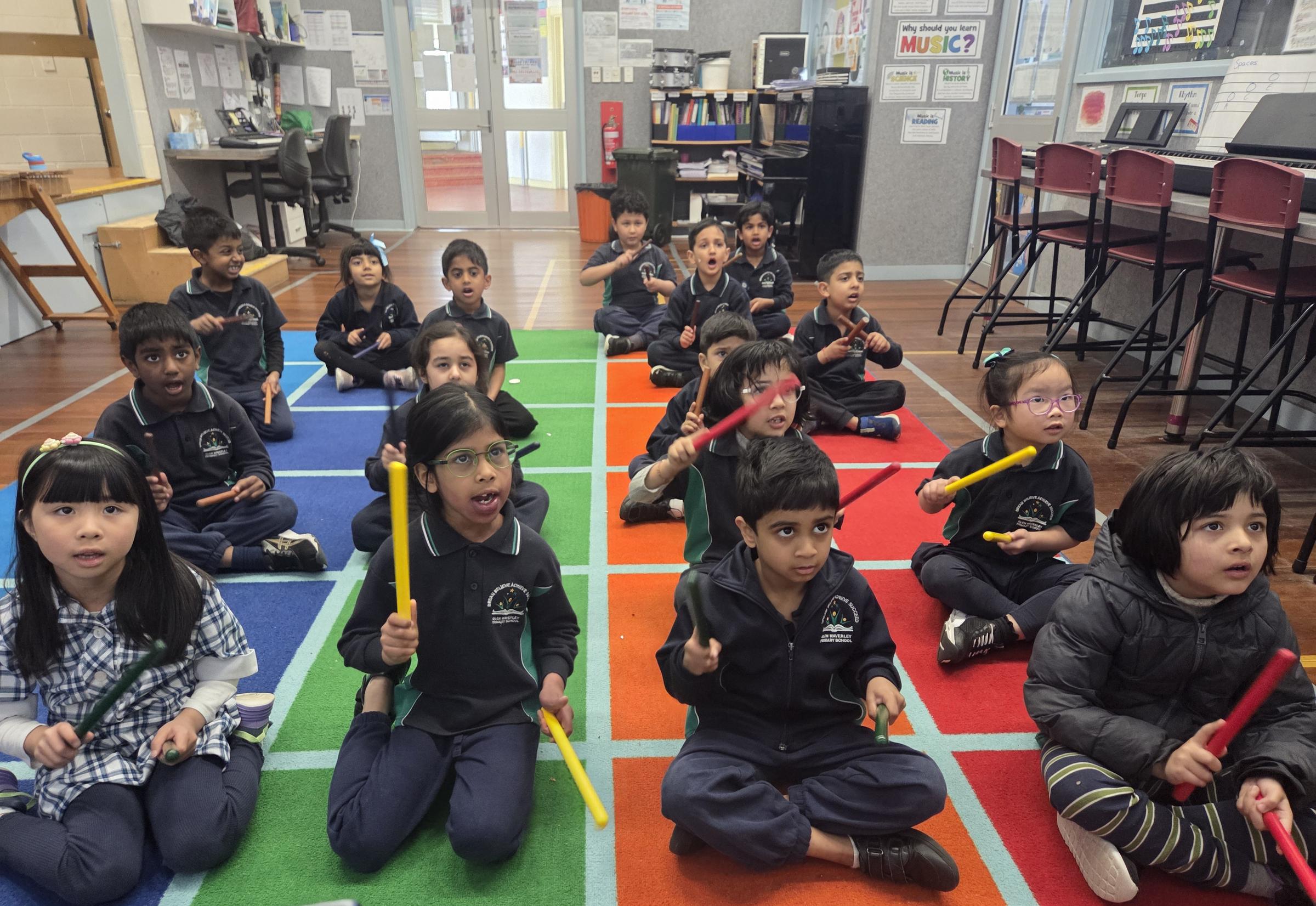
Prep Music Innovation will also take place this term with students expanding their knowledge of beat, rhythm and sound. Students will use body percussion along with percussion instruments such as triangles, tambourines, drums and rhythm sticks to copy and create simple rhythms with a steady beat.
Prep
This term, Prep students will begin exploring the concept of an informal form notation called stick notation as an exciting and simple way to represent rhythms in music. Through clapping, chanting, movement and the use of instruments such as rhythm sticks, hand drums and tambourines, students will learn how sounds and rhythms can be represented using simple visual symbols.
Students will participate in fun rhythm games and activities where they will practise reading, copying and creating short rhythmic patterns using stick notation. Using beat boards and body percussion, students will develop their understanding of how symbols can represent sounds.
Students will also have opportunities to create their own rhythms and perform them individually and as a class. These activities will help students develop early music literacy skills, rhythm awareness and confidence in reading and performing simple musical patterns.
Curriculum Links:
- use play, imagination, music knowledge and processes to discover possibilities and develop ideas VC2AMUFD01
- create music that communicates ideas and explores meaning VC2AMUFC01
Key Vocabulary: informal notation, stick notation, rhythmic patterns, beat, rhythm
Year 1
Year 1 students will explore the concept of dynamics (volume) throughout this term. Through singing, movement, listening activities and playing a range of instruments such as hand drums, shakers and triangles, students will learn to recognise and perform different dynamic levels.
Students will take part in fun games, songs and musical activities where they will explore sounds that are loud (forte), medium loud (mezzo forte) and soft (piano). They will practise changing the dynamics of their playing by responding to visual cues and changes within songs.
Curriculum Links:
- select and combine elements of music when composing and practising music for performance VC2AMU2C01
- sing and play music to communicate to audiences in informal settings VC2AMU2P01
Key Vocabulary: dynamics, loud (forte), medium loud (mezzo forte), soft (piano)
Year 2
Throughout this term, Year 2 students will explore the concept of rhythm through the use of drums. Through clapping and drumming activities, students will develop their understanding of how different sounds and patterns can be combined to create rhythm.
Students will participate in fun rhythm games, songs and drumming activities where they will practise copying, performing and creating a variety of rhythmic patterns. They will explore different ways of playing the drums, including striking, tapping and using different parts of the drum to create contrasting sounds.
Curriculum Links:
- develop listening skills and skills for singing and playing instruments VC2AMU2D01
- select and combine elements of music when composing and practising music for performance VC2AMU2C01
Key Vocabulary: rhythm, striking, tapping, rhythmic patterns
Year 3
Students in Year 3 will begin exploring the guitar, developing their understanding of the instrument and building their confidence in playing. Students will learn about the different parts of the guitar, how to hold the instrument correctly and how to use the strings and frets safely and effectively.
Through practical activities and songs, students will develop their guitar technique while learning to play simple melodies and rhythmic patterns. They will practise correct finger placement, strumming and picking techniques, gradually building their skills as they become more comfortable with the instrument. Students will have opportunities to apply their new skills by learning and performing songs on the guitar, both individually and as part of a group.
Curriculum Links:
- sing and play music they have learnt and/or created to audiences in formal and informal settings VC2AMU4P01
- develop listening skills and skills for working with elements of music when singing and playing instruments VC2AMU4D01
Key Vocabulary: guitar, melody, rhythmic patterns, finger placement, strumming, picking
Year 4
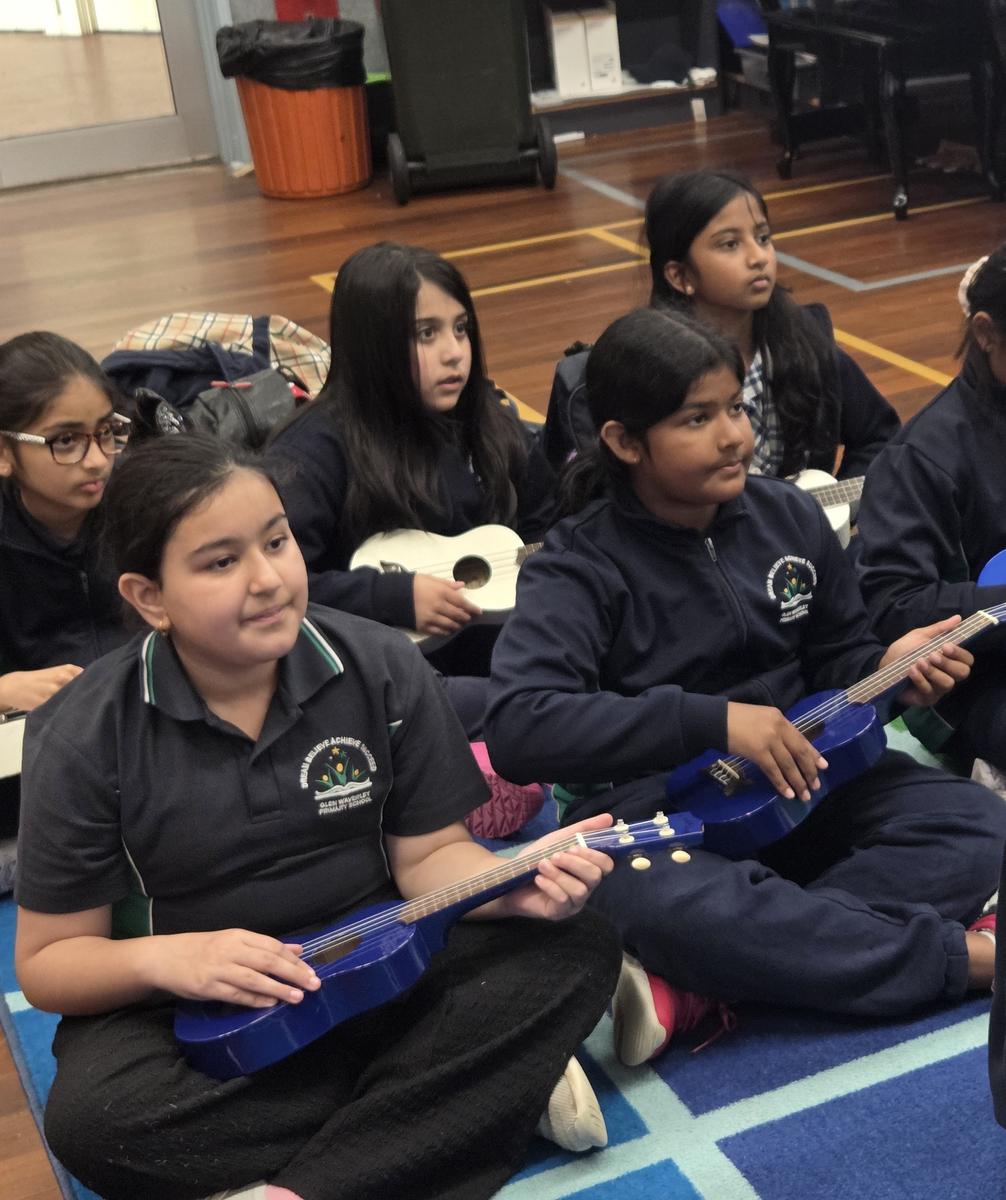
This term, Year 4 students will begin learning theukulele, developing their understanding of the instrument and building their confidence as musicians. Students will learn about the different parts of the ukulele, string names, correct posture and how to hold and care for the instrument safely.
Through practical activities and songs, students will develop their ukulele technique, learning to strum simple rhythms and play basic notes. They will practise changing between notes and develop their ability to maintain a steady beat while playing along with songs.
Students will have opportunities to apply their new skills by learning and performing songs individually and as part of a group. They will develop their ensemble skills by listening carefully to others, keeping in time and working together to create a cohesive performance.
Curriculum Links:
- sing and play music they have learnt and/or created to audiences in formal and informal settings VC2AMU4P01
- develop listening skills and skills for working with elements of music when singing and playing instruments VC2AMU4D01
Key Vocabulary: ukulele, strum, rhythms, ensemble skills
Year 5
During Term 4, Year 5 students will explore and expand their knowledge of the history and development of music, learning about key musical periods and a variety of genres. They will investigate the Baroque, Classical, Romantic and Modern periods, discovering the distinctive characteristics, instruments, composers and styles associated with each era.
Students will also explore a range of music genres, including reggae, jazz, rock, pop and folk music. Through listening activities, discussions and practical musical experiences, students will compare different styles and identify how features such as instrumentation, rhythm, melody, dynamics (volume) and tempo (speed) can vary between genres and periods. Throughout the unit, students will develop their listening and analytical skills by identifying and discussing the features of different pieces of music.
Curriculum Links:
- explore ways that the elements of music are combined to communicate meaning in music across cultures, times, places and other contexts including from Aboriginal and Torres Strait Islander Peoples VC2AMU6E01
- work with elements of music and use compositional devices to communicate ideas, perspectives and meaning when composing and practising music for performance, and, as appropriate to the style, document and/or record the music they compose VC2AMU6C01
Key Vocabulary: musical periods, music genres, rhythm, melody, dynamics, tempo
Year 6
Year 6 students will begin preparing for one of the special musical highlights of their final year of primary school - learning and performing their graduation song! Students will work together to learn the melody, lyrics and structure of the chosen song, developing their confidence and musical expression as they prepare for their graduation performance.
Throughout the term, students will practise singing with accurate pitch, clear diction and appropriate expression. They will focus on maintaining a steady tempo (speed) and singing together as a cohort. Students will also develop their ability to listen carefully to one another and work as an ensemble, ensuring their voices blend together during the performance.
As the term progresses, students will rehearse and refine their performance, working on memorising the lyrics and adding appropriate dynamics (volume) and expression. They will build confidence through repeated practice and develop their performance skills as they prepare to share their graduation song with their families, teachers and school community.
Curriculum Links:
- rehearse and perform music in a range of forms they have learnt and/or composed to audiences in informal and formal settings VC2AMU6P01
- work with elements of music and use compositional devices to communicate ideas, perspectives and meaning when composing and practising music for performance, and, as appropriate to the style, document and/or record the music they compose VC2AMU6C01
Key Vocabulary: melody, lyrics, structure, pitch, diction, tempo
How can you support your child’s art learning at home?
- Explore different genres of music that you wouldn’t normally listen to.
- Listen to your favourite movie soundtracks and discuss how the music sets the mood
- Make a family band! Everyone joins in with a song using their voice, instruments or homemade/makeshift instruments!