Teaching & Learning

How Students Learn Best
Attention, Focus and Learning
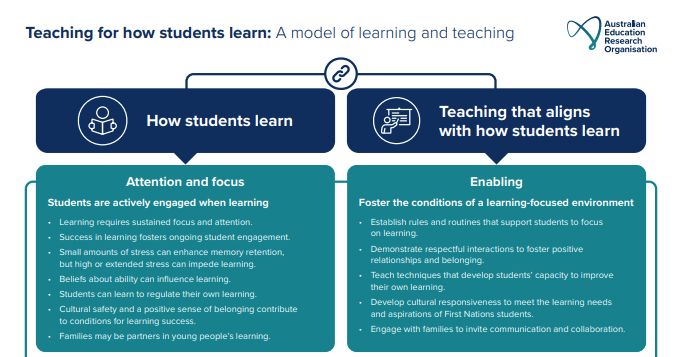
For students to learn successfully, they first need to focus their attention on what matters most. Research from the Australian Education Research Organisation (AERO) and the Victorian Teaching and Learning Model (VTLM 2.0) tells us that attention is the gateway to learning. Before new knowledge can be understood, remembered and applied, students need learning environments that help them feel safe, engaged and ready to learn.
At Whittlesea Primary School, we support students by creating classrooms that Enable Learning. Teachers establish predictable routines, clear expectations and positive relationships so students know what to expect and can focus on learning rather than managing uncertainty. Learning tasks are carefully planned to minimise unnecessary distractions, provide clear instructions and build confidence through achievable steps.
Teachers also recognise that every student is different. Some students may need movement breaks, visual supports, additional processing time or quiet learning spaces to help them regulate their attention and remain engaged. These adjustments ensure all students can participate successfully in learning. Once students are focused and ready to learn, teachers use evidence-informed practices to keep their attention on the learning goal.
This includes:
Clearly explaining what students are learning and why it is important
Breaking new learning into manageable steps
Modelling new skills before students practise them
Regularly checking for understanding and providing timely feedback
Providing scaffolded practice before students work independently.
By creating supportive learning environments and using explicit, adaptive teaching practices, we help students develop the attention, confidence and independence they need to become successful lifelong learners.
Research from the Australian Education Research Organisation (AERO) shows that families play an important role in helping children succeed at school. Small, everyday interactions can make a big difference to your child's learning, confidence and wellbeing.
Here are some simple ways you can support learning at home:
- Talk about learning every day - Ask your child what they learned, what they enjoyed and what challenged them
- Read together regularly - Reading books, magazines or recipes helps build vocabulary, comprehension and a love of learning
- Encourage effort and persistence - Praise your child's hard work, resilience and willingness to keep trying, rather than focusing only on results
- Practise everyday maths - Involve your child in cooking, shopping, measuring, telling the time or budgeting to build maths skills in real-life situations
- Create routines for learning - A regular time and quiet space for reading or homework can help children develop positive learning habits
- Support attendance - Coming to school every day, on time, helps children stay connected to their learning and friendships
Stay connected with the school - Read school communications, attend events where possible and talk with your child's teacher if you have any questions or concerns.
Working together, families and schools create the best opportunities for every child to grow, learn and achieve their best.
PREMIER'S READING CHALLENGE
The Premier's Reading Challenge is well underway. Remember to keep recording your challenge and choice books online at https://vprc.eduweb.vic.gov.au/home . If you are unsure of your child's login details, contact your child's classroom teacher via Compass. The challenge ends on the 4th September, so you still have 39 days to complete the challenge!
Number of books students should read to complete the Challenge
Students can read more books than the number set for the Challenge and keep adding these to their reading list.
Foundation – Year 2
Number of books: 30
Number of books from the Challenge book list: 20 or more
Year 3 – Year 6
Number of books: 15
Number of books from the Challenge book list: 10 or more