Wellbeing

Happy Holidays
Wishing all our staff, students and families a very happy and safe holiday break! We hope you have the opportunity to rest and recharge ahead of term 4.
While the holidays are a much-needed break from the usual school routine, a change in routine can sometimes be challenging, particularly when it comes to supporting positive physical and mental health. Maintaining some structure, staying connected, getting active and making time for rest can all help support wellbeing during the holidays.
Below you will find some helpful information shared by the Department of Education, including tips and strategies to support positive mental health and wellbeing during the holiday period.
They have also included a number of contact details for support services should you or your family need some additional help or someone to talk to during the break.
Remember, it is okay to ask for help, and support is available.
For parents and carers Wellbeing support for students during the school holidays
This guide provides tips and resources for parents, carers and families to support the mental health and wellbeing of children and young people in their care during the school holidays. This includes services to reach out to if more support is needed.
Actions that support positive mental health
Encourage your child or young person to:
Exercise and eat healthily to boost their mood
Prioritise sleep to support mental and emotional wellbeing
Explore relaxation techniques and coping strategies
Stay in touch and catch up with friends and loved ones
Make time to do things they enjoy
Practice positive self-talk, and remind them they are not alone
Engage in healthy online habits
Seek professional help if needed.[1]
The department has developed wellbeing activities and conversation starters for parents and carers of primary school-aged children and secondary school-aged children.
Feeling it: mindfulness resources and activities for secondary students. Smiling Mind gives tips on self-care, understanding and managing emotions, being mindful, being kind to yourself, navigating uncertainty and preparing for change.
Signs a child or young person may need mental health support
In some cases, these actions will not be enough to support positive mental health.
Keep an eye out and seek professional help for changes that last two or more weeks such as:
Loss of interest or involvement in activities normally enjoyed
Feeling ‘low’, unusually stressed or worried
Doing ordinary things gets harder
Being easily irritated or angry
Taking more dangerous risks, like using alcohol or drugs
Withdrawal or feeling overwhelmed
Difficulties with concentration and motivation
Having a lot of negative thoughts
Changing sleeping and eating habits.[2]
Young people supporting each other
Young people are most likely to turn to each other for support before seeking out an adult or service provider.
Young people can support each other by:
contacting 000 if a friend needs urgent assistance or is at risk of harming themselves or others
reaching out to a friend, offering support and letting them know you care
letting their friend know they may need to tell a trusted adult about their concerns.
Having these types of conversations can be difficult for young people. Information for young people on how to support a friend is available via:
the Mental Health and Wellbeing Toolkit: If you or a friend need help with mental health
Mental health resources
Supporting your young person during the holidays (headspace)
Mental Health and Wellbeing Toolkit (Department of Education)
Raising Learners Podcast Series: providing expert advice and information to parents and carers on topics including how to keep your child safe online
Learn how to handle tough times (headspace)
Get into life (to keep your headspace healthy) (headspace)
Online wellbeing and safety
Safe Socials (Department of Education)
ScrollSafe (Orygen)
Mental health support
Contacting 000 for urgent assistance
Your local GP for a mental health plan and referrals
headspace Counselling: Young people aged 12-25 can access counselling services from headspace. During the holidays, students can call their local headspace centre
eheadspace: 1800 650 890 www.headspace.org.au/eheadspace
Kids Helpline: 1800 551 800 www.kidshelpline.com.au
Lifeline: 13 11 14 www.lifeline.org.au
Beyond Blue: 1300 224 636 www.beyondblue.org.au
Head to Health: 1800 595 212 https://www.medicarementalhealth.gov.au/head-to-health-clinics-victoria
Thank You!
As the term comes to an end, I’d like to take a moment to acknowledge and thank those who quietly work away in our Wellbeing Space, supporting our students, families and staff throughout the term.
Jacinta, our School Nurse, thank you for the support you provide to individual students and families, helping to manage health concerns and ensuring our students are supported to be happy, healthy and ready to learn.
Baelea, our Occupational Therapist, has been incredibly busy working alongside staff throughout the term. Thank you for sharing your knowledge, providing practical advice and supporting staff to ensure our classroom practices are inclusive and best support our students to learn and participate.
Emily, our Headspace Mental Health Clinician, thank you for providing weekly support to our students and families, as well as sharing valuable knowledge and education with our staff to help us better support student mental health and wellbeing.
Thank you all for the important work you do behind the scenes. Your support, knowledge and commitment make a real difference to our students, families and staff, and we are very grateful to have you as part of our school community.
Our wonderful Education Support staff — Heidi, Danielle, Jess, Ebony, Jac, Elise, Claudia, Emily and Bec — deserve a special thank you for everything they do throughout the school day.
Whether providing individual support to students, working with small groups, assisting in classrooms or supporting staff, your contribution makes such a difference to the wellbeing, inclusion and learning of our students.
Thank you for your patience, care, flexibility and willingness to step in wherever you are needed. So much of what you do happens quietly behind the scenes, but please know that it does not go unnoticed and is very much appreciated.
R U OK? Day
Last Thursday, 10 September, our Year 7–9 students and VET Sports, Aquatic and Recreation studnets had a great opportunity to hear from guest speaker Tom Dunn, who shared his story of being an ‘ordinary’ kid who has gone on to do some pretty extraordinary things!
Tom took students on a journey through his experiences, adventures and travels, sharing stories that had everyone captivated. His message reminded students that you don’t have to be extraordinary to achieve great things — sometimes it’s about being open to opportunities, having a go and seeing where life takes you!
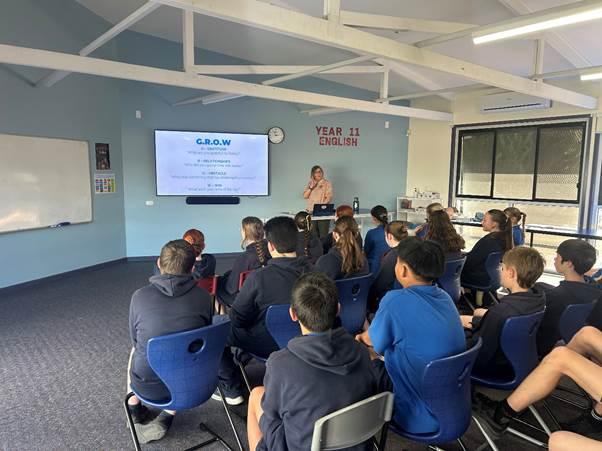
Students then got involved in some fun and practical connection sessions with Pam McConville from the LLEN. Through a range of activities, students explored what it means to build meaningful connections with others and picked up some handy tips for starting conversations — even when you’re not quite sure what to say!
From listening to an inspiring story to practising the art of conversation, it was a great day of connecting, learning and stepping outside our comfort zones.
A big thank you to Tom and Pam for their time they gave as well as Claudia Cox from the LLEN in all her organising to make this opportunity possible.