
Mathematics News
Conchita Thomas
( Maths Leader)
Mathematics News
Conchita Thomas
( Maths Leader)
Welcome back everyone, to what has been a great start to Term 4!
Throughout the year, we have been developing our students’ mathematical fluency, building strong number sense and deepening their understanding of place value. Partitioning has been an important strategy in this learning, helping students understand that numbers can be broken apart and recombined in different ways. It involves breaking numbers into smaller parts in different ways to help children understand place value, develop mental computation skills and solve problems efficiently. For example, understanding that 46 can be partitioned into 40 and 6, or 30 and 16, or 20 and 20 and 6, helps students see numbers flexibly and use this knowledge to solve calculations more efficiently. Here are some more examples for larger numbers:
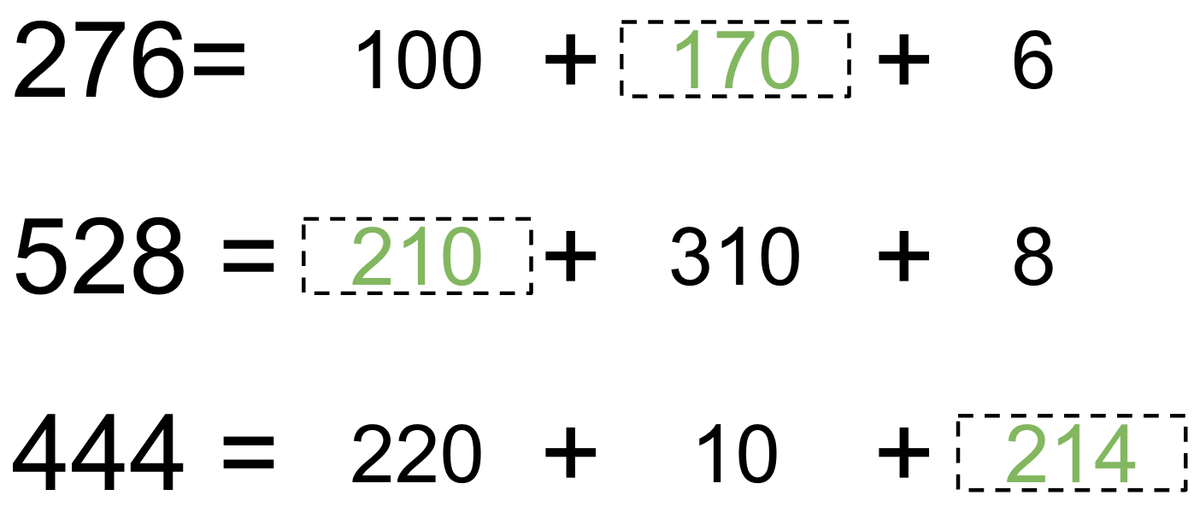
These experiences support students to move beyond counting by ones towards using more efficient mental strategies for addition, subtraction and other operations. They also encourage students to explain their thinking, recognise patterns and choose strategies that make sense to them.
Partitioning supports learning in the Number strand of the Victorian Curriculum F–10 Mathematics Version 2.0. Whilst it contributes to children's understanding of place value, the relationships between numbers and efficient calculation strategies, the activities also develop the four mathematical proficiencies:
As we continue to strengthen these skills, families can support learning at home by encouraging children to break numbers apart, find different combinations and explain how they reached an answer. Asking questions such as “How else could you make that number?” or “Can you break that number apart to make the calculation easier?” helps develop flexible thinking and confidence.
Example:
To solve 8 + 7, partition 7 into 2 and 5.
Add 2 to 8 to make 10,
then add the remaining 5 to make 15.
Or 48 + 27 = 48 + 2 = 50 + 25 = 75.
This strategy helps children see how numbers relate to one another rather than relying on counting every object and develops efficient mental calculation strategies for solving problems. Below is a game that you could play with your children, to help practise partitioning, to support adding mentally.
What you need: Number cards, paper and pencils, or counters ( or other manipulatives that help with counting that you might have at home eg buttons, pasta etc)
How to play:
Example: A player draws 24 and partitions it into 20 + 4. If their current total is 35, they calculate 35+20+4=59
Why this game works: Children practise breaking numbers apart and recombining them while making decisions about how to reach the target. They also develop confidence explaining their calculations.
Finally, when my own children were in primary school, I remember they would come home with maths puzzles for families to solve. At home, my daughters and I would become engaged in animated discussions as we explored different ways of solving each problem. These experiences were not only enjoyable but also provided wonderful opportunities to develop mathematical language, reinforce mathematical concepts and strategies, and build positive attitudes towards maths. Working together encouraged us to explain our thinking, listen to different perspectives, take risks, try unfamiliar approaches and recognise that making mistakes is a valuable part of learning.
Each newsletter this term, I will be providing some puzzles that families are invited to solve together. The solutions will be provided in the following newsletter.
Email to let me know how you go with one or all of the following:
Puzzle 1
What number am I?
I am odd.
I am 5 times a number.
My digits add to 6.
What number am I?
Puzzle 2
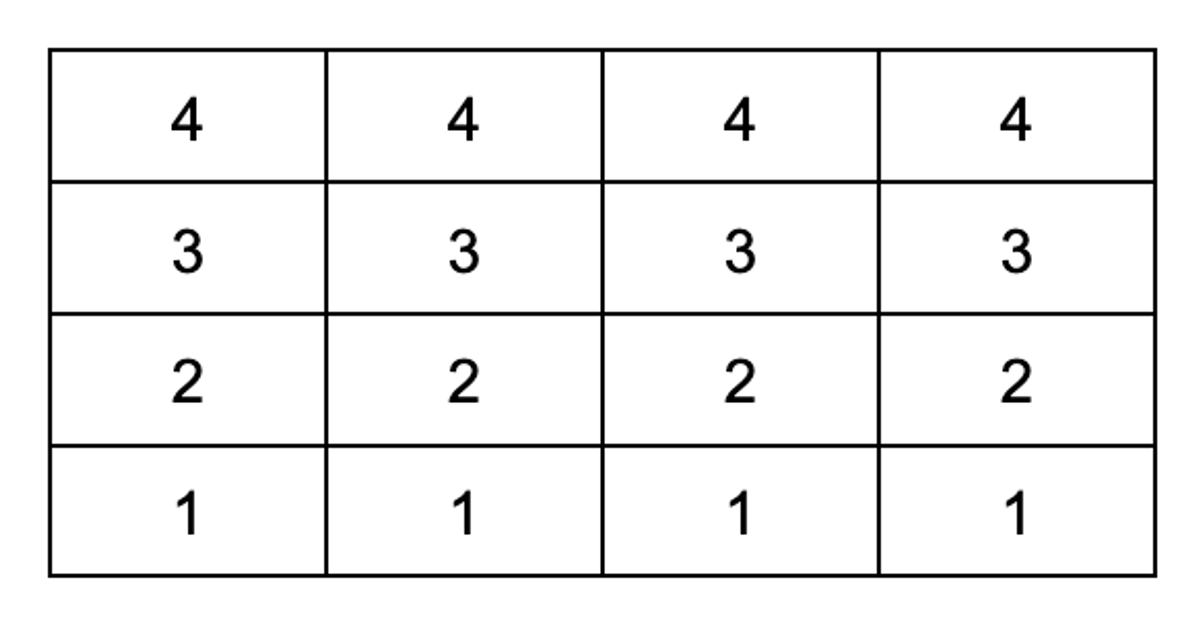
Rearrange the numbers so that the sum of the numbers in each row and each column is 10. Find as many ways as possible of doing this. Email to me all the options that you found and I will announce in the next newsletter the family/ families that found the most.
Puzzle 3
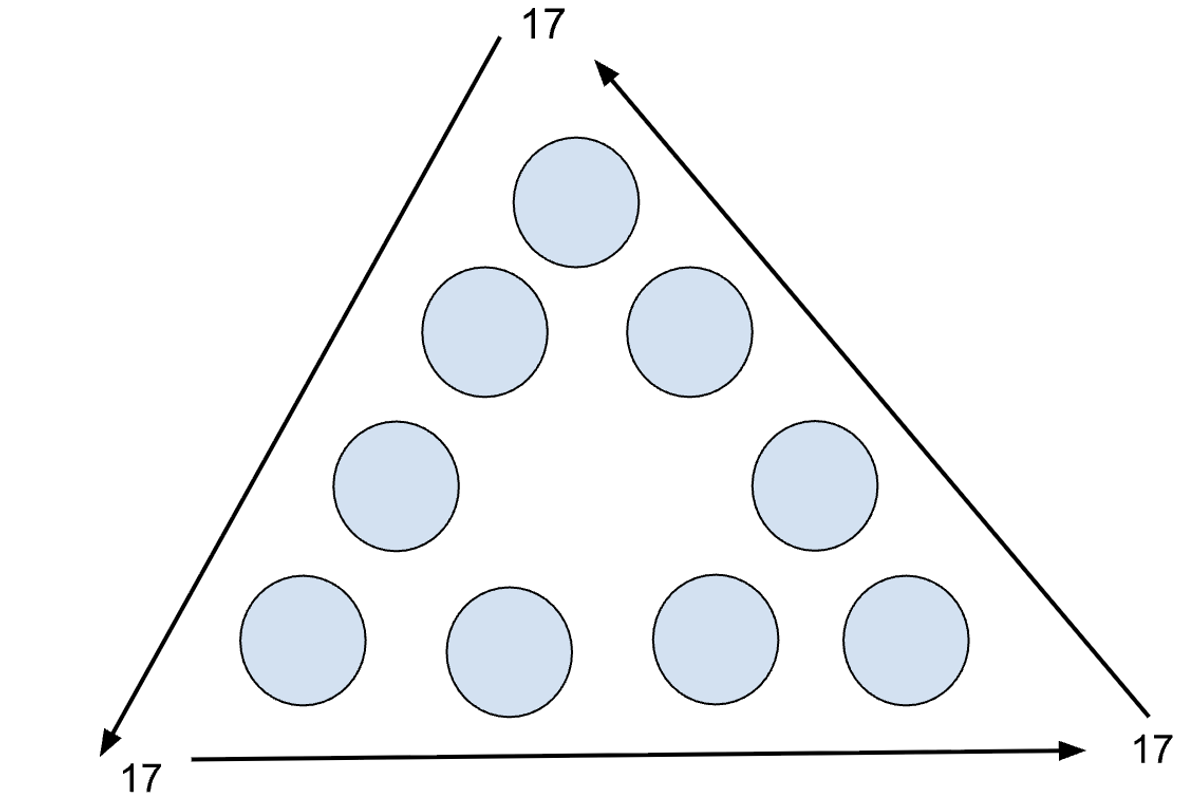
Using the numbers 1 to 9, place them in each circle so that the sum of each side of the triangle is 17. Each number can only be used once. Is there only one solution?
Happy partitioning and puzzle solving everyone!
Kind regards,
Conchita Thomas
Maths Leader