Science

Grade 1
After discussing and establishing that plants need fresh air, water and sunlight to help them to grow and remain healthy, Grade one have been working in teams to investigate what happens to plants and how they change when not provided with optimal growing conditions. Plant germination and growth depend on the requirements of the plant and its environment. Most plants tolerate some variability in their environment, such as high and low temperatures, over the course of a day and/or a year. The closer conditions are to optimal for a particular species, the more likely they are to grow rapidly (compared to similar plants in different conditions) and/or flower more rapidly and more abundantly
Students have discussed what things might affect plant growth, used their senses to observe and measure plant growth and recorded their observations using a drawing. They have enjoyed observing just how much a small primula seedling can grow in just one week. At the conclusion of this investigation, we will plant the primulas into the Foundation garden boxes for everyone to enjoy.
Grade 2
Having recently been on a ‘Schoolyard Safari’ to find living creatures in the Peaceful Garden, students have focussed more directly on what they know about Earthworms.
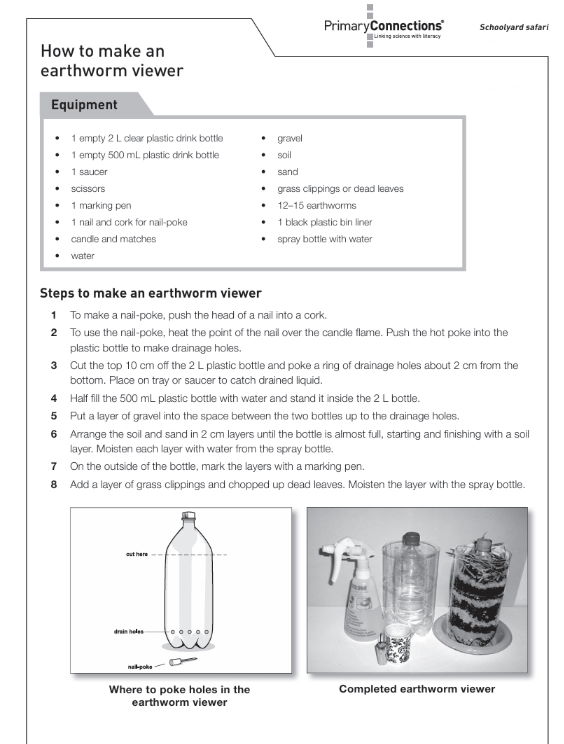
Students have been able to observe and draw the features of an earthworm, observe and describe earthworm movement, identify features of earthworms that allow them to breathe, feed, move and protect themselves underground and each class has had the opportunity to make their own Earthworm viewer - an earthworm habitat where they can see the worms moving. This can be created simply at home with some easily accessible resources –
Did you know - Earthworms are annelids, which means ‘ringed’ animal. They are cylindrical animals without a backbone (invertebrate). They are divided into segments. While they don’t have lungs, they have very thin skin through which they absorb oxygen and expel carbon dioxide. As their skin is permeable, they can lose water by evaporation, and it is important that they do not dry out or they will not be able to ‘breathe’. Earthworms have primitive eyes, which allow them to avoid sunlight and therefore avoid the surface of the Earth, where they could be eaten by birds. They are one of a host of organisms that processes the world’s organic matter and helps maintain ecosystems. The earthworm’s body is divided into ring-like segments. Each segment has eight tiny bristles, called setae, which enable the earthworm to ‘grip’ the soil and move along. Adult earthworms have a clitellum near the head end of the body, which is part of the reproductive system. It is often called a saddle because it is a thickened, usually paler coloured, saddle-shaped area. Earthworms have two sets of muscles. They have circular muscles around each segment, which the earthworm tightens to stretch out, becoming long and thin. They also have a longitudinal set of muscles running along the length of their bodies. These compress the earthworm, making it shorter and fatter. Earthworms move by using their bristles (setae) to anchor themselves and push through the soil. If they can squeeze into small cracks they force their way through; otherwise they eat their way through. The mouth of an earthworm is folded in on itself. When earthworms eat, they fold out this front section and pull the soil or organic material back into the top of their digestive tract. The digested remains are deposited as manure or castings, which make the ground more fertile.
Grade 3
Students have continued to investigate and learn to describe the features that all living things share. They have based this on the acronym MRS GREN
M -Movement R – Respiration S – Stimuli G – Growth R – Reproduction E – Excretion N - Nutrition
MRS GREN helps us list the features of living things if something cannot do all of these things – they are simply not a living thing!
Students have also used a continuum to show how living things are different in how they move and placed organisms along a continuum for each life characteristic MRS GREN. We are currently learning to describe these features that all living things share including that all living things are made up of these microscopic parts called cells.
Grade 4
After learning to identify the features of producers and consumers in an ecosystem by analysing the interactions between living and non-living things in a particular ecosystem, students have been able to categorise consumers based on their diets. (Consumers - A consumer is a living thing that gains its energy by feeding on other living things. All animals get their energy from eating other living things, whether those living things are plants or other animals. This means that all animals are consumers. They consume other living things for food.)
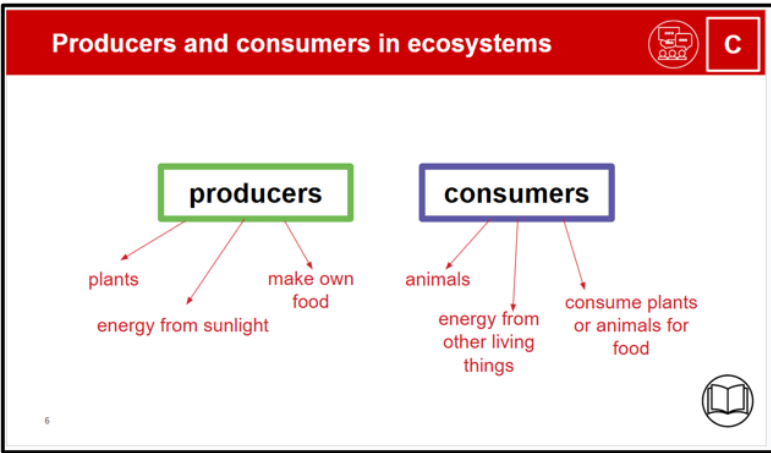
Now that they know the difference between producers and consumers and how they are reliant on each other for survival, we are delving deeper into how this occurs including learning to identify the features of decomposers and identify the three main types of decomposers in an ecosystem. Decomposers are an important part of any ecosystem, because they help the nutrients from dead matter and waste re-enter the environment. The 3 types of decomposers – Bacteria (microorganisms - tiny living things that cannot be seen with the naked eye - that live everywhere on Earth and can break down any type of dead matter or waste, as there are thousands and thousands of bacteria species, potentially more.), Fungi (can be collections of microorganisms (like mould) or microorganisms (bigger living things like mushrooms). Both mould and mushrooms can break down dead things and waste and are often more familiar than bacteria as they can be seen with the naked eye) and Detritivores (insects and worms) -are animals that are decomposers. This category comprises not only worms, but also insects like maggots, termites and dung beetles. Each decomposer animal specialises in breaking down different types of things. For example, dung beetles break down poo, termites break down dead plant matter, maggots break down dead animals and waste, and worms can often break down all types of dead matter and waste.
Grade 5
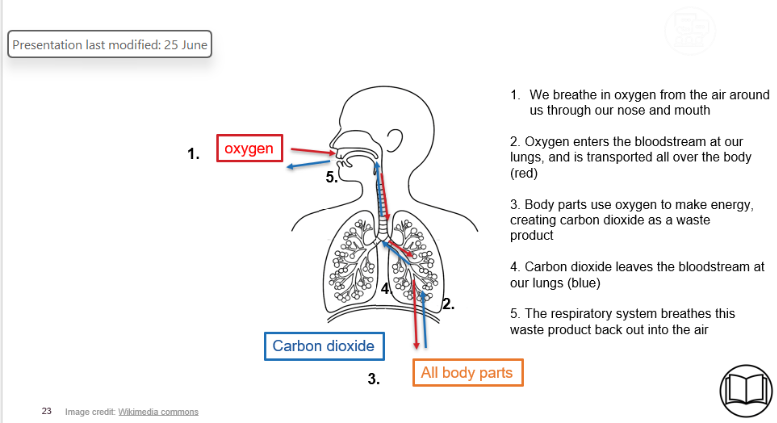
Students continue to describe how the parts of the human body work together to get what it needs from its environment to grow and function. Students have been able to identify organs, their functions and that when they work together, they make up a body system. Using these, our bodies need oxygen, energy, nutrients, and to get rid of waste, and we have looked at how we meet these needs. Last week we had a closer look at the respiratory system – its parts, role and its functions. This has sparked some interesting discussion, especially about how the transfer of oxygen occurs and then the transfer and release of carbon dioxide from our bodies.
Grade 6
We are learning to describe the physical features of a habitat and how they can change over time. Students have identified and described the physical features of a habitat, identified and described the microhabitats found in a habitat and explained different ways habitats can change over time. To do this we have looked at how Port Phillip Bay has changed over tens of thousands of years.
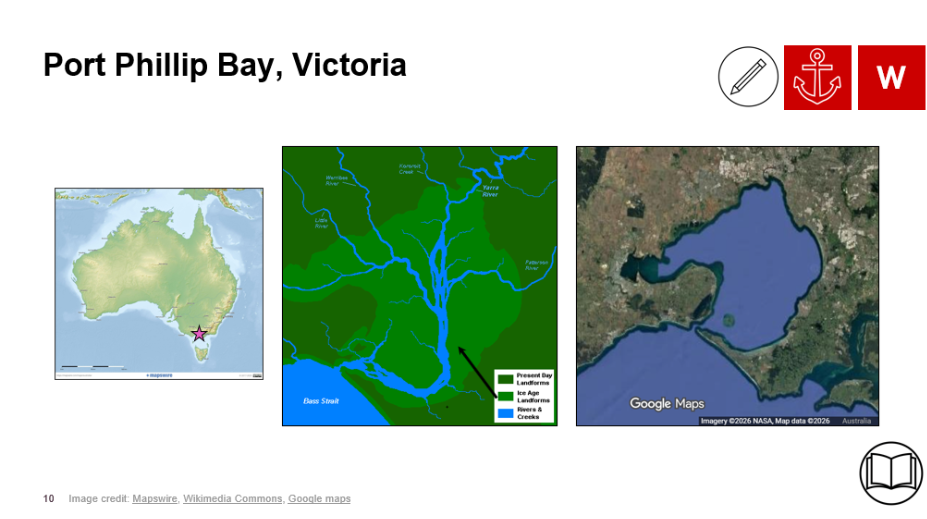
There are several different types of habitats including Forests, natural temperate grasslands, arid, alpine, aquatic, and urban and these habitats are changing all the time. Habitats change can be predictable to unpredictable, small to catastrophic, slow to fast, and natural or human driven. Thes changes effect a habitats food supply, shelter within it, breeding grounds, animal and plant populations and biodiversity.