Dean of Middle Years
Mr Sam Yeats
Dean of Middle Years
Mr Sam Yeats

We are proud to share the recently finalised 2026 NAPLAN results. NAPLAN provides a snapshot of student performance at a specific point in time, assessing key areas such as spelling, grammar and punctuation, reading, writing, and numeracy. While these results are just one of many tools we use to understand student progress, they offer valuable insights into both individual and collective learning.
At Mount Alvernia College, NAPLAN data is one of several indicators used to identify strengths and opportunities for growth. Our teachers and Extended Leadership Team thoughtfully analyse this information to refine teaching programs and provide targeted support where needed.
A summary of the College’s overall performance is included in the tables below for your reference.
Table 1: Mt A Year 7 NAPLAN 2026 compared with Year 7 NAPLAN State Mean
G and P | Spelling | Writing | Reading | Numeracy | |
| School Mean 2026 | 579 | 551 | 568 | 555 | 558 |
| State Mean 2026 | 527 | 531 | 517 | 526 | 535 |
| % Year 7 School Difference from State Mean 2026 | 9.9% | 3.8% | 9.9% | 5.5% | 4.3% |
Table 2: Year 7 Historical Means (2021 – 2026)
2021 | 2022 | 2023 | 2024 | 2025 | 2026 | |
| Writing | 554 | 563 | 567 | 586 | 588 | 568 |
| Reading | 574 | 574 | 577 | 571 | 578 | 555 |
| Spelling | 570 | 572 | 556 | 551 | 557 | 551 |
| G and P | 584 | 579 | 584 | 581 | 586 | 579 |
| Numeracy | 573 | 582 | 566 | 558 | 564 | 558 |
Table 3: Mt Alver Year 9 NAPLAN 2026 compared with Year 9 NAPLAN State Mean 2026, and distance from State Mean as a Year 7 cohort 2024
G and P | Spelling | Writing | Reading | Numeracy | |
| School Mean 2026 | 621 | 582 | 641 | 601 | 593 |
| State Mean 2026 | 547 | 561 | 556 | 553 | 559 |
| % Difference from State Mean Year 9 2026 | 13.5% | 3.7% | 15.3% | 8.7% | 6.1% |
| % Difference from State Mean when same cohort was in Year 7 2024 (same cohort) | 6.9% | 5.6% | 9.4% | 5.3% | 6.3% |
Table 4: Year 9 Historical Means (2021-2026)
2021 | 2022 | 2023 | 2024 | 2025 | 2026 | |
| Writing | 588 | 607 | 631 | 644 | 659 | 641 |
| Reading | 594 | 614 | 614 | 605 | 608 | 601 |
| Spelling | 597 | 601 | 593 | 587 | 583 | 582 |
| G and P | 598 | 622 | 625 | 631 | 627 | 621 |
| Numeracy | 596 | 620 | 600 | 598 | 591 | 593 |
Both our Year 7 and Year 9 cohorts of 2026 have performed above the state means in every domain. For our Year 9s, it is particularly encouraging to note the growth of this cohort since joining the College in Year 7.
It is also important to view these results within the context of the revised NAPLAN testing schedule. Since 2023, NAPLAN has been held in Week 7 or 8 of the academic year rather than in May (Term 2). This means students complete the assessments after only a short time in their new year level. At Mount Alvernia College, we use this data to celebrate strengths, identify opportunities for growth, and ensure every student is well supported to continue their learning journey.
These outcomes are a testament to our students' commitment to learning and the dedication of our teaching staff. Our teachers continually refine their practice and work collaboratively to strengthen literacy and numeracy across every learning area. Their expertise, care and high expectations help create the strong foundations that enable our students to grow in confidence, embrace challenge and achieve success both at school and beyond. Well done to our students, their families and their teachers.
In looking ahead to this term, the new semester brings about reflection and goal setting opportunities. I am confident that many students reflected on their Semester 1 results and feedback in their recent Home Room Mentor teacher meetings. In doing so, it is not unusual for a student to simply conclude that they need to ‘study more’. In our experience, often it is not just the ‘how much’ study that makes a difference, but also the ‘what’.
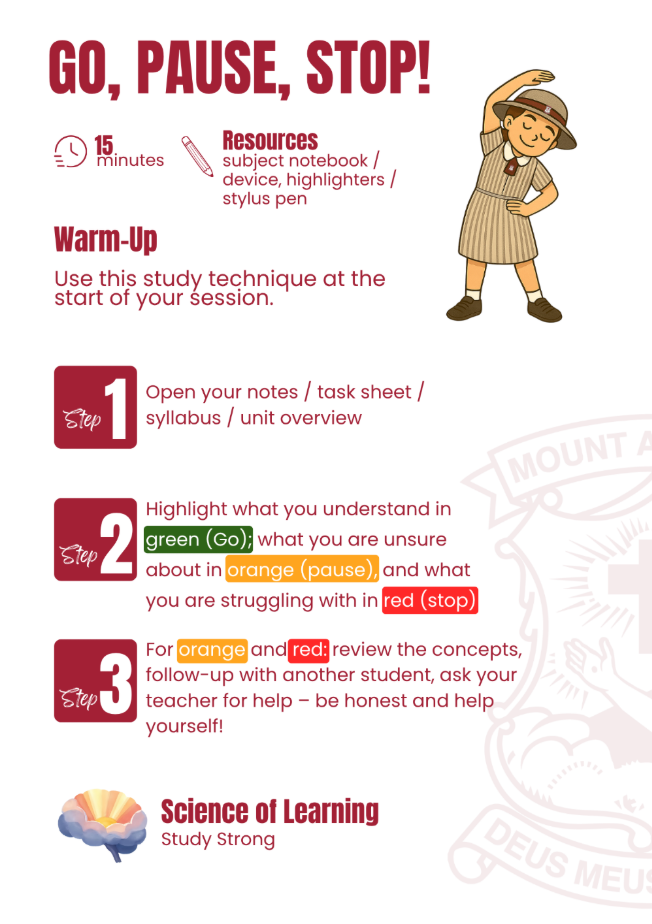
Earlier in the year, I shared the Brain Dump technique – a great way to quickly show what you know, what you need to know, and where to focus next. In this newsletter, I will share the ‘Go, Pause, Stop!’ technique, which is another method to self-check your own learning. This technique is best used throughout a unit of learning (typically from Weeks 1-5 in the middle years at Mount Alvernia College) and is an excellent technique to recommend when your child says “I don’t have any homework” for a subject. Completing one of these per topic, per subject would help a student identify their strengths and areas of growth, ensuring that they grasp an idea or skill before moving on to something else.
Some effective ways to use a Go, Pause, Stop!