
Year 1 Term 3 Newsletter

Welcome to Term 3
Welcome back to all our students and families. We hope everyone enjoyed a relaxing and refreshing holiday break.
Term 3 promises to be a busy and exciting time in the classroom as students continue to build their skills and confidence across all areas of learning.
There are many special events to look forward to this term, including the much-loved Book Week, where we will celebrate the joy of reading through stories, activities and our annual dress-up parade. Students will also enjoy a visit from Fizz Kids, bringing a hands-on science experience that is sure to spark curiosity and excitement about our Humanities weather unit.
We look forward to another fantastic term of learning growth and fun, and we thank you for your continued support.
Yvonne, Tegan, Sonia and Chelsea
General Reminders
Please remember to wait outside the building at drop-off and pick-up times – no parents in the corridors. Your support helps us create a calm and orderly environment for our students.
We also kindly ask that parents and family members please avoid standing directly in front of the 1A and 1B classroom windows after school drop-off and before dismissal, as this can be distracting for our students and can interrupt classroom routines and learning time.
Given the cooler weather, please ensure students are dressed appropriately with school jumpers, long pants and beanies. Please ensure all uniform items are labelled, as we are still finding many unnamed items.
Please pack a recess snack, a fruit break snack and lunch for your child each day. We continue Nude Food again this term with the aim of bringing less rubbish into lunchboxes. Fruit break must be a piece of fruit, yoghurt or cheese, as we only have 10 minutes to eat. Please avoid including products with nuts in lunchboxes in support of those students with allergies. Water bottles are kept in the classroom for easy access and to encourage your child to hydrate regularly.
Finally, thank you to the families who have already done so, but please ensure that you let your class teacher know well in advance if you have a family holiday planned during the school term, in addition to putting it on to Compass.
Specialist Timetable
Specialists | 1A | 1B | 1C |
|---|---|---|---|
Music (Tamara Spain) | Wed | Thurs | Thurs |
Italian (Stella Mondy) | Thurs | Thurs | Thurs |
Art (Suzanne Reid) | Thurs | Thurs | Tues |
| PE (Bec Robinson) | Fri | Fri | Tues |
Science (Louise Slann) | Mon | Tues | Mon |
Library | Tues | Mon | Wed |
Important Dates
10/08: Fizz Kids Incursion
24-27/08: Book Week 'Symphony of Stories'
25/08: Book Week Parade
31/08: Year 1 Music Concert 2:15
18/09: Last Day of Term- 2:30 dismissal
Parent Helpers
At CEPS, we highly value working together as a whole community and actively encourage family participation and involvement. Throughout the year, we will be seeking helpers for excursions and incursions, please keep an eye on Compass for opportunities to assist.
We also greatly appreciate parent helpers who can support students with reading. Parents are warmly invited to assist during Session 6 (2:40–3:20 pm). A dojo has been or will be sent out shortly outlining the days your child’s teacher is seeking help.
When helping with the children at CEPS, it is required that you wear a Working With Children’s Check (WWCC) displayed on a lanyard at all times.
If you have not got a WWCC and wish to volunteer, application forms can be found online at: www.workingwithchildren.vic.gov.au
Remember to sign in each day you volunteer at CEPS via the computer at the office. This is a mandatory requirement. You will also be required to sign out.
Attendance
Our rolls are legal documents, therefore we must be accountable for any absences. Please assist with this by informing the school through Compass, email or phone call to record the absence. Late students need to be signed in at the office by a parent/caregiver and collect an orange pass to present to their teacher on arrival at their classroom.
Teaching and Learning
English
Reading
This term, students will continue to participate in daily phonics sessions. Our phonics program is designed to reinforce and build upon students’ existing knowledge, introducing them to new sound (code) representations such as /ay/ and /ai/. These sessions aim to enhance their decoding skills and support reading development.
During reading sessions, teachers will work closely with each child to develop proficiency in fluency, accuracy, and comprehension. We will explore a variety of fiction and nonfiction texts, engaging in discussions to deepen their understanding and make connections to their own experiences.
Additionally, your child will be read to daily, with high-quality picture books used to model comprehension strategies such as sequencing and retelling. These activities support the development of critical thinking and help students articulate their thoughts about the texts they encounter.
Writing
As part of their writing development, your child will be guided to write words and sentences with correct letter formation, sizing, and punctuation. They will also be encouraged to expand their vocabulary and practice correct grammar. Our main focus will continue to be on sentence structure and writing and adding more detail. We will also explore recounts and narratives.
Speaking and Listening
This term, we will continue to focus on enhancing your child’s speaking and listening skills. Students will be encouraged to actively participate in class discussions, sharing their thoughts and experiences respectfully during group activities and yarning circles.
We will continue to listen to each student share what they did with our class bear upon its return.
Mathematics
This term in Maths, students will focus on the units of addition and subtraction, time, length and patterns. Learning will follow a clear daily structure using the gradual release model, starting with a daily review and moving through I do, we do, you do to build confidence and independence.
Our Addition and Subtraction unit focuses on supporting students to move beyond counting objects and begin developing more efficient strategies for solving addition and subtraction problems. It builds students’ understanding of numbers within 20 and connects concrete materials, drawings, equations and mathematical language. The goal is for students to become flexible thinkers who understand numbers, rather than relying only on counting one-by-one.
During our Time unit, students develop their understanding of time by exploring the order and duration of everyday events. They learn to sequence activities throughout the day and week using time language such as before, after, first, next, morning and afternoon. Students explore calendars, days of the week, months and recurring events to build their understanding of how time is organised.
Students also develop their ability to compare the duration of events by identifying which activities take longer or shorter amounts of time. They use everyday experiences to describe and compare how long activities last and develop the language needed to talk about time.
Our Length unit develops students’ understanding of length by comparing, ordering and measuring objects. They learn to describe length using mathematical language such as longer, shorter, taller and smaller. Students explore how to compare objects directly, estimate lengths, and measure using informal units while recognising the importance of using consistent units and starting points.
Finally, our Patterns unit develops students’ understanding of patterns by identifying, creating and continuing repeating patterns. They explore patterns using objects, shapes, colours, sounds, movements and numbers. Students learn to recognise the repeating part of a pattern and use this understanding to predict what comes next.
Students further develop their ability to describe patterns, explain the rule that creates a pattern, and identify when something does not follow the pattern. They begin to explore number patterns and make connections between patterns and mathematical thinking.
Humanities
In this unit, students explore weather and how it changes over time. They learn to observe and describe daily weather conditions using appropriate vocabulary and explore how weather affects the way people live, work and play.
Students investigate different types of weather, including sunny, rainy, windy and cloudy conditions, and develop their understanding of how weather patterns can be observed and recorded. They use tools such as weather charts, symbols and observations to collect and communicate information about weather.
Students also explore how people respond and adapt to different weather conditions by considering how weather influences clothing choices, activities, homes and daily routines. They develop their ability to ask questions, make observations and share information about the world around them.
We will conclude our unit by writing and presenting our own weather reports, allowing students to apply their understanding of weather observations and terminology. We are also looking forward to our exciting weather incursion with Fizz Kids in August, where students will further explore the science behind weather.
Well Being
Students will continue their learning through the Respectful Relationships program. This term, they will explore important topics such as how to respond when someone doesn’t want to play, ways to manage worries, and how different emotions—like happiness, sadness, and excitement—feel in our bodies. We will also be learning about personal space: what it means, how to recognise when someone is in our personal space, and how to respond respectfully.
CEPS VALUES
COURTESY RESPECT CO-OPERATION RESPONSIBILITY
Each week, all classes will continue to engage in Respectful Relationships lessons, discuss our CEPS Skill of the Week and have regular yarning circles. These lessons will encourage the development of skills that promote our school values and the positive and personal growth of all students.
In Year 1, we continue to give out weekly awards on a Friday afternoon assembly for students who have displayed the CEPS values. We will contact you through Compass if your child is receiving an award.
Your child may receive a CEPS raffle ticket for displaying the expected positive behaviours! Award winners will be drawn and announced during assembly on Friday afternoons.
Supporting learning from home
Please ensure you listen to your child read for at least ten minutes each night, and take time to read to them as well. Students will bring home one decodable reader (or a chapter book if they have successfully made their way through the decodable levels) and two free-choice books (please ignore any numbers assigned to the free-choice books).
We also encourage students to practise the high-frequency words sent home each
fortnight. The first list this week came home on Monday 20th July.
We hope you enjoy reading and sharing the library books your child borrows at home. Please ensure these are returned in your child’s library bag on their scheduled library day.
Mathletics tasks will be assigned across the term. These tasks provide helpful insight into the learning taking place in class. Your child’s login details and password have been provided.
Please also practise skip counting forwards and backwards in 2s, 5s, and 10s from any starting point up to 120.
Weekly Routines
Before School
At 8:57 am, students will hear the music signalling it's time to line up. We kindly ask that students have their school bags ready and wait at their class's designated spot. We understand mornings can be busy, but please do your best to ensure your child arrives on time, as learning begins promptly at 9.00am.
After School
At the end of the day, students will be collected from the eating area. Students attending Team Kids will be collected by Team Kids staff from their classroom. If you’re running late or unable to pick up your child by 3:30 pm, please call the office as we don't check dojo during class time.
Friday Assembly
Students will attend assembly every second Friday at 3.00pm. After assembly, children will return to their classroom for collection to go home. Our first assembly was Friday 24th July.
Communication
You are welcome to contact your classroom teacher via email through Compass. Whilst families are navigating the transition to Compass, we are also still using Dojo for messages between parents and teachers at this stage. This is likely to be phased out at some stage this year. We are also still currently using Dojo to share learning updates from our classrooms.
With that said, you are always more than welcome to pop into the classroom before or after school if you have any queries or concerns.
Whilst we endeavour to get back to you promptly, please understand that we are often unable to check these messages until after 3:30pm. If you need an important message to be passed on to your child, we ask that you communicate this via the office (e.g. to advise that your child will be collected early or by another family member). The office will then pass the message on to your child's classroom teacher.
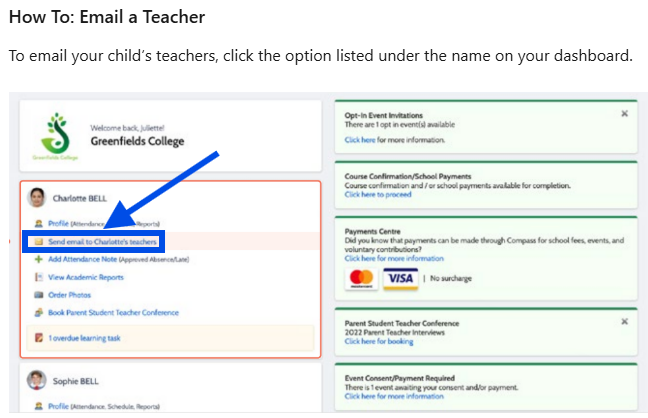

Compass: Compass is the formal tool for communication regarding attendance, payments, excursions, camps, permission forms, school reports, etc.
Please use Compass to advise the school in a timely manner of all student absences.
Early Pick Up: If you need to pick up your child early, please collect them from the office area and be sure to sign them out. You will require an Early Leaver's Pass, provided by the office staff, before we are able to dismiss students.
You can also keep up-to-date by using the school website and weekly newsletters: http://www.cheltenhameast.vic.edu.au