
Year 3 Term 3 Newsletter

Meet the teaching team
3A - Kate Burman (PLC Leader)
3B - Emma Cecil (alternate Mondays, Tuesday, Wednesday)
- Lauren Harris (alternate Mondays, Thursday, Friday)
3C - Bec Taylor
Welcome to Term 3
A big congratulations to all students for their fantastic achievements in Semester 1. This Semester we will revise and consolidate what students were taught in Semester 1 and build new knowledge and skills to progress their learning. This term we will be investigating real life topics such as deforestation and sustainability, which will be informed by our excursion to Healesville Sanctuary in August.
Specialist Timetable
Specialists | 3A | 3B | 3C |
Music (Sue Digby) | Mon | Mon | Mon |
Art (Suzanne Reid) | Wed | Thurs | Wed |
Italian (Stella Mondy) | Wed | Thurs | Mon |
Science (Louise Slann) | Mon | Wed | Wed |
PE (Bec Robinson) | Fri | Wed | Fri |
Library | Tues | Tues | Tues |
Important Dates
31/07: Silent Disco (during school)
14/08: Y3-6 Assembly
17/08: 3-6 House Athletics Carnival
18/08: Special Food Day
20/08: Excursion to Healesville Sanctuary
24/08 - 27/08: Book Week- 'Symphony of Stories'
25/08 Book Parade
28/08: Y3-6 Assembly
4/09: Father's Day Stall
10/09: Special Food Day
11/09: Y3-6 Assembly
14/09: District Athletics
18/09: Last Day of Term - Whole School Assembly. Early dismissal 2.30 pm.
Electronic Rolls
Our electronic rolls are legal documents therefore, we must be accountable for any absences. Please assist with this by informing the school by replying to the text message sent by Compass in the event of your child being away.
Teaching and Learning
English
Reading
This term students will continue to master the sounds (phonemes) that different combinations of letters (graphemes) make to enhance their ability to decode (read) and encode (spell) unfamiliar words. Students will also investigate how time is represented through the tense of a verb by adding a suffix to the base word, e.g. -ed, -ing, and using auxiliary verbs, e.g. I am baking. Students will learn when and how to make changes to the base word if required, e.g. doubling the last consonant. They will apply this knowledge to their reading by removing the suffix to identify the base word when decoding words. To improve reading fluency, students will read short texts, focusing on using punctuation to improve phrasing and expression.
In Semester 2, students will be supported in applying the comprehension skills and strategies they developed in Semester 1 to our mentor novel. This includes predicting, finding facts and details, identifying the main idea, inferring, identifying the author's purpose, summarising and synthesising. Students participate in whole class and small-group text-based discussions and provide written responses to questions asked. They are supported in justifying their responses using evidence from the text and their prior knowledge to encourage them to make meaningful connections to the novel. During After Lunch, the teacher will read a novel for enjoyment and model what good readers sound like and what they do.
Writing
This term, students will develop skills in persuasive writing. Persuasive writing aims to persuade the reader to adopt a point of view or take a specific action by setting out the writer’s position and developing a series of logical arguments to support it. Using The Great Kapok Tree as our mentor text, students will research and write a persuasive text arguing against deforestation. Students will revise the text structure of a persuasive text. They will understand different strengths of arguments and how reasons are used to support each of their arguments. They will develop skills to express their opinions through the use of precise vocabulary and modal verbs and adverbs. During writing sessions, students will continue to practise composing sentences correctly. Their focus is on using a range of conjunctions to join two or more ideas, clauses and sentences together to create compound sentences. They will also ensure that the subject and verb in their sentences agree and are anchored in time through tense. They will learn how to use pronouns correctly to avoid their writing becoming repetitive and to ensure it flows smoothly. Students will be encouraged to take more of the lead in revising and editing their own work for structure, grammar, punctuation and spelling.
Speaking & Listening
Whole class, small group and paired discussions with their peers are fundamental to learning and used across the whole curriculum. We want students to be engaged, active learners and to share their knowledge, ideas and wonderings with their peers and teacher. We will support them to construct understanding together, to express their opinions and to listen respectfully to others. To that end, students will be explicitly taught how to have a productive conversation with their peers by helping them develop collaborative behaviours such as sharing their knowledge and ideas, actively listening to points of view of others, asking questions, providing feedback and confirming understanding as an individual and a group. In addition, students will have opportunities to present completed work to the class and respond to their peers' questions.
Mathematics
This term, students will revise and consolidate addition and subtraction strategies that were taught in Semester 1 before moving on to using the vertical algorithms to add and subtract three- and four-digit numbers, with and without renaming. Students will use maths blocks and their knowledge of place value to support their understanding of how numbers are renamed. They apply their knowledge of the inverse relationship between addition and subtraction to solve problems. Students will move on to revising and consolidating multiplication and division strategies and practise solving worded problems using a range of strategies. They will be introduced to the vertical algorithm to multiply 2 digit numbers by a 1-digit number, with and without renaming, before practising dividing 2-digit numbers by a 1-digit number, with and without renaming. Our measurement units will focus on identifying angles as a measure of turn and use right angles as a reference to compare other angles in everyday situations. We will also investigate time, reading time to the nearest minute on both analogue and digital clocks.
Humanities
In Humanities, students will explore the big question: How can people care for the environment so it continues to support all living things? They will investigate similarities and differences in climate across different parts of Australia and examine the environment's capacity to sustain the lives of humans and other living things and how this is affected by human activity. Students will learn that living sustainably requires the mindful use of resources and responsible waste management. A visit to Healesville Sanctuary will provide students with the opportunity to learn about Australia's native animals and the challenges they face due to human impacts. At the conclusion of the unit, students will consider practical actions that individuals and communities can take to reduce their environmental footprint.
Wellbeing
CEPS VALUES
COURTESY RESPECT CO-OPERATION RESPONSIBILITY
This term, our CEPS value focus is Co-operation. Students will participate in Wellbeing sessions where they will explore and discuss ways they can work and play co-operatively with others. We will provide opportunities for the students to practise being a team player, share and include others, play by the rules and work with others to achieve set goals through group work and social skills activities.
Students will continue their learning through our Respectful Relationships program this term. Throughout these lessons, they will explore ways to build and maintain positive relationships by recognising their own personal strengths and identifying areas they would like to further develop. Students will also learn and practise a range of positive coping strategies to help them respond to challenges, manage change, and build resilience in everyday situations.
We will continue to celebrate students who demonstrate our school values through weekly awards, presented at our fortnightly Friday afternoon assemblies.
Students may also receive CEPS raffle tickets for showing the school values, with winners drawn and announced at assembly.
Supporting learning from home
Reading
Continue to help your child develop a consistent habit of reading. This means setting aside some quality screen-free time each day to read. It is recommended that students read for at least 15 minutes a day. Create a space that is comfortable for reading and read books that appeal to your child; it is best if they select the books that interest them (Kingston Libraries have 100s of books to choose from, and the librarians can recommend books that may be of interest to your child, so a trip to the library will help you find some good reading material). When reading, aim to be present and focused on this activity alone. You can: ask your child to read a few paragraphs or a chapter of their book to you to help them practise reading fluently and with expression; read a book to your child that may interest them but they cannot yet access; listen to an audiobook together or participate in shared reading of a book or text where you both take turns reading text. Discuss what they are reading to ensure they are reading for meaning and clarify any unfamiliar vocabulary and concepts in the text. These reading sessions should be enjoyable, so aim to be enthusiastic, encouraging and patient.
Maths
By the end of the year, all students should be able to fluently recall single-digit addition and subtraction facts to 20 and extend them to larger numbers, e.g. 8 + 4 = 12, 28 + 4 =32, 80 + 40 = 120. To help them achieve this, we recommend regularly playing the card and dice games on Google Classroom. Also, students can play online games, such as those found on www.mathplaygound.com and www.coolmathgames.com, to build their fluency. Similarly, students should practise recalling multiplication and division facts for 2’s, 3’s, 5’s and 10’s. By mastering these facts, students will be able to dedicate greater mental effort to problem-solving. Activities are regularly assigned on Mathletics that complement the topics studied in class and can be completed as part of their homework. As in Semester 1, continue to look for opportunities where your child can use maths in everyday life so they understand the importance and relevance of developing solid maths knowledge and skills.
Writing
Reading provides a foundation for writing because students become familiar with how texts and sentences are structured and how language is used to engage the reader. This term, we are focusing on persuasive texts. There are many examples of persuasive texts in everyday life. Draw your child’s attention to persuasive texts in your travels, e.g. advertisements, and discuss how the text and images are used to persuade the reader to think or do something. In everyday conversations, encourage your child to share their ideas and opinions. Assist them in persuading you of their position and support them in listening respectfully to other people's points of view; for example, if your child wants to go to Luna Park for the day, encourage them to think of reasons to support their position. Children's books that showcase the persuasive genre include The Day the Crayons Quit, Hey Little Ant and Can I Be Your Dog? Again, the librarians at Kingston Library will be able to help you find books that have persuasive writing.
Homework
In Year 3, Homework is expected to be daily reading routines and completion of assigned Mathletics tasks. From time to time, there will also be tasks provided to consolidate classroom learning. e.g. Maths problems/ Writing /Handwriting / English Orthography. These will be posted on Google Classroom.
Term 2 Additional Information
Communication
You are welcome to contact your classroom teacher via email through Compass. Whilst families are navigating the transition to Compass, we are also still using Dojo for messages between parents and teachers at this stage. This is likely to be phased out at this year.
With that said, you are always more than welcome to pop into the classroom before or after school if you have any queries or concerns.
Whilst we endeavour to get back to you promptly, please understand that we are often unable to check these messages until after 3:30pm. If you need an important message to be passed on to your child, we ask that you communicate this via the office (e.g. to advise that your child will be collected early or by another family member). The office will then pass the message on to your child's classroom teacher.
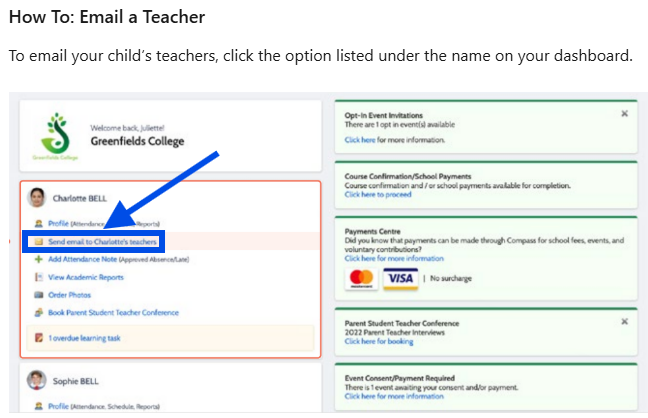

Compass: Compass is the formal tool for communication regarding attendance, payments, excursions, camps, permission forms, school reports, etc.
Please use Compass to advise the school in a timely manner of all student absences.
Early Pick Up: If you need to pick up your child early, please collect them from the office area and be sure to sign them out. You will require an Early Leaver's Pass, provided by the office staff, before we are able to dismiss students.
You can also keep up-to-date by using the school website and weekly newsletters: http://www.cheltenhameast.vic.edu.au