Humanities 9/10
HUMANITIES LEARNING AREA
Humanities 9/10
HUMANITIES LEARNING AREA
| 🎓 Course Type | Compulsory |
|---|---|
| ⏱ Hours per week | 4 |
| ✏️ Selection | Automatically included |
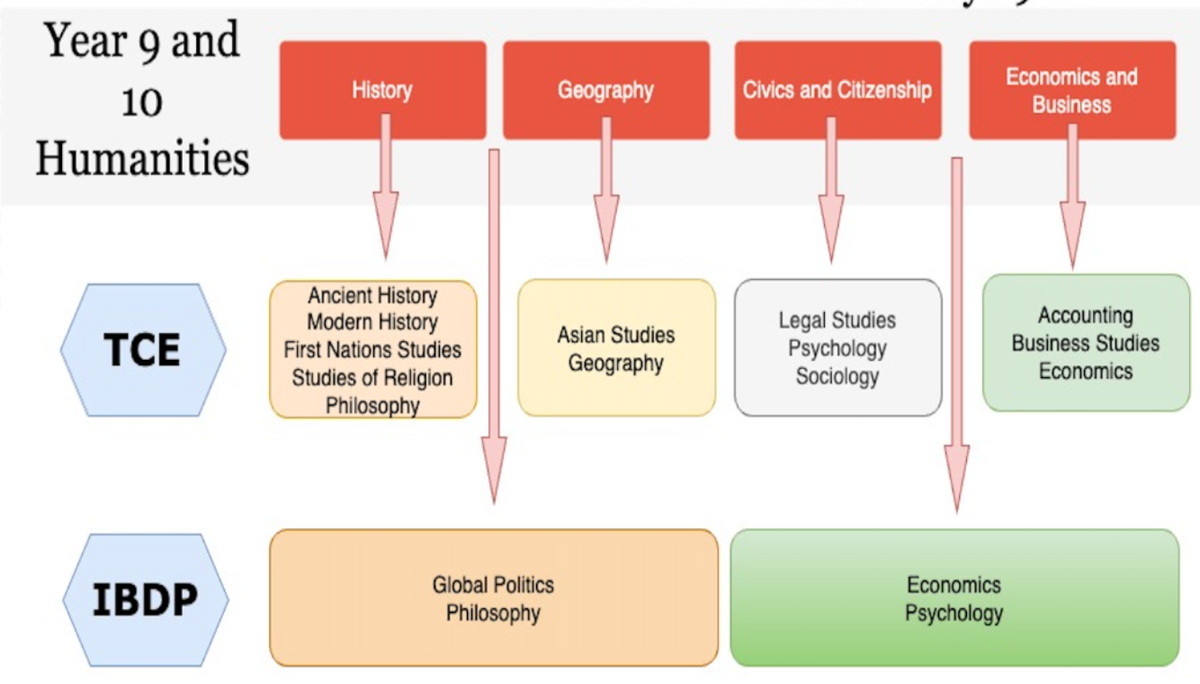
| 🧭 Future Pathways | TCE Level 2 and 3 HASS Courses on offer IB DP Standard Level Individuals and Societies Courses on offer IB DP Higher Level Individuals and Societies Courses on offer |
Over the course of Year 9 and 10 - students study four distinct subject disciplines. These are:
History (Year 9 and 10)
Geography (Year 9 and 10)
Civics & Citizenship (Year 9 only)
Economics and Business (Year 10 only)
Unit: Making and Transforming the Australian Nation (History)
Students are reintroduced to the key concepts of history including evidence, cause and effect, significance, contestability, perspectives, continuity and change.
Students explore:
the causes and effects of European imperial expansion and the movement of peoples in the late 18th and early 19th centuries, and the different responses to colonisation and migration
the key social, cultural, economic and political changes and their significance in the development of Australian society during the period
the causes and effects of European contact and extension of settlement, including their impact on the First Nations Peoples of Australia
Unit: First World War (History)
This unit explores:
Unit: Biomes and Environmental Management (Geography)
This unit explores the biomes of the world, their characteristics, and their significance as sources of food and fibre, while also examining the environmental functions that sustain life. Students gain a deeper understanding of the relationship between biomes, food security, and sustainable environmental management.
Students investigate:
the distribution of biomes,
their role in food production and security, and the challenges posed by their alteration.
the major environmental challenges affecting sustainability,
the worldviews that shape human responses, and
the strategies used to manage change within specific environments.
Unit: Civics and Citizenship
In this unit students learn about the legislative processes through which federal government policy is shaped, developed and implemented. Students study the role of the Australian Constitution in providing the basis for Australia's federal system and the process for constitutional change through a referendum. They explore the influence of a range of media in shaping identity and attitudes to diversity. Students investigate how Australia's international obligations shape Australian law and government. Students discuss the challenges to and ways of sustaining a resilient democracy and a cohesive society in Australia, in our region and/or globally. Students compare the key features of Australia’s system of government compared with at least one other democratic or non-democratic system of government in the Asia-Pacific region
Unit: Second World War (History)
In this unit, students explore:
the causes, outbreak and course of the Second World War and the significance of Australian involvement
he places where Australians fought, and their perspectives and experiences during the Second World War, such as the fall of Singapore, prisoners of war (POWs), the Kokoda campaign
the significant events and turning points of the Second World War, including the Holocaust and use of the atomic bomb
Students are explicitly taught research, referencing and writing skills.
The major tasks are a research essay completed under timed conditions as well as an interactive oral assessment.
Unit: Building Modern Australia (History)
In this unit, students study an overview of the effects of significant post–Second World War world events, ideas and developments on Australian society. These include:
the causes of changes in perspectives, responses, beliefs and values on migration that have influenced Australian society since 1945
the contributions of significant individuals and groups in the campaign for the recognition of the rights of First Nations Australians and the extent to which they brought change to Australian society
the significant events, individuals and groups in the women’s movement in Australia, and how they have changed the role and status of women
Students are explicitly taught source evaluation and reflection skills.
The major task is a portfolio of learning which includes a context statement and a reflection.
Unit: Economics and Interconnections (Economics and Geography)
In this unit students are introduced to the study of economics including and overview of:
the structure and practices of the Australian economy,
what are economic indicators and why they influence economic decision-making
the ways that government intervenes in the economy to improve economic performance and living standards within Australian society
Students are introduced to
the ways that places and people are interconnected with other places through trade in goods and services, at all scales
the impacts of the production and consumption of goods on places throughout the world, and strategies to manage sustainability in these places
The major task is an independent inquiry where students investigate a single product or service.
Unit: Geographies of Human Wellbeing (Geography)
In this unit students are introduced to the geography of human wellbeing.
There is a focus on:
the methods used to measure spatial variations in human wellbeing and development, and how these can be applied to determine differences
reasons for, and consequences of, spatial variations in human wellbeing at a regional and national scale (Tasmania and Australia), as well as drawing on studies from India, Bangladesh and China.
responses of international and national government and non-government organisations to improve human wellbeing in Australia and in Asia
The major assessment for this unit is integrated into the Year 10 Humanities Exam.