
Wellbeing
Fiona Dandie & Robert Pain
Wellbeing
Fiona Dandie & Robert Pain
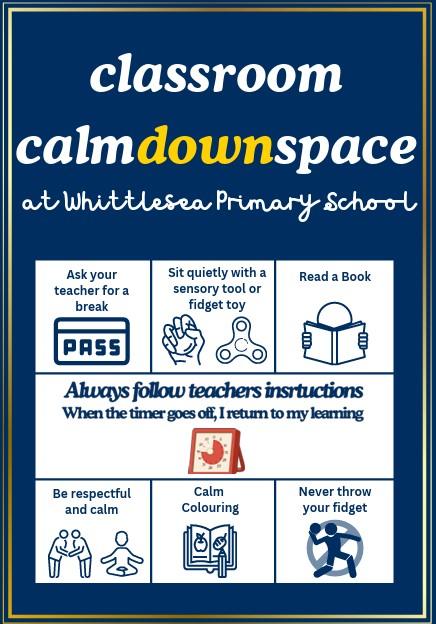
Whittlesea Primary School's 'Calm Down' strategies:
Deep breathing exercises are a simple yet effective way to calm students when they are dysregulated in the classroom. Slow breathing in through the nose and out through the mouth can slow the heartbeat down and help the student calm down.
Distraction can sometimes help a student stay calm. A variety of books, calm colouring, word finds, and fidget toys can be useful. Having books in the calm-down space provides children with a distraction from their emotional state. Drawing and colouring are forms of art therapy that help children calm down and express their emotions. Each classroom's calm-down space has a supply of colouring books, calming colouring, plain paper, and sharpened pencils for students to use.
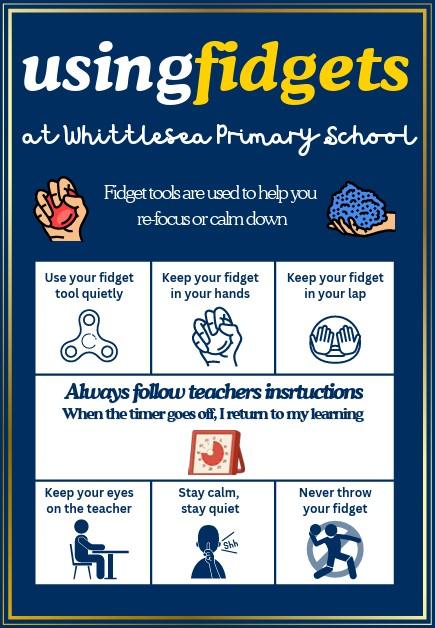
Sensory tactile objects, also known as ‘fidget toys’, are objects for students to hold and touch. They also help students to refocus and gain control over their emotions. A ‘calm down tool kit’ is available for students if required. Personal sensory boxes can also be developed to cater for individual needs.
Possible fidget toys could include:
• Stress Balls – Students can squeeze and poke the stress ball to release negative emotions.
• Calming Bottles – Fill a plastic bottle with water and items such as glitter and jelly beads. Students can stare at the glitter floating around. This settles their breathing and emotions.
• Bottle of Bubbles – This helps students control their breathing and calm down.
• Small Puzzles – Puzzles distract students away from negative emotions, calming them down.
• Stretchy Bands – Put a range of different-sized rubber bands in the kit for students to pull and stretch.
• Pipe Cleaners –Students can bend them into different positions.
• Noise-Cancelling Headphones – Some students become overwhelmed when there is too much noise. By blocking out the noise, the student can calm themselves down.
*Please note that appropriate school fidgets do not include items such as squishies.
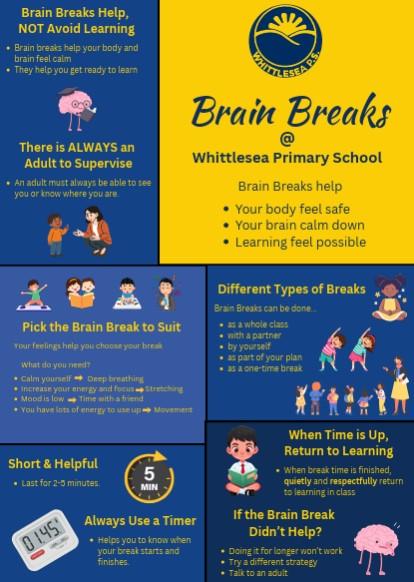
Brain Breaks:
During learning time, all teachers will use a variety of simple physical and mental Brain Breaks. They have a positive effect on learning by:
Calm Down Spaces:
When students are dysregulated, they may need a space to regulate their emotions and be ‘calm’. All learning areas at WPS have a designated classroom area where students can take time to regulate and then continue their learning.
When students feel great frustration, anger, sadness or anxiety, they become confused and may be unsure how to control their emotions. By providing them with a quiet place to calm themselves down, students can regain control over their emotions. This also provides opportunities for diffusing a negative emotion or situation
before it escalates.
Setting up a ‘calm down space’ in the classroom gives students the opportunity to self-regulate their emotions in a peaceful, safe place.
Children develop mathematical skills at different rates, and it is common for them to find some maths concepts challenging at times. However, for some children, ongoing and significant difficulties with numbers, mathematical concepts and calculations may be linked to dyscalculia.
Dyscalculia is a specific learning difficulty that affects a person's ability to understand and work with numbers. It does not reflect a child's intelligence or effort. Children with dyscalculia may have strengths in many other areas but find mathematical concepts particularly difficult to learn and apply.

Dyscalculia affects the way a person understands numbers and mathematical relationships. It can make it difficult to develop a strong sense of number and to remember and use mathematical facts and procedures.
Dyscalculia can look different from one child to another. Some children may have difficulty understanding basic number concepts, while others may grasp them when first taught but struggle to remember and apply them independently.
A child with dyscalculia may experience difficulties with:
Children may also become anxious or frustrated during maths activities, particularly if they have experienced repeated difficulty despite trying hard.

Some signs that a child may need additional support include:
It is important to remember that having difficulty with maths does not necessarily mean a child has dyscalculia. A range of factors can affect learning, and children may need different types of support at different times.
If you have concerns about your child's mathematical learning, a good first step is to speak with their classroom teacher. Teachers can share observations about your child's learning at school and discuss the support and strategies that may be helpful.
Depending on the child's needs, further advice may be provided by professionals such as:
A comprehensive assessment can help build a clearer picture of a child's strengths and areas of difficulty and guide the provision of appropriate support.
There are many strategies that can help children develop mathematical understanding and confidence. Support might include:
Most importantly, children benefit when adults recognise that struggling with maths is not the same as lacking ability. With patient teaching, appropriate adjustments and opportunities to practise, children can build their mathematical understanding and confidence.
If you have concerns about your child, please don't hesitate to speak with their classroom teacher or a member of the school's wellbeing.