Student Wellbeing
What is Dyscalculia?
Tonight we celebrate maths with our Math;s Afternoon. A specific learning disorder with impairment in mathematics (often referred to as dyscalculia) is associated with significant difficulty understanding numbers and working with mathematical concepts.
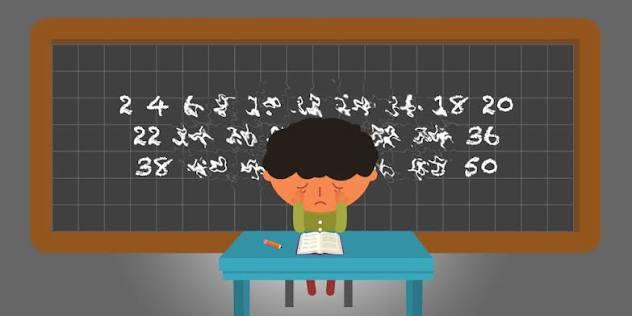
Dyscalculia is a term referring to a wide range of difficulties with maths, including weaknesses in understanding the meaning of numbers, and difficulty applying mathematical principles to solve problems. Dyscalculia is rarely identified early.
Studies have been done to try to identify predictors of potential mathematical disability. The main predictors include:
- Not knowing which of two digits is larger, i.e. understanding the magnitude and relationship of numbers
- Lacking effective counting strategies
- Poor fluency in identification of numbers
- Inability to add simple single-digit numbers mentally
- Limitations in working memory capacity
If basic maths facts are not mastered, many teenagers and adults with dyscalculia may have difficulty moving on to more advanced maths applications. Additional language processing disorders can make it difficult for a person to grasp the vocabulary of maths. Without a clear understanding of this vocabulary, it is difficult to build on maths knowledge.Success in completing more advanced maths problems requires the ability to follow multi-step procedures. For individuals with learning disorders, it may be difficult to visualise patterns, different parts of a maths problem, or identify critical information needed to solve equations and more complex problems.
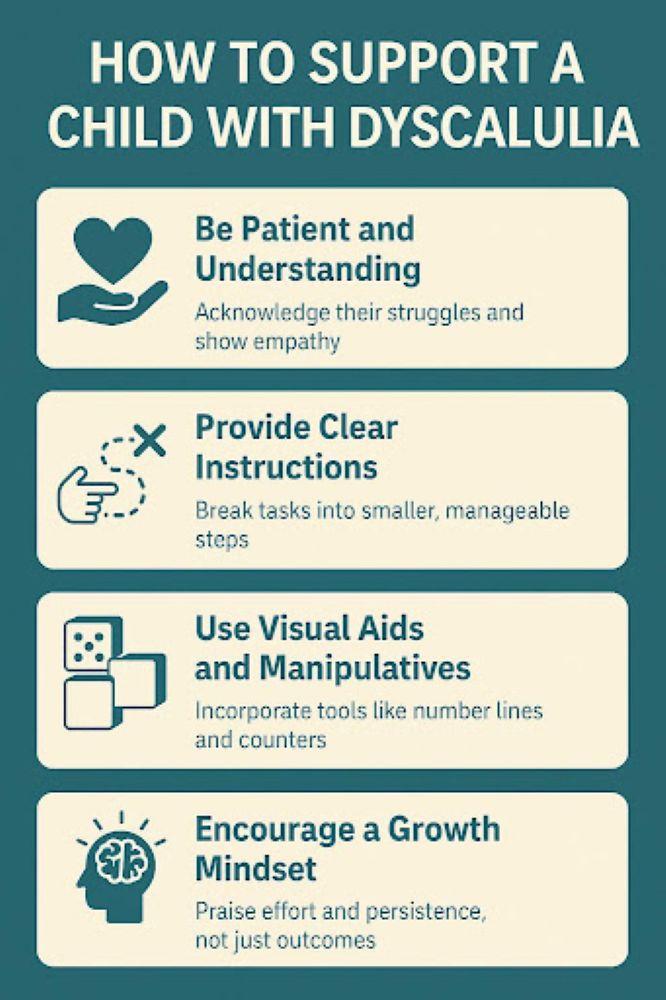
What can you do to support your child?
- Money management: Use play money to teach counting and basic addition and subtraction skills, and allow children to simulate buying items to practice making change.
- Cooking and measurements: When cooking together, children can practice measuring ingredients, doubling or halving recipes, and understanding fractions in a hands-on way.
- Time management: Help children practice telling time using a clock with both digital and analog faces, and involve them in activities that require time calculation, like setting timers or planning events.
- Play games: Any games that include dominoes, cards or dice to support number sense in action.