Wellbeing

Fidget Tools at School
Over recent weeks, we have noticed an increasing number of students bringing "fidget toys" to school that are not suitable for the classroom. While these items are often sold as fidgets, many are designed for play and are becoming more of a distraction than a support for learning.
To help maintain calm and focused classrooms, we ask that students only bring a fidget to school if its use has been discussed and agreed upon with their classroom teacher.
It is important to remember that fidgets are tools, not toys. When used appropriately, they can support some students with attention, self-regulation and concentration. However, fidgets that are noisy, visually distracting or encourage play can interrupt learning for both the student using them and those around them.
If you believe your child would benefit from using a fidget at school, please speak with their classroom teacher. Together, we can determine whether a fidget is an appropriate support and identify one that is quiet, discreet and suitable.
Thank you for your continued support in helping us create a positive, focused learning environment at Stella.
Introducing Our Semester 2 SRC Representatives
We are excited to announce our Semester 2 Student Representative Council (SRC) members for each year level.
Our SRC representatives play an important role in our school community. They are the voice of their peers and help share student ideas, suggestions and feedback about how we can continue to make our school a welcoming, safe and positive place for everyone.
Throughout the semester our SRC members will meet regularly with Mrs Palombi to discuss student ideas, identify ways we can improve our school and work together on initiatives that support our school values of Respect, Responsibility, Resilience and Safety.
Being an SRC representative is a wonderful opportunity for students to develop leadership skills, listen to the ideas of others and contribute positively to our school community.
We congratulate our Semester 2 SRC representatives and look forward to seeing the positive contributions they will make.
Families are warmly invited to attend our Whole School Assembly next week Friday 31 July where our SRC representatives will be officially presented with their SRC badges in recognition of their leadership role.
We congratulate the following students:
| Prep | Kiri & Olivia |
| Year 1 | Elyse & Noah |
| Year 2 | Audrey & Luke |
| Year 3 | Pia & Teddy |
| Year 4 | Alex & Jack |
| Year 5 | Ella & Ashton |
| Year 6 | Paddy & James |

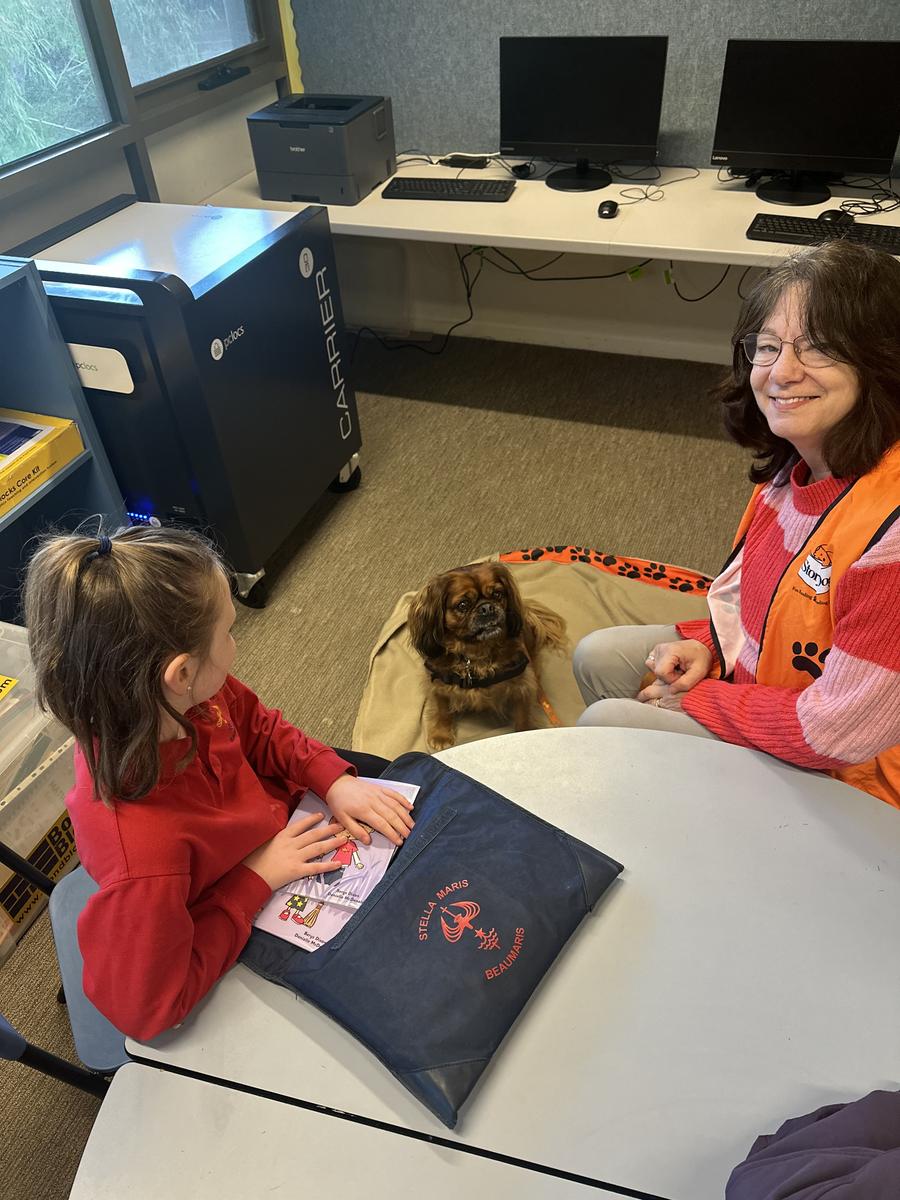
Story Dogs Is Back
When children read to a dog, the outcomes are amazing!
It is a non-judgemental setting, the children's focus improves, their literacy skills increase and their confidence soars. The accepting, loving nature of dogs gives this program its magic and helps children relax, open up, try harder and have fun while reading to a friendly, calm dog. Woof!
We are excited to welcome Story Dogs back to Stella Maris this year in Year 2 and 3! Story Dogs is a wonderful literacy and wellbeing program that pairs trained therapy dogs with students to support reading confidence, engagement and a love of books.
Through regular sessions, a number of students have the opportunity to read aloud to a calm and caring canine companion in a relaxed and supportive environment. The presence of the dogs helps children feel comfortable, builds their confidence as readers and encourages positive connections with literacy.
Story Dogs supports students by:
- developing reading confidence and fluency
- encouraging a love of books and storytelling
- providing a calming and supportive space for students
- building positive social and emotional wellbeing
We are grateful to our Story Dogs volunteers and their amazing dogs for sharing their time, patience and companionship with our students. We look forward to seeing the smiles, confidence and enjoyment this program brings to our Stella Maris community.
Student Wellbeing: Knowing When to Ask for Help
One of the most important skills we can teach children is that it is okay to ask for help. Just as we seek support when we are physically unwell, it is equally important to reach out when we are feeling worried, overwhelmed or upset.
Children can sometimes find it difficult to recognise or express how they are feeling. They may show signs of needing support through changes in behaviour, withdrawing from others, becoming unusually emotional or finding it difficult to concentrate. Creating regular opportunities to talk about feelings helps children feel safe, heard and understood.
At school, we encourage students to identify trusted adults they can turn to when they need support. This may be a parent or carer, teacher, school leader, family member or another trusted adult. Reminding children that asking for help is a sign of courage and strength—not weakness—helps build their confidence and resilience.
You can support your child at home by:
- Having regular conversations about their day and how they are feeling.
- Listening calmly and without judgement.
- Letting them know that all emotions are normal and okay to talk about.
- Encouraging them to seek help early if something is worrying them.
Reminding them that they never have to face challenges alone.
By working together, home and school can create a supportive environment where every child feels valued, connected and confident to seek help whenever they need it. Helping children understand that asking for support is a positive and healthy choice is an important step in promoting lifelong mental health and wellbeing.
Mental Health in Primary Schools (MHiPS)
At Stella Maris, we are committed to supporting the wellbeing of every child. This year, our school has continued its involvement in the Mental Health in Primary Schools (MHiPS) initiative, with Deputy Principal Angela Palombi leading this important program.
Children's mental health and wellbeing play a vital role in their learning, relationships and overall development. Positive mental health helps children build resilience, manage challenges, develop healthy relationships and reach their full potential. While many children thrive, others may experience periods where they need additional support. Schools play an important role in fostering positive mental health and creating safe, supportive environments where every child can flourish.
The MHiPS initiative has been developed by paediatricians, educators, psychologists, researchers and teachers to strengthen the capacity of primary schools to promote and support student mental health and wellbeing. Through specialised professional learning, experienced educators become Mental Health and Wellbeing Leaders, enabling schools to build staff knowledge, strengthen whole-school practices and provide early support for students when needed.
Throughout the year, we will continue to work closely with staff, students and families to promote positive wellbeing, build resilience and ensure that every child feels safe, supported and connected within our Stella Maris community.
Angela Palombi
Wellbeing Leader