
Senior School Update
The wellbeing and safety of our community is our top priority at Friends’. Every day, we want all our community members to feel safe and to ensure the School is welcoming and inclusive. This is underpinned by our Quaker values and has always been at the heart of the School’s ethos and culture.
Our physical and mental health are shaped by our experiences at home, at school and in other parts of our lives. So, what do Quakers have to say about the way we look after our mental health?
Quaker involvement with mental health goes right back to 1796, when William Tuke founded The Retreat in York, a mental health hospital for Quakers. People were treated with respect, given useful work, welcomed into the community and, above all, loved. This was in sharp contrast to the harsh and often inhumane treatment that people received in asylums at that time. The approach was revolutionary and helped shape some of the practices of modern mental health care.
This Quaker commitment to humane mental health care also has a remarkable history in the United States. Friends Hospital in Philadelphia, founded by Quakers, is the oldest psychiatric hospital in the United States. Its history even includes the use of pet therapy in the early 1800s. These examples remind us that caring for people’s wellbeing is not a new concern for Friends; it is a longstanding expression of our belief in the value of every person.
Connection is what gives purpose and meaning to our lives and, closely connected to this, is caring for each other. One of our core Quaker beliefs is that there is that of God in everyone, so every person is of value, important and worthy of care. An essential part of caring within Quakerism is listening.
This is reflected in the work of Quaker writer Parker Palmer, who has written extensively about his own struggles with mental health. When people tried to cheer him up or make him feel better, their efforts were often unsuccessful. What really helped was a Quaker friend who visited him each week, without talking too much, but instead simply tried to be empathetic. Palmer concluded that kindness and being alongside someone when they are in distress are important factors in healing.
These stories offer a powerful reminder of the kind of community we want to be: one in which people are treated with kindness, humanity and respect, and where wellbeing is understood as something we create together.
This philosophy is reflected in the many ways we seek to support students’ wellbeing. Our pastoral care, Gatherings, co-curricular opportunities, learning support and relationships with families all contribute to a culture in which students can feel safe, connected and able to flourish.
Our recent Wellbeing Weekend and Wellbeing Week have provided timely opportunities for students to rest, reconnect and recharge. They also invite us to consider wellbeing not simply as an individual responsibility, but as something we create together. Kindness, humanity, respect and the willingness to listen are not additional to our educational purpose; they are central to it.
The goal of a Quaker education is centred around the intrinsic worth of all students. Academic achievement matters, but it is not the measure of a young person’s value. Our task is to create the conditions in which students can recognise their own worth, experience a genuine sense of belonging and develop the confidence to let their lives speak.
I often think of the School’s role as being to identify a student’s talents or passions and “fan the flames” of those interests. When a young person discovers something they are good at, something they care about, or something that gives them a sense of purpose, we have an opportunity to nurture that spark. From this sense of self-worth and belonging, so much else can flow: motivation, resilience, curiosity, connection and a willingness to take on challenges.
This is not to suggest that every student will find school easy, or that wellbeing means removing every difficulty. Rather, it means ensuring that students are known, supported and encouraged to see themselves as capable and valued members of a community. It also means recognising that students do not all learn, communicate or demonstrate their abilities in the same way.
The well-known cartoon below illustrates this beautifully. Its animals are all asked to take the same exam: “Please climb that tree.” The joke is that the animals have unique gifts, yet the assessment measures only one narrow capability. The elephant, penguin, monkey and other animals are not lacking in worth or potential; they are simply being asked to demonstrate their abilities in a way that does not suit them.
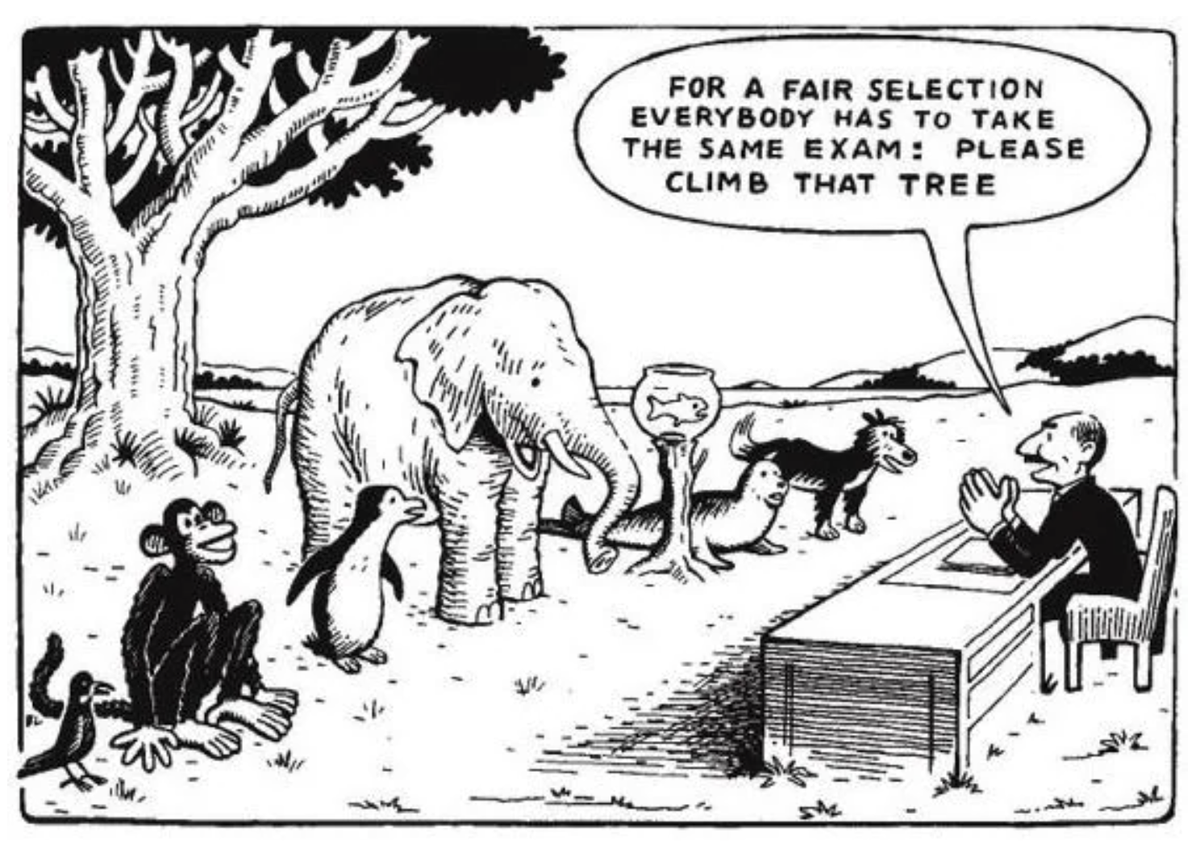
This is a powerful reminder that fairness is not always about treating everyone identically. It is about recognising difference, removing unnecessary barriers and creating opportunities for each person to demonstrate their strengths.
It also invites us to consider whether our education system, particularly in the senior secondary space, remains too reliant on outdated models of assessment. The traditional examination has an important place, but it cannot tell us everything about a young person’s capabilities, potential or readiness for the future.
Our teachers and Access and Inclusion team are making great strides in our understanding of difference. Increasingly, adjustments are being made to accommodate students’ differences and to capture a fairer snapshot of their ability and potential. The question is not simply, “Can this student meet the standard in the standard way?” but, “What conditions will allow this student to demonstrate what they know, understand and can do?”
This work is an important expression of our Quaker commitment to equality. If every person is of value, then we need to be careful not to define their worth by a single measure of achievement or ability.
It is also one of the reasons we are excited to be a founding partner in the New Metrics initiative with the University of Melbourne. New Metrics is a collaborative research-practice partnership that seeks to develop new ways of assessing, recognising and reporting the complex competencies that matter for students’ lives beyond school. It challenges the limitations of a system that relies heavily on narrow attainment measures and summative examinations.
The premise of this methodology is matching, not ranking, key capabilities. Rather than asking how students compare with one another through a single number, the work explores how we can better understand what a learner knows and can do, and match that richer evidence to pathways where they are most likely to thrive. The University’s research is developing new assessments and learner profiles that recognise a broader range of capabilities, including those that are not readily captured by traditional examinations.
This is a significant opportunity for Friends’ to contribute to the future of education. We look forward to sharing more details of this work with our community in the near future.
Our commitment to wellbeing is not separate from our educational purpose. It is woven through it. When students feel valued, connected and understood, they are better placed to engage in learning, develop their capabilities and contribute positively to the lives of others.
As we continue to develop our wellbeing initiatives and rethink how we recognise student success, we remain guided by a simple but profound Quaker conviction: there is that of God in everyone. Our responsibility is to see that worth, nurture it and create the conditions in which it can flourish.
Adam Chambers - Head of Senior School (Years 9 to 12)