Year 5/6 Bulletin
Summarising a fiction text














 Armadale Primary School

Year 5/6 Bulletin
Summarising a fiction text
To summarise a narrative by identifying what a character wants and selecting the events connected to that goal.
“Stories contain lots of events, but a summary doesn’t include everything. We’re going to decide which events matter by asking whether they connect to what the character wants.”
Students explored how to summarise a narrative by identifying what the main character wanted and selecting the important events that connected to their goal.
As a class, we revisited a familiar text and discussed the character's main goal. Students worked together to identify which events were essential to the story and which details could be left out.
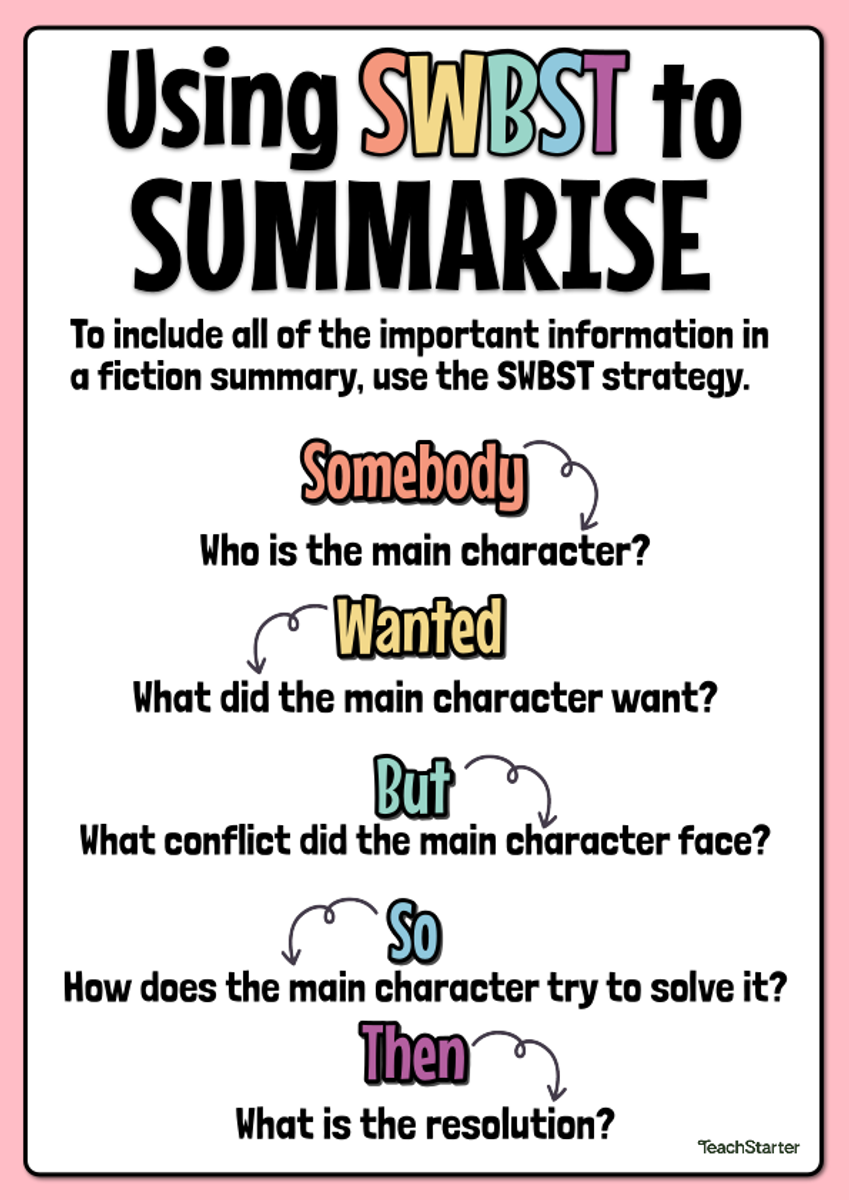
To support our learning, we used the SWBST (Somebody, Wanted, But, So, Then) anchor chart to help organise our thinking and identify the key elements of a narrative:
Using this structure, students practised identifying the most important information and combining it into a clear, concise summary.
We focused on the idea that a good summary does not retell the entire story. Instead, it includes the key events that explain the character's goal, the challenges they faced and the outcome.
Families can support this learning by discussing books, movies or familiar stories together. Encourage your child to use the SWBST strategy to explain the story in their own words.
Questions you could ask:
A challenge to try: Ask your child to choose a favourite book or movie and summarise it using five sentences, following the SWBST structure. These conversations will help students strengthen their reading comprehension, distinguish important events from minor details and communicate their understanding clearly.
Year 5/6 Team
Allira.Zeneli@education.vic.gov.au