Things To
Know
SAVE THE DATES

Things To
Know
SAVE THE DATES
BIG THE RETURN OF THE RPS CAKE RAFFLE!
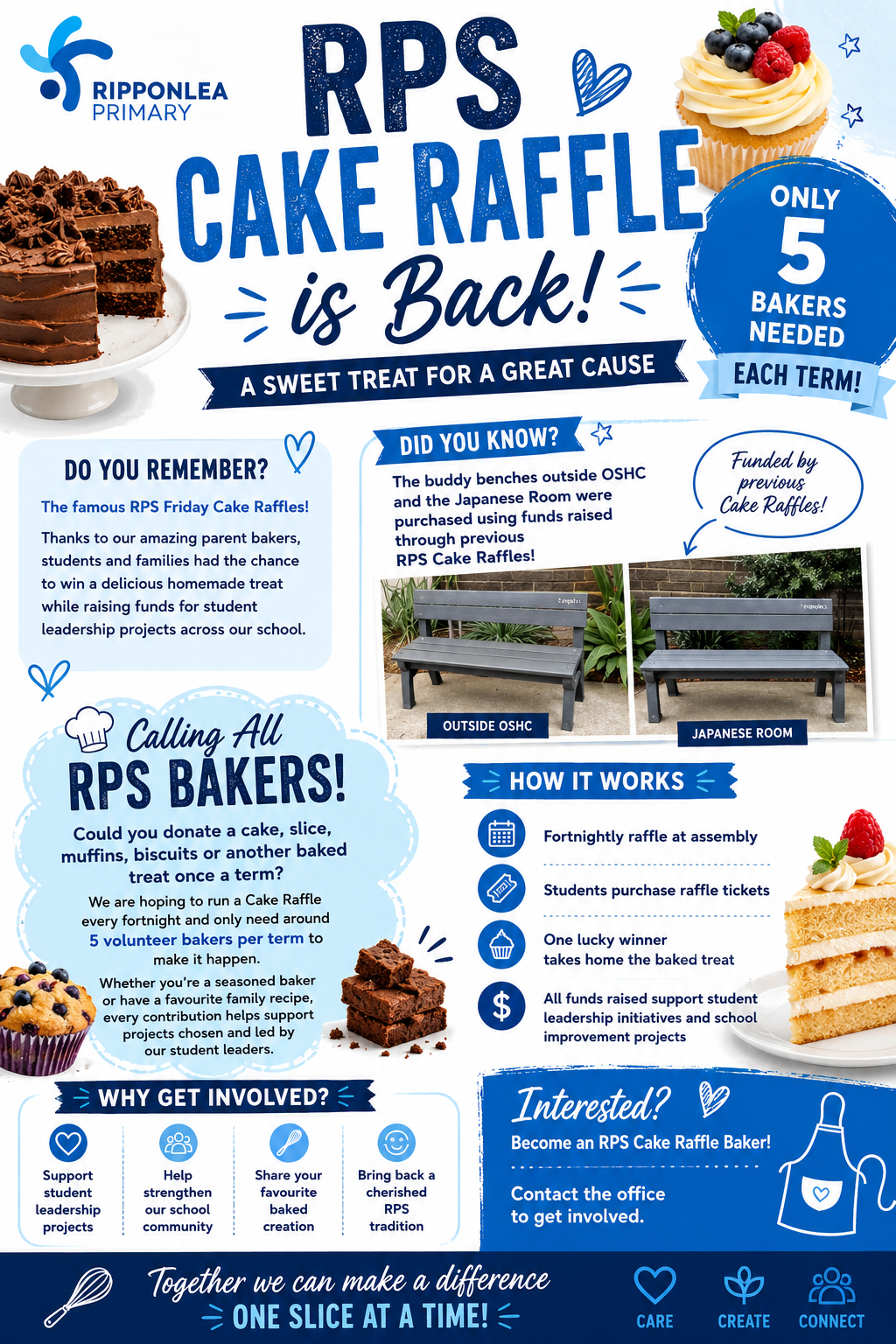
Rippers, we would love to bring back a wonderful old RPS tradition, the Friday Cake Raffle!
Many of our long-term families may remember the days when our generous parent bakers would donate a delicious homemade cake, slice or sweet treat to be raffled off at assembly. It was always a highlight of the week, and the lucky winner took home something truly scrumptious to enjoy with their family.
What many people may not realise is that every dollar raised through the cake raffle went directly towards student leadership projects. In fact, the buddy benches located outside OSHC and the Japanese Room were funded entirely through proceeds from previous cake raffles.
We would love to see this tradition return. It doesn't need to happen every week even a fortnightly raffle would make a wonderful contribution to our school community. To make it work, we only need around five volunteer bakers per term who are willing to donate a baked item when rostered.
Whether it's a family favourite slice, cupcakes, muffins, biscuits or a classic cake, every contribution helps our students make a difference around the school.
If you would be willing to join our Cake Raffle Bakers Team, please contact Lee at the office. We'd love to hear from you.
Together, let's bring back a much-loved RPS tradition and continue supporting student-led projects across our school.
https://docs.google.com/spreadsheets/d/1xrjhFCkUw0pdBKcpbhYTmqpXmo8jDIwv5Nr92hTElMU/edit?usp=sharing
"Who knows what our student leaders might create next with the funds raised?"
At Ripponlea Primary School, one of our ongoing priorities is ensuring that every student has the opportunity to learn, retain knowledge and experience success in the classroom. This week, we have been exploring this idea with students from Foundation to Year 4, with Year 5/6 discussions taking place tomorrow.
A key concept underpinning our work is Cognitive Load Theory, which simply means that our brains can only process a limited amount of new information at one time. When students are learning something new, they need to focus their attention on the lesson, the task and the thinking required. Every distraction competes for that attention and reduces the brain's capacity to learn.
Research tells us that learning occurs when information moves from our working memory into our long-term memory. This process requires concentration, repetition, practice and attention. When students are distracted, they often miss critical pieces of information, making it more difficult to understand, remember and apply their learning.
This week, we asked students a simple question:
"What behaviours distract your learning?"
Importantly, we did not ask students to name individuals. Instead, we focused on the actions and behaviours that interrupt learning.
Across year levels, students consistently identified:
What was particularly encouraging was that students were also able to identify their own role in creating a positive learning environment. Many suggested strategies such as:
One phrase that emerged from our discussions was:
"Hey, that's not okay."
Students recognised that respectful peer feedback can help maintain a positive learning environment for everyone.
As part of these discussions, we also explored the power of non-verbal prompts. Students learned that not every interruption requires a verbal response from a teacher or peer. Simple strategies such as eye contact, a gesture, pointing to expectations, moving closer to a student, or redirecting attention back to the task can often help students self-correct without interrupting the learning of others.
Drawing on the work of Bill Hansberry, we know that the least intrusive intervention is often the most effective. These subtle prompts maintain student dignity, reduce unnecessary attention on inappropriate behaviour and help keep the entire class focused on learning.
This work aligns closely with the thinking of education consultant Bill Hansberry, who reminds us that behaviour is communication and that every behaviour serves a function. Often, students engage in certain behaviours because they are seeking something—attention, connection, avoidance, sensory stimulation or a sense of control.
One of the most common functions of disruptive behaviour is attention-seeking. While attention is a normal human need, students sometimes learn that calling out, being silly or disrupting others is an effective way to gain social recognition from peers. When classmates laugh, react or engage, the behaviour is reinforced and becomes more likely to occur again.
This is why we are helping students understand that distractions are often a choice. While all children make mistakes and occasionally lose focus, students can learn strategies to regulate their behaviour, make positive choices and contribute to a productive learning environment. Equally important is helping students understand that they do not need to reward distracting behaviours with attention. By staying focused on their learning and encouraging peers respectfully, students can help create classrooms where everyone can succeed.
At Ripponlea, we want every classroom to be a place where students feel safe, respected and ready to learn. By reducing distractions and increasing engagement, we maximise every child's opportunity to build knowledge, develop confidence and achieve success. Every minute spent learning matters, and every student deserves the opportunity to learn without unnecessary interruptions.
Looking ahead to Term 3, we will continue this work by exploring the concept of consequential learning and helping students understand the relationship between the choices they make and the outcomes they experience. Students will be encouraged to reflect on how their decisions impact not only their own learning, wellbeing and relationships, but also the learning opportunities of others.
Through classroom discussions, reflective practices and explicit teaching, we will support students to recognise that every choice has a consequence—some positive, some less desirable—and that taking responsibility for our actions is an important part of becoming a successful learner and community member.
Our goal is not simply to reduce inappropriate behaviour; it is to help students develop the self-awareness, self-regulation and decision-making skills that will serve them throughout their lives. By understanding how choices influence outcomes, students become empowered to make decisions that support their own success, contribute positively to their classroom community and uphold our shared commitment to learning.
Learning is a team effort between students, staff and families. Thank you for your ongoing support as we continue to strengthen the learning culture across our school and uphold our commitment to helping every student thrive.
At Ripponlea Primary School, we know that every family’s circumstances are different, and that the rising cost of living continues to place pressure on many households.
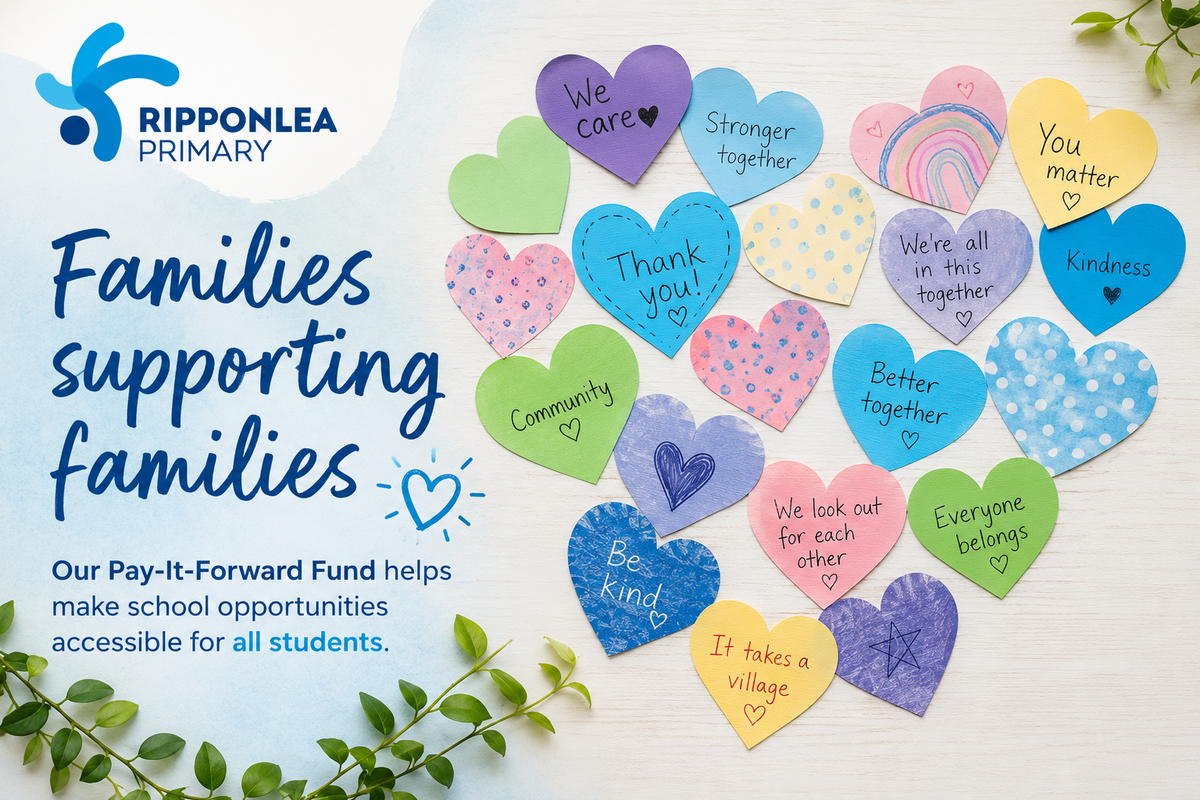
Earlier this year, we introduced the Ripponlea Primary School Pay-It-Forward Fund as part of our Parent Payments and Contributions model. This voluntary fund allows families who can do so to contribute towards supporting other students within our school community.
We would also like families to know that this support is available to access.
The Pay-It-Forward Fund can assist with costs related to:
Our goal is simple: we want all students to be able to participate in and enjoy the opportunities offered at school, regardless of temporary financial challenges.
Support is provided confidentially and respectfully through the school. If your family is experiencing financial hardship and would benefit from assistance, please contact the office or speak with Natalie confidentially.
Sometimes families can give support, and sometimes families need support, both are a normal part of being a caring community.
We are incredibly grateful for the kindness and generosity shown by our Ripponlea families.
At Ripponlea Primary School, we are incredibly proud of the rich, engaging and high-quality learning experiences we provide for every student, every day. A key part of making this possible is the voluntary Curriculum Contributions made by our families.
Curriculum Contributions go directly towards classroom budgets, empowering our teachers to purchase high-quality, purposeful materials that support daily teaching and learning. These are the resources that bring lessons to life supporting hands-on exploration, creativity, collaboration and deep thinking across all areas of the curriculum.
In classrooms, these contributions help fund:
Our specialist programs particularly benefit from these contributions. They enable us to provide:
Curriculum Contributions also support:
While many families will be familiar with the individual book packs from Maxim, it is important to understand that Curriculum Contributions go well beyond these items. They fund the shared resources that all students access daily the materials that often sit behind the scenes but are essential to delivering a high-quality education.
At times, these contributions may not always be immediately visible, but their impact is felt in every classroom, every lesson and every learning experience.
We are deeply grateful to all families who have made voluntary contributions. Your support makes a tangible difference to the opportunities we can provide and ensures our teachers are well-equipped to deliver engaging, inclusive and high-quality learning programs.
Thank you for partnering with us to support your child’s learning.