
Gospel


A reading from the holy Gospel according to Matthew 20:1-6
Why are you jealous because I am generous?

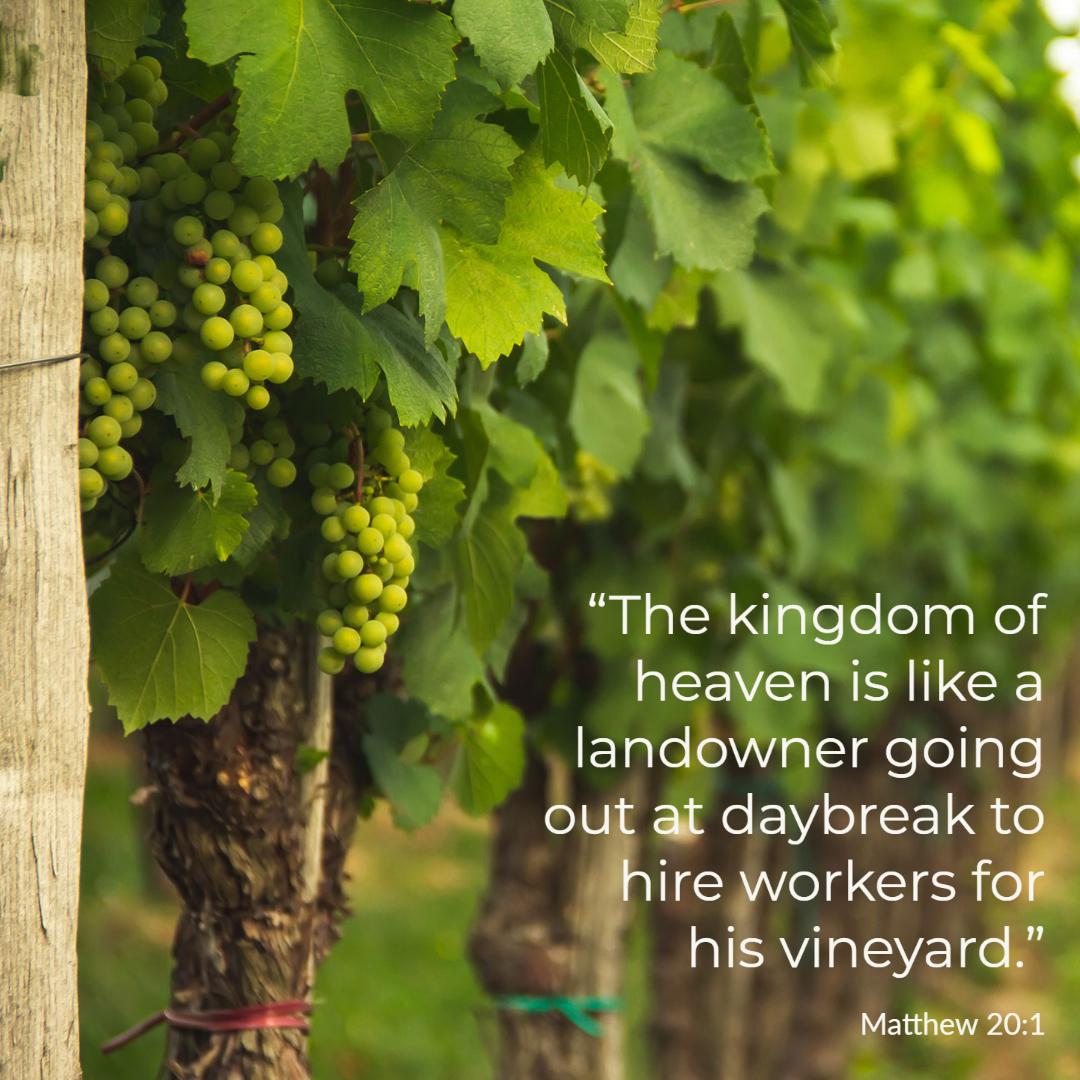
Jesus said to his disciples: ‘The kingdom of heaven is like a landowner going out at daybreak to hire workers for his vineyard. He made an agreement with the workers for one denarius a day, and sent them to his vineyard. Going out at about the third hour he saw others standing idle in the market place and said to them, “You go to my vineyard too and I will give you a fair wage.” So they went. At about the sixth hour and again at about the ninth hour, he went out and did the same. Then at about the eleventh hour he went out and found more men standing round, and he said to them, “Why have you been standing here idle all day?” “Because no one has hired us” they answered. He said to them, “You go into my vineyard too.” In the evening, the owner of the vineyard said to his bailiff, “Call the workers and pay them their wages, starting with the last arrivals and ending with the first.”
So those who were hired at about the eleventh hour came forward and received one denarius each. When the first came, they expected to get more, but they too received one denarius each. They took it, but grumbled at the landowner. “The men who came last” they said “have done only one hour, and you have treated them the same as us, though we have done a heavy day’s work in all the heat.” He answered one of them and said, “My friend, I am not being unjust to you; did we not agree on one denarius? Take your earnings and go. I choose to pay the last-comer as much as I pay you. Have I no right to do what I like with my own? Why be envious because I am generous?” Thus the last will be first, and the first, last.’

Gospel Reflection
On a first reading of this gospel story, the reader is probably struck by the unfairness of the situation. The landowner has employed day labourers at different times throughout the day to work in his vineyard. However, come the end of the day, the landowner pays all the day labourers the same amount. Not surprisingly, the labourers employed at daybreak to work the whole day are upset that those who have only worked the last hour of the day are paid the same amount. The landowner reminds them that he is paying them what they agreed at the start of the day, and yet the reader is left uncomfortable about the whole arrangement.
Of course, this is the purpose of Jesus’ story! The key to the story is in the introduction. Most of the kingdom parables told by Jesus begin with a formulaic statement, ‘The kingdom is like …’ and this one is no different. What follows is almost always a description of an everyday event that is turned on its head. In all of the kingdom parables recorded in the gospels, Jesus describes a world order in which people respond in unexpected and sometimes confusing ways. His message is that the kingdom, or reign, of God turns expectations upside down. In the kingdom, people who are treated badly in this world are held in great esteem; the balance of power is turned upside down; and the usual order of things is challenged. The landowner’s final comment in the parable, ‘the last will be first, and the first, last’, is a perfect example of the challenging nature of Jesus’ kingdom parables. In the kingdom, those who hold themselves to be first in this world will be brought down, and those who are treated as least in this world will be exalted.
Historical Context – Labourers for hire
Jesus’ parable describes a situation that would have been very familiar to his audience. At the time, there were many quite wealthy landowners who controlled large vineyards, orchards and crop fields. They would have employed a certain number of permanent workers but come harvest time there was a need for more workers and, much like today, they sought to employ part time workers for a short period of time until the rush was over. Men looking for work would gather in the marketplace of a village and landowners would select workers and send them to their property to work.
Scriptural context – Kingdom parables
A feature of the kingdom parables that Jesus used is a challenging ‘shift’ to the unexpected. Jesus only ever uses parables to describe what the kingdom is like, and never says exactly what it is or isn’t. In each parable he compares the kingdom of God to something that would be familiar to a 1st century audience but then he twists the familiar and makes the challenging shift by making the familiar, unfamiliar. (This ‘shift’ is sometimes called a ‘discombobulating shift’.) Jesus tells us that the kingdom of God disrupts our normal way of thinking, it turns our expectations upside down and it completely challenges our ‘normal’ relationships.
Have you thought? Equality or Equity?
How would you feel if you had done a full day’s work and were paid the same as someone who had only worked for one hour? Is the landowner in the parable being unjust? He pays the workers exactly what he promised them – but he promised everyone the same amount, regardless of when they started work. The workers who started at 6.00 am complain. How do you think the workers who started later in the day felt? The landowner claims the right to be generous – is generosity unfair? There is a difference between treating people equally and equitably. What has the landowner done here?