
Learning Specialist News
Be Kind
Be Responsible
Be an Active Learner

Learning Specialist News
Be Kind
Be Responsible
Be an Active Learner
This term, all students from Prep to Year 6 will participate in a consistent, whole-school approach to developing maths fact fluency using the Facts on Fire program.
Maths fluency is much more than answering questions quickly. It is about developing accurate, effortless recall of key number facts so that students can focus their thinking on more complex mathematical problem solving. These are known as declarative facts; basic facts that students can recall automatically, such as addition, subtraction, multiplication and division facts. Declarative facts also extend beyond basic number facts to other areas of mathematics.
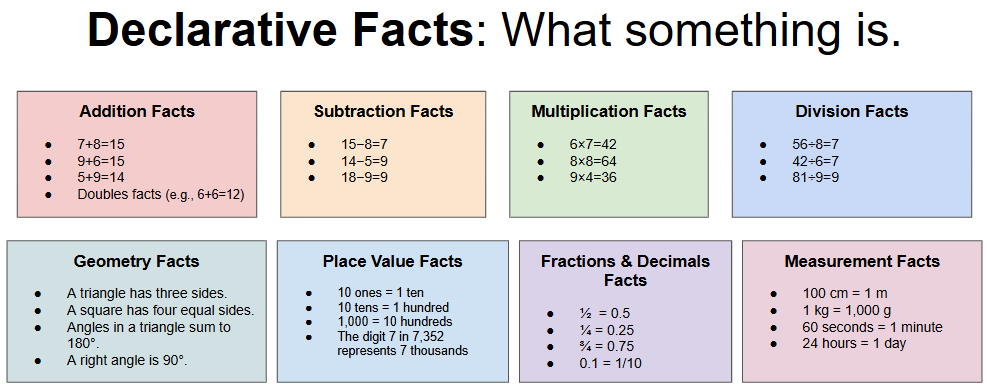
During our recent curriculum day, last Monday, staff spent time strengthening their understanding of how students develop mathematical fluency and prepared to implement the Facts on Fire program across the school. We analysed student data and explored the sequence of fluency skills that students develop throughout their years of schooling. Because mathematics is hierarchical (builds on prior knowledge), strong fact recall provides an important foundation for students to tackle increasingly complex concepts with confidence. It’s often referred to as the gateway between Novice and Expert on the learning continuum.
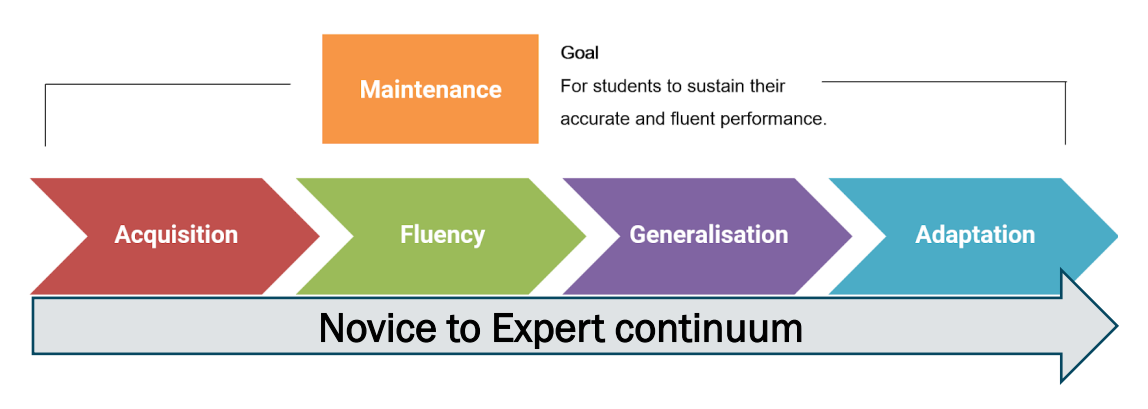
When students have to work out simple facts by counting on their fingers or using other strategies every time, it places extra demand on their working memory. If these facts become automatic, students can devote more attention to understanding mathematical concepts, solving challenging problems and explaining their reasoning.
The Facts on Fire program provides students with short, focused practice sessions several times each week. Students work on a carefully sequenced set of facts that matches their current stage of learning, ensuring they experience both success and appropriate challenge. Teachers regularly monitor progress so that every student continues to build fluency at a pace that is right for them.
It is important to remember that fluency is built after accuracy. Students first develop an understanding of mathematical concepts through explicit teaching before building speed and automatic recall of the related facts. This means students are never expected to memorise facts without first understanding what those facts represent.
We are excited to implement this consistent approach across the school and look forward to seeing our students grow in both confidence and capability as their mathematical fluency develops. As the term progresses, we will continue expanding our school-wide fluency practices to support every learner.
Learning Specialist
Ben Sandison