Level 3 & 4
Welcome to another exciting week of learning in Grades three and four!
It has been wonderful to see our students continue to embrace new challenges with enthusiasm, curiosity and a genuine love of learning. This week will provide many opportunities for students to inquire, create, collaborate and deepen their understanding across a range of learning areas.
We are looking forward to another rewarding week of learning together.
Literacy
Spelling
Through reading, spelling and writing, students will continue to strengthen their understanding of the 111 Rule by applying it to increasingly complex vocabulary. They will learn to identify when a word has one syllable, one vowel and ends with one consonant, meaning the final consonant is usually doubled before adding a suffix.
Students will revisit the spelling patterns ce, ci, cy and ge, gi, gy, exploring how these letter combinations create the soft /s/ and /j/ sounds in words and apply these patterns as they encounter more challenging vocabulary.
Reading
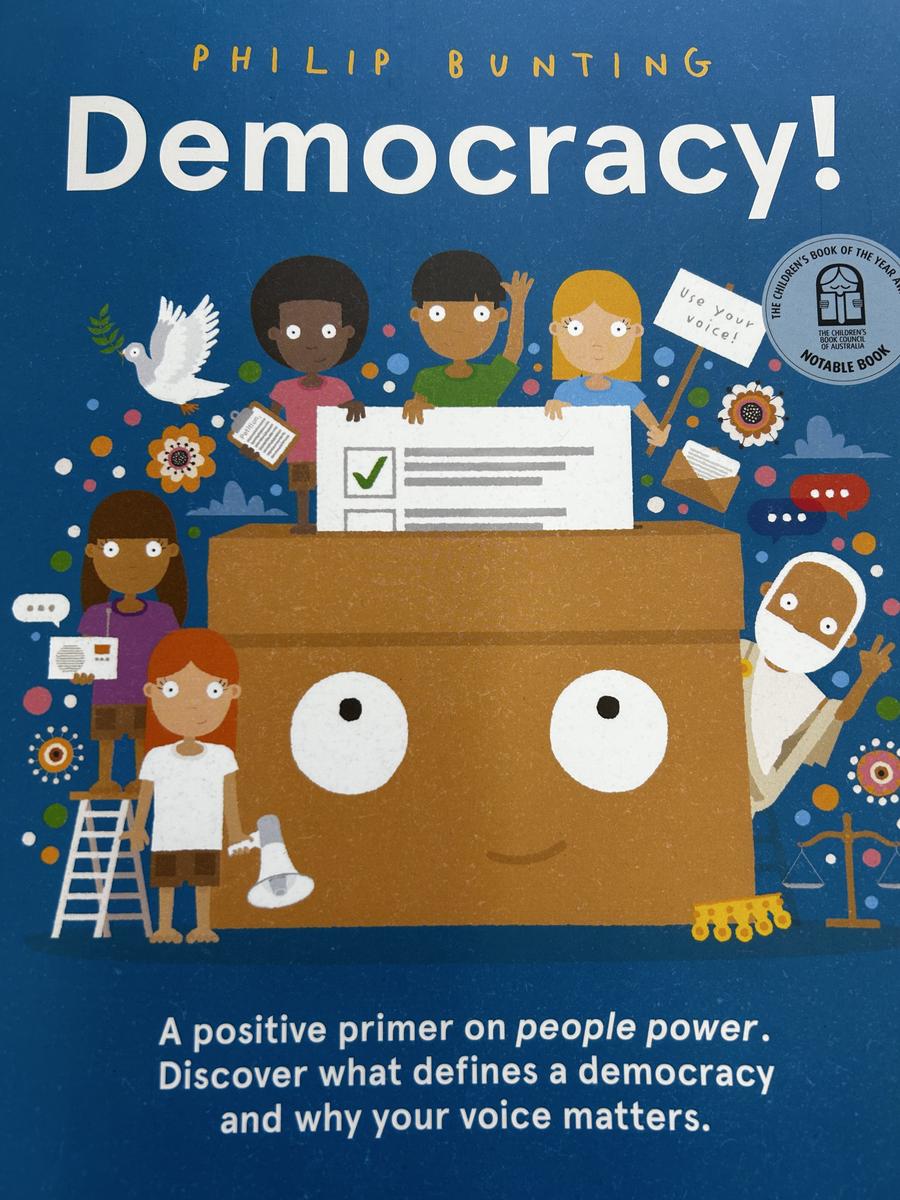
Our mentor text this week is Democracy by Philip Bunting. This picture book will introduce our students to the concept of democracy and explore how people can use their voice and power to create positive change in their communities. Students will learn about different levels of government, leadership, fairness and the importance of participating in decision-making.
Students will continue developing their literacy skills while exploring our CBL Big Idea of Power.We will unpack the rich vocabulary, analyse the author's voice, investigate how authors position and persuade their readers, and complete comprehension tasks that build their understanding of the roles and responsibilities of National, State and Local Government. Through these learning experiences, students will consider how power, leadership and decision-making help shape our communities.
WHAT CAN YOU DO AT HOME:
Talk with your child about the decisions that are made in your family and community. Discuss who makes these decisions, why they are important, and how everyone can contribute respectfully by sharing their ideas and listening to others.
Writing
We will transition from studying biographies to creating their own autobiographies. Students will explore the features of autobiographical writing as they reflect on significant events, experiences and achievements from their own lives, learning how to organise these in chronological order using engaging and descriptive language.
There will be opportunities to develop writing creativity through free-choice narrative writing, allowing students to apply their growing knowledge of effective story structure, character development and descriptive language.
WHAT CAN YOU DO AT HOME:
Encourage your child to share stories about their life, such as a favourite holiday, a memorable celebration or a challenge they have overcome. You might also enjoy looking through family photos or sharing stories from their early years. Talking about these experiences together can help your child recall details, organise events in chronological order and build confidence as they write their autobiography.
Maths
Grade 3 - Angles
Students will learn to identify and compare right, acute and obtuse angles, and investigate how angles can be found in everyday objects and shapes. They will develop their understanding of how and where angles are used in the world around them.
We have planned practical investigations and problem-solving activities that encourage students to observe, compare and explain the angles they find in both the classroom and the wider environment.
Grade 4 - Multiplication and Division
We will continue developing multiplication and division strategies, building confidence in solving increasingly complex number problems efficiently and accurately.
Students will apply a range of mental and written strategies to solve multiplication and division problems involving larger numbers, while using estimation to check the reasonableness of their answers.
Through rich problem-solving tasks and real-world investigations, our students will strengthen their mathematical reasoning and explain the strategies they used to reach solutions.
WHAT CAN YOU DO AT HOME:
Encourage your child to look for different types of angles around your home or while out and about. Ask them to identify whether they can spot an acute, right or obtuse angle in objects such as doors, clocks, signs or playground equipment.
Look for opportunities to use any of the four processes (addition subtraction multiplication division) in real life - such as sharing food equally, calculating quantities for recipes, working out the total number of items in equal groups, working out change or adding scores during games and sporting events.
Encourage your child to practise their times tables regularly by saying them out loud, writing them down, or through quizzing.
Multiverse on Mathletics and Hit the Button (website) can be a fun interactive way to practise and strengthen number fact knowledge and work towards automaticity
CBL (Challenge Based Learning)
This term, our Challenge Based Learning (CBL) Big Idea is Power.
This week we are investigating our guiding question “What is Law?”
We will explore the differences between rules and laws, why laws are important, and how they help keep communities safe, fair and organised.
Students will also develop their understanding of the roles and responsibilities of local government and investigate how community members use and contribute to local services, recognising the important role everyone plays in building strong and connected communities
WHAT CAN YOU DO AT HOME:
Talk with your child about the rules and laws they encounter each day. Discuss why these rules and laws exist, who creates them and how they help keep people safe, treated fairly and working together. You might also identify examples of local services, such as libraries, parks, roads or rubbish collection, and discuss how they benefit your community.
Wellbeing
SWBPS
Through our SWPBS program and token system, we continue to recognise and celebrate students who demonstrate positive work habits, respectful relationships and safe behaviours, helping to create a supportive learning environment where everyone can thrive.
Our focus this week - Be at class line up by the second bell
Respectful Relations - Stress Management Continued
We will continue to explore strategies for recognising and managing stress, helping students build resilience, regulate emotions and maintain positive wellbeing in everyday situations.
Kitchen Garden
We continue to rely on the support of our wonderful parent helpers to ensure this program is safe and successful. We also warmly welcome help from extended family such as grandparents, aunts, and uncles. If you or a family member can spare some time to support the program, the sign-up link is:
We post our recipes on Showbie for students who would like to recreate the amazing dishes they make in our cooking classes.
Please use the Showbie code below if your child would like to access these recipes:
9JYVE
INFORMATION & REMINDERS
Term Three Dates
August
3rd - Assembly Monday 9:00am
-7:30pm Online Parent Workshop hosted by Cyber Safety Project. ‘Balancing Life and Tech’ – Reducing conflict and restoring healthy screen balance.
5th August - Coffee & Chat. Focus on attendance, holiday leave, absenteeism and wellbeing.
6th August – House Athletics
Please note – there are several dates on the Sentral calendar for the VSSS26 Mass Choir.
Reminders
-please help support your child to make sure their iPad is charged and ready to use each day
-fidget tools; we would appreciate your support in making sure students are not bringing collections of squishes/fidget toys to school