Careers Hub












 Lakeside College


ATAR and Scaling in the VCE
ATAR vs Study Score
What are VCE Study scores?
A VCE study score is a score between 0 and 50, showing how well you performed in a VCE Unit 3-4 sequence, compared to all the other students in the state enrolled in that study. It’s the first step to calculating your ATAR.
The highest study score you can get is 50. Every year, the average study score for all studies is 30. If you score between 23 and 37, it means you’re in the middle range. 38 or higher means you’re in the top 15%.
Take a look at the table below to better understand what a study score is.
| What is a study score? | A rank showing how well you performed in each subject relative to all other students doing the same subject in that year. |
| What does a study score indicate? | Your performance in different subjects. |
| What is the maximum study score attainable? | 50/50 |
| Who determines the study score? | VCAA (Victorian Curriculum and Assessment Authority) |
| How is it calculated? | The study score is calculated using the standardised scores of each graded assessment for that study. |
How is the study score calculated?
The study score is the combination of the standardised scores of each graded assessment. There are three graded assessments for each study, which may include School-assessed Coursework (SACs), School-assessed Tasks (SATs) and examinations.
Each graded assessment in a study contributes a specific percentage, or weighting, to the final study score.
Once the scores have been standardised, weighted and totalled, your total score is compared with the scores of all other students in that study and then converted to a score out of 50.
What is an ATAR?
You’ll get an ATAR (Australian Tertiary Admission Rank) after you complete the VCE. This is a number between 0.00 and 99.95 that goes up in increments of 0.05. It indicates your rank among all other Year 12 students across Australia. An ATAR is used by universities to select students for their courses.
| What is an ATAR? | Information about how well you performed overall against other students – specifically to help tertiary schools select applicants. |
| What does an ATAR indicate? | Your overall percentile rank compared to the age group in a given year. |
| What is the maximum ATAR attainable? | 99.95 (Top 0.05%) |
| Who determines the ATAR? | VTAC (Victorian Tertiary Admissions Centre) |
| How many students can get a 99.95 ATAR | 40-50 students nationally. |
Why do we need an ATAR?
Universities use ATARs to rank students for selection into their courses. It’s calculated by universities and released by the VTAC.
Universities may use an ATAR on its own or with other selection criteria to rank and select applicants for admission into university courses.
Why don’t universities use our study scores for selection into their courses?
Students take different combinations of VCE subjects. So, it’s difficult to compare a student’s overall performance based on their study scores.
For example, how would you compare Oliver’s score of 45 in Specialist Mathematics with his friend who scored 47 in Foundation Mathematics? Who performed better? To make fair comparisons between students’ overall performances, VTAC scales study scores and converts them into an ATAR.
How is your ATAR determined?
First, your study scores are adjusted and added up to get your aggregate. This aggregate is then placed in order on a percentile scale, which helps convert aggregates into ATARs.
The highest aggregates will get the highest ATAR of 99.95. If your ATAR is below 30.00, it will be listed as ‘less than 30’ on your ATAR statement, but you can see the exact number in the online results services.
The flowchart below outlines the process of determining your ATAR:
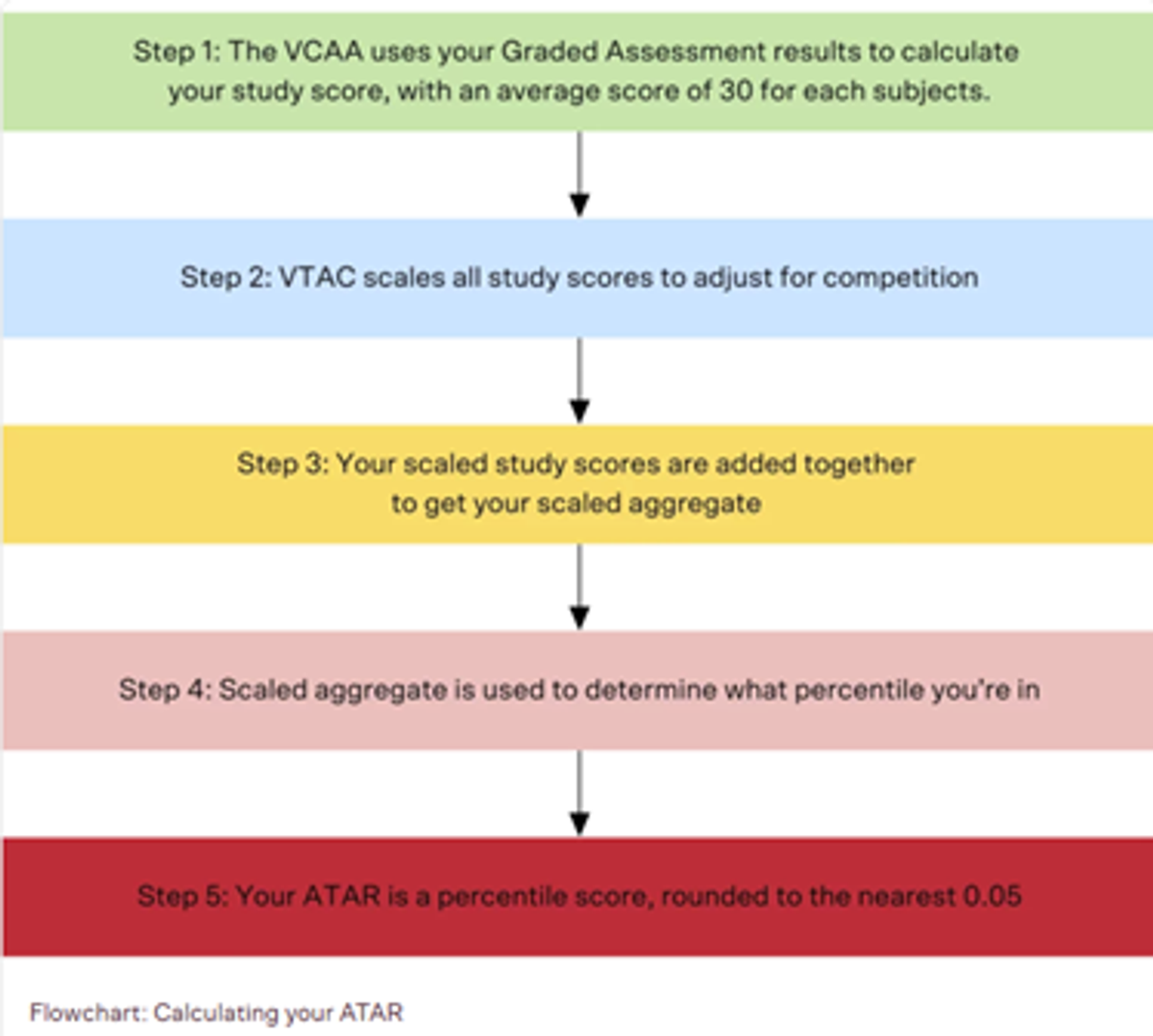
Source: matrix.edu.au
Helping Your Child Prepare for VCE Exams
Preparing for VCE exams can feel overwhelming for students, but parents play a vital role in supporting their child through this important stage. One of the best ways to help is by encouraging healthy routines. Ensure your child gets enough sleep, eats balanced meals and has regular breaks during study to maintain focus and wellbeing.
Creating a study-friendly environment is equally important. A quiet, organised space free from distractions can help students concentrate. Parents can also work with their child to develop a realistic study timetable, balancing revision with rest and hobbies.
Emotional support is just as crucial as academic preparation. Listen to your child’s concerns, reassure them that effort matters more than perfection and remind them that setbacks are a normal part of learning. Encourage them to practise exam techniques, such as working through past papers or timing themselves in mock exams.
Finally, model calmness. If parents show a positive attitude and trust in their child’s ability, it reduces pressure and builds confidence. With a balance of structure, encouragement, and self-care, parents can help their child feel prepared, capable and resilient when approaching their VCE exams.
Ms Maree Worker
Careers Coordinator