Respectful Relationships


















 Karoo Primary School
Respectful Relationships at Karoo Primary School
Respectful Relationships – Topic 8: Positive Gender Relations
This term, students across Karoo Primary School will be exploring Topic 8: Positive Gender Relations as part of the Victorian Department of Education’s Resilience, Rights and Respectful Relationships (RRRR) curriculum.
Here is a look at what each year level is focusing on:
Foundation
Activities within Topic 8 will assist students to:
• develop an understanding of the negative impacts of gender-based violence
• develop an understanding of the positive impact of respectful gender relations
• practice enacting skills to support positive peer relations
• practise strategies they can use to help keep themselves safe or seek help in situations involving gender-based violence.
Years 1 and 2
Activities within Topic 8 will assist students to:
• develop an understanding of gender based violence as involving unfair and hurtful behaviours based on ideas about what it means to be a boy, girl or gender diverse person
• identify how gender-based violence can include things that people say (verbal), things that they do to other people’s bodies or possessions (physical), or things that affect how safe or welcome other people feel, for example, ignoring them, leaving them out or laughing at them (psychological)
• examine the effects of physical, verbal and psychological forms of gender-based violence
• identify and practise respectful and gender-friendly behaviours
• develop and practise assertive and help seeking strategies to protect themselves when they feel unsafe in situations involving gender-based violence.
Years 3 and 4
Activities within Topic 8 will assist students to:
• identify different forms of gender-based violence, including physical, verbal and psychological violence
• examine the effects of gender-based violence on victim-survivors, witnesses and those who intentionally use violence
• describe and demonstrate what respectful, gender-inclusive behaviours look like in action
• assess situations involving forms of gender-based violence to consider possible responses (safely leave,intervene, refuse to participate, seek help)
• describe and practise help-seeking skills and strategies that can be used when encountering uncomfortable or unsafe situations involving peers or adults
• rehearse and refine strategies for seeking, giving and denying consent respectfully and describe situations where consent is required.
Years 5 and 6
Activities within Topic 8 will assist students to:
• define gender-based violence
• develop strategies for building positive and respectful relationships
• explore the relationship between negative gender norms and acceptance of gender-based violence
• identify and normalise behaviours that demonstrate respect and recognition ofthe rights of others within inter personal relationships
• understand what is meant by ‘affirmative consent’ in relation to intimate relationships
• demonstrate proactive peer-support and help-seeking strategies that can be used in response to instances of gender-based violence.
These important learning opportunities help us strengthen our whole-school commitment to creating a safe, inclusive and supportive environment where every student feels valued and respected. This learning also aligns with our Karoo Values of Kindness, Tenacity and Personal Excellence.
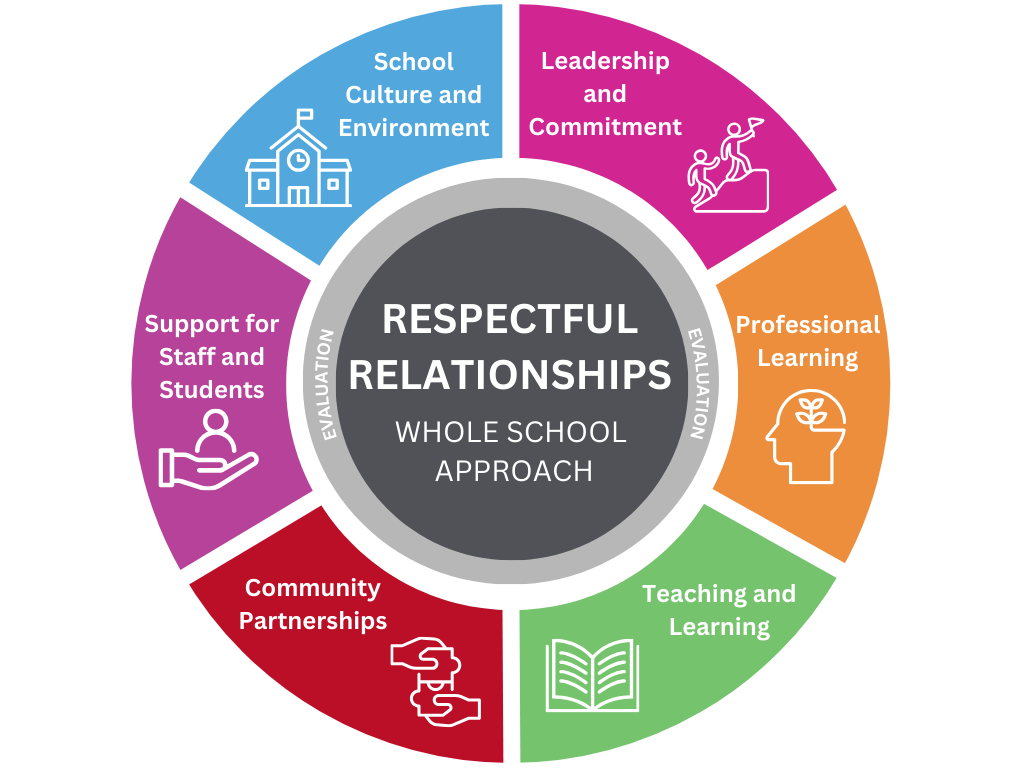
Respectful Relationship Myths
Myth: Students will use the Resilience, Rights and Respectful Relationships teaching and learning materials learning materials like a textbook
Fact: The Resilience, Rights and Respectful Relationships teaching and learning materials are designed to support teachers to deliver respectful relationships education in the classroom.
Teachers use their experience and knowledge to deliver this material in the most suitable way for their students. Materials were developed by nationally and internationally recognised experts from the University of Melbourne’s Graduate School of Education.
Myth: It is inappropriate to teach young children about consent
Fact: For younger children consent education includes an age-appropriate focus on what it can look or sound like to ask for permission or consent, to refuse permission or consent and to understand that consent can’t be obtained by pressuring people to do something they don’t want to do. For example, giving or denying permission to borrow a pencil.
Consent education also includes learning activities that support prevention of child sexual abuse, by teaching about bodily autonomy, body boundaries, the difference between ‘safe’ and ‘unsafe’ secrets and the importance of seeking help from trusted adults if children’s ‘early warning signals’ are sending a message that they might not be safe.
Research shows significant increases in knowledge and improved self-protective behaviours occurs when students are taught their rights to be safe from abuse and their right to say no or to tell, even when someone in authority over them abuses them.
Source: Respectful Relationships, https://www.vic.gov.au/respectful-relationships

RRRR information is available on the Arc platform. Please scan the QR code above.
Keep an eye on future newsletters to learn more about what your child’s year level is exploring through the RRRR curriculum.
If you have any questions or concerns please do not hesitate to reach out via the Compass protal.
Mrs. Karen Corrales