
Teaching & Learning

VLTM 2.0 - 'Elements of Learning'
The Victorian Teaching and Learning Model 2.0 (VTLM 2.0) describes how students learn and the teaching practices that best support that learning. It places explicit teaching at its core and is grounded in cognitive science, neuroscience and educational psychology.
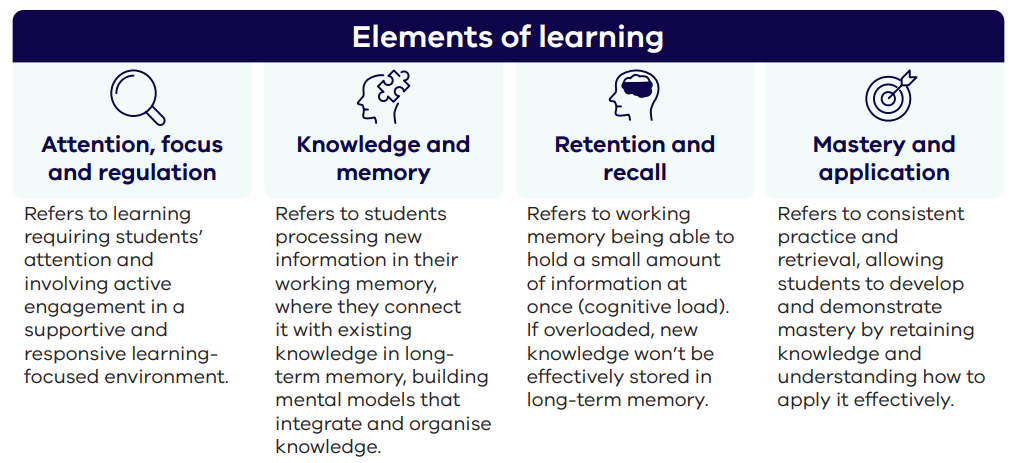
VTLM 2.0 organises learning into four connected Elements of Learning. These are short, practical guides teachers use when planning lessons so learning is more reliable, memorable and transferable for every student:
- Attention, focus and regulation
- Knowledge and memory
- Retention and recall
Mastery and application
These four elements describe the learning process (the “how” of the learner). The VTLM 2.0 then pairs them with four Elements of Teaching (Planning, Enabling Learning, Explicit Teaching and Supported Application), the practices teachers use to bring the elements of learning to life in the classroom.
What this looks like at Whittlesea Primary School
- Lessons begin with a clear focus and routines that help students regulate.
- New ideas are explicitly linked to prior learning and modelled by the teacher.
- Students practise with guidance, revisit learning through retrieval activities, and apply skills in increasingly complex tasks.
Teachers use short checks for understanding and planned opportunities for spaced practice so learning 'sticks'.
This is already informing our lesson planning and professional learning. As the Department supports schools in implementing VTLM 2.0, we are using the model to refine our curriculum design, lesson design, classroom routines, and assessments