
PCA Confirms Helmet Standards Transition Timeline

Pony Club Australia is confirming the transition timeline for upcoming changes to accepted helmet standards.
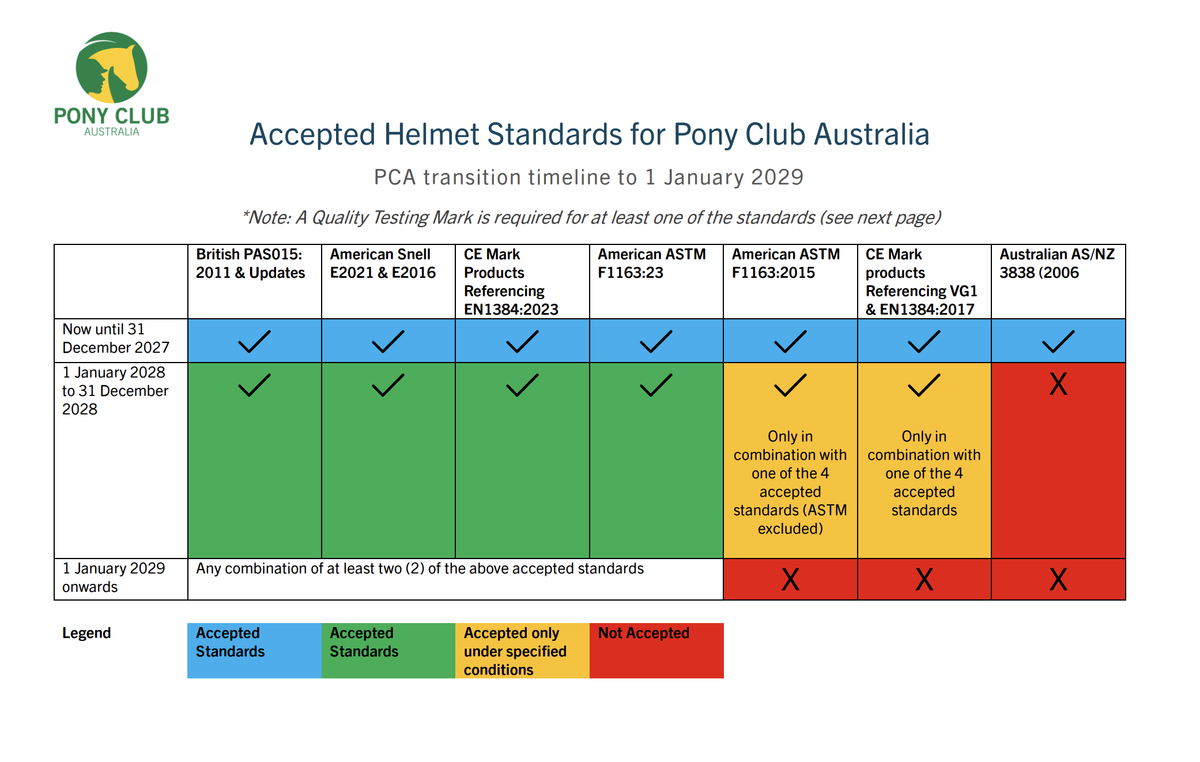
The changes originate from the FEI’s phased update to protective headgear requirements, which progressively removes some older standards and moves towards helmets meeting at least two of four approved standards.
Equestrian Australia announced its national transition arrangements earlier this year. PCA is working towards alignment with EA by 1 January 2029, while providing Pony Club members with an additional 12 months to phase out older helmet standards that remain common across our membership.
This means the current range of PCA-accepted helmet standards will remain in place until 31 December 2027.
What does this mean for Pony Club members?
Now until 31 December 2027
Helmets must meet at least one of the following accepted standards:
- AS/NZS 3838 (2006 onwards)
- PAS 015:2011 and updates
- Snell E2016 or E2021
- CE marked helmets referencing EN 1384:2023
- CE marked helmets referencing VG1 and EN 1384:2017
- ASTM F1163:2015
- ASTM F1163:2023
This additional transition period gives Pony Club members 12 months’ notice before the older standards begin to be phased out.
1 January to 31 December 2028
Helmets meeting any of the following standards will continue to be accepted:
- PAS 015:2011 and updates
- Snell E2016 or E2021
- CE marked helmets referencing EN 1384:2023
- ASTM F1163:2023
The following standards will only be accepted when used in combination with one of the four accepted standards above:
- CE marked helmets referencing VG1 and EN 1384:2017
- ASTM F1163:2015, except in combination with ASTM F1163:2023
AS/NZS 3838 will no longer be accepted from 1 January 2028.
From 1 January 2029
Helmets used in Pony Club activities and competitions will need to meet at least two of the following four standards:
- PAS 015:2011 and updates
- Snell E2016 or E2021
- CE marked helmets referencing EN 1384:2023
- ASTM F1163:2023
Members purchasing a new helmet are encouraged, wherever possible, to choose one that already meets the requirements applying from 1 January 2029.
What about helmet tagging?
PCA is continuing to work through how helmet tagging will operate alongside the revised standards.
Further information will be provided once a consistent approach across all states has been confirmed. In the meantime, members and clubs should continue to follow any existing tagging requirements (if applicable in your state).
It remains the rider’s responsibility to ensure their helmet meets the standards currently accepted by PCA.
Quality testing marks
At least one applicable helmet standard must carry an appropriate quality testing mark. Members should be aware that the CE mark itself is not a quality testing mark for the purposes of these requirements.
The accompanying PCA helmet standards guide includes examples of recognised quality testing marks and a simple table showing the transition through to 2029.
Looking after your helmet
Correct fit and adjustment of the retention harness are essential to a helmet’s performance. Helmets should ideally be professionally fitted, particularly when purchasing a new helmet.
The FEI recommends replacing helmets every three to five years, depending on frequency of use, wear and material fatigue.
Any helmet that has sustained a significant impact should be replaced immediately, even where there is no visible damage.