From the Head of Junior School

A Fortnight of Wonder, Hope and Joy
What an outstanding fortnight we have had in the Junior School. Over the past two weeks, our students have been immersed in two of the great joys of childhood: curiosity and imagination. National Science Week gave our students opportunities to ask questions, investigate, experiment and wonder about the world around them. Book Week has taken us into the equally important world of stories, characters, creativity and possibility. Together, these celebrations capture something fundamental about childhood: children are naturally curious, imaginative and eager to make sense of the world around them.
There is perhaps a greater need for this than ever. We are educating children in a world that can sometimes feel increasingly complex, uncertain and serious. Domestically and internationally, our news is filled with stories of conflict, division, economic uncertainty, environmental challenges, technological change and social pressures. Children are not immune to this environment. They hear conversations, see images and absorb the concerns of the adults around them. While schools cannot, and should not, shield children from the realities of the world, we can ensure that their experience of childhood contains something equally powerful: hope, joy, belonging, wonder and the confidence that the future is worth investing in.
This is one of the reasons I believe strongly in the importance of the experiences we create in Junior School. Education is about preparing children for the future, but it is also about ensuring they have a childhood worth remembering. There should be moments in every school year when the ordinary routines are interrupted and we deliberately celebrate learning, creativity and community. National Science Week and Book Week provide exactly these opportunities.
Book Week is one of the flagship weeks of the Junior School calendar. The costumes, dress-ups, parades, classroom activities, visiting authors and the sheer enthusiasm of our students create an atmosphere that is quite unlike an ordinary school day. There is something wonderful about seeing a Junior School filled with characters from books, with children and teachers alike wrapped in painted cardboard, hairspray and face paint. It is joyful, sometimes ridiculous, occasionally chaotic, and entirely appropriate.
Importantly, though, Book Week is not just for the children. Having families join us for these occasions is enormously valuable. Students love seeing their parents, grandparents and family members at school, sharing in something that matters to them. But I also think there is immense value for the adults. There is something wonderfully refreshing about coming into a school for a morning that is light, celebratory and completely unashamedly joyful. For a short time, adults get to step away from the pressures of work, responsibilities and the seriousness of everyday life and simply enjoy being around children.
Perhaps this helps explain the enduring appeal of programs such as the ABC's Old People's Home for 4 Year Olds. Since it began in 2020, the program has attracted millions of viewers through its combination of joy, happiness, wholesomeness and nostalgia. It reminds us of something that can be easily lost in the busyness of adult life: the simple pleasure of being around children as they play, discover, laugh and see the world with fresh eyes. Coming into the Junior School at any time can offer a little of this, but particularly on days when children and staff are transformed by costumes, books, characters and an enormous amount of imagination.
There is also a serious educational purpose behind this joy. Student engagement in learning is a growing concern across education systems around the world. For many students, disengagement is not simply about ability or behaviour; it is about whether they perceive learning to have value, relevance and enjoyment. If learning becomes something that is simply done to children rather than something they want to participate in, we should not be surprised when engagement diminishes.
This is why occasions such as National Science Week and Book Week matter. They are not the solution to engagement, but they are one of the many tools available to us. They allow us to champion particular areas of learning and communicate an important message: Science is fascinating. Reading is exciting. Stories matter. Learning can be joyful. A child who becomes fascinated by an experiment during Science Week or discovers a book they cannot put down during Book Week has experienced something more powerful than simply completing another lesson. They have experienced the possibility that learning can be personally meaningful.
The challenge for schools is to capture that sense of engagement beyond the flagship occasions. We need to continue creating classrooms where children have voice, where curiosity is encouraged, where questions are valued, where learning connects to the world they inhabit and where there is genuine enjoyment in mastering something new. Book Week and Science Week are opportunities to make these values highly visible, but they should also remind us of what we are trying to achieve every day.
Junior School is, and should remain, a place of wonder. It should be a place where imagination is valued, where innocence is protected, where children can dress up, ask ridiculous questions, become someone else for a morning, discover something unexpected and simply delight in being young. Of course, we have important learning to do. We have knowledge, skills, outcomes and expectations to pursue. But education is not diminished by joy; in many ways, joy is what makes learning memorable.
At a time when the world can sometimes feel uncertain, I think there is real educational and human value in creating spaces where children experience hope and joy. We should not underestimate the power of a child laughing with their friends, proudly showing their costume to their family, discovering something through an experiment or finding themselves completely absorbed in a story.
After all, if Junior School isn't a time for wonder, imagination, hope and joy, when is?
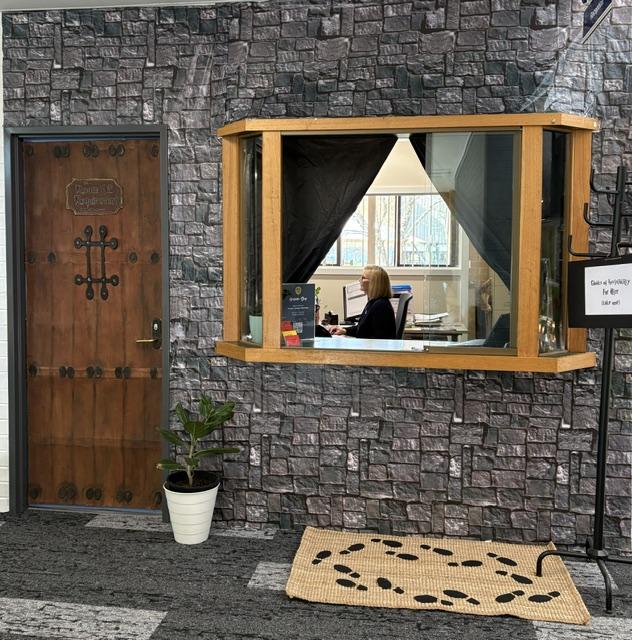
Mrs Arrell really got into decorating her door, turning the reception area into the Room of Requirement out of the Harry Potter series.
Christopher Sanders
Head of Junior School