Wellbeing News
Wellbeing in the Classroom – Rights, Resilience and Respectful Relationships
Help-Seeking:
Welcome back to Term 3! From Prep to Grade 6, we’re kicking things off this term with a focus on help-seeking in our Wellbeing lessons. Through our weekly Rights, Resilience and Respectful Relationships sessions, Students will learn to recognise when they need support, identify trusted people to turn to, and build the confidence to reach out — whether to a friend or an adult. Activities will explore peer support, communication skills, solving everyday problems, and strategies for staying safe in uncomfortable situations.
Why It Matters:
Research shows help-seeking is one of the most powerful tools for protecting young people's mental health, yet many students — particularly those facing the greatest distress — feel unable to ask for help. Common barriers to young people asking for help include embarrassment, fear of not being believed, and simply not knowing who to approach. Young people are also more likely to turn to peers than adults as they get older, which is why building peer-support skills alongside formal help-seeking pathways is so important.
By normalising help-seeking as a strength rather than a weakness, we aim to give every student the confidence and skills to ask for support when they need it most.
How Parents Can Support Help-Seeking at Home:
Keep the door open. Let your child know no problem is too small (or too big) to bring to you, and be ready to calmly give your full attention when your child does come to you for help.
Normalise asking for help. Seek help from your child to solve small problems or share times you've asked for help yourself — it shows children that help-seeking is a sign of strength, not weakness.
Create opportunities to connect. Dedicated 1:1 time doing something you both enjoy, sharing family meals together or driving them places (the car is a great place to engage young people in conversation).
Ask open-ended questions. Invite your child to share something they need some help with by asking open questions like, “What was tricky today?" instead of "How was school?"
Build a ‘trusted adults’ list together. With your child, identify 3–5 people they could turn to if they couldn't talk to you. Students have a ‘helping hand’ at school but it is equally important for young people to know who they can seek help from outside of the school context.
Recognise help-seeking behaviour when it happens. Provide encouragement and positive feedback for help-seeking. For example, “It looked as though you felt upset. I’m really glad you came to talk to me about it”.
Resist the urge to go into Problem Solving mode. Sometimes kids just need to feel heard, loved and supported when they share what’s been bothering them. Practise active listening by focusing on their emotions and experience without offering solutions. For example:
'How did that make you feel?'
'It sounds as if you were (angry/frustrated/excited), were you?'.
‘That sounds tough. Do you want help to find a solution or do you just need to get it off your chest?’
Resources for Parents:
Children’s books-
- What to Say When You Don’t Know What to Say by Davina Bell
- Hannah Asks for Help by Tom Percival
Websites-
- Raising Children Network – articles, videos and guides for all ages
- ReachOut Parents – tools and 1:1 coaching for parents of 12–18 year olds
- Beyond Blue – Parenting and Mental Health
Helplines-
- Kids Helpline – 1800 55 1800 (free, 24/7, ages 5–25)
- Beyond Blue – 1300 22 4636
Health and Human Development – Talking the Talk
Later in Term 3, Heath and Human Development will be a Wellbeing Focus across all year levels. Classroom teachers will facilitate Talking the Talk sessions to explore Sexuality, Consent, Respectful Relationships at an age appropriate level.
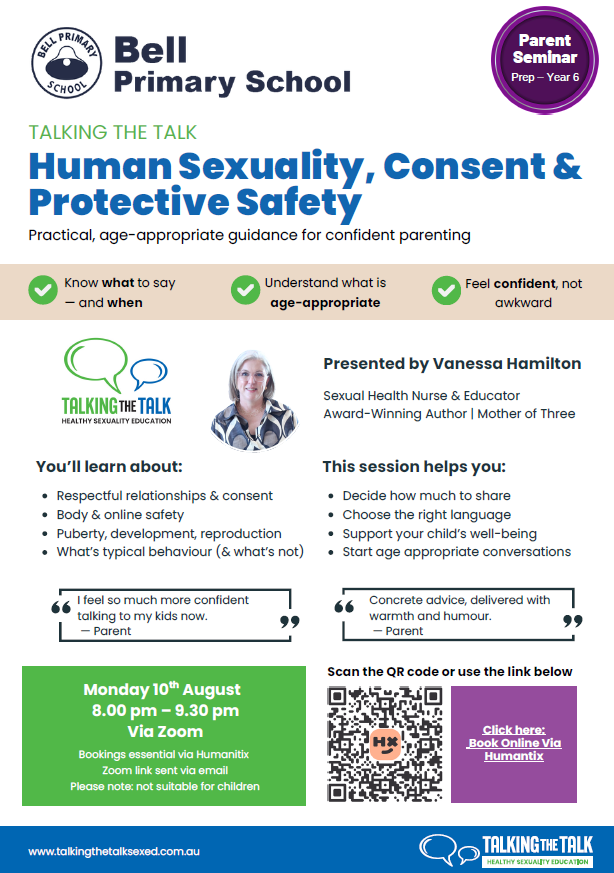
We are excited to welcome back Vanessa Hamilton, founder of Talking The Talk, to run an online parent information session on Monday 10 August, 8:00pm to 9:30pm. For more information and booking details, please see flyer below.