What you need to know
Key industry developments









 First National Real Estate

What you need to know
Key industry developments
Priority: AU/NZ, Medium, National
👓 1 minute read
AI will look very different by May next year – and Samantha McLean plans to make sure our Convention conversation has kept pace.
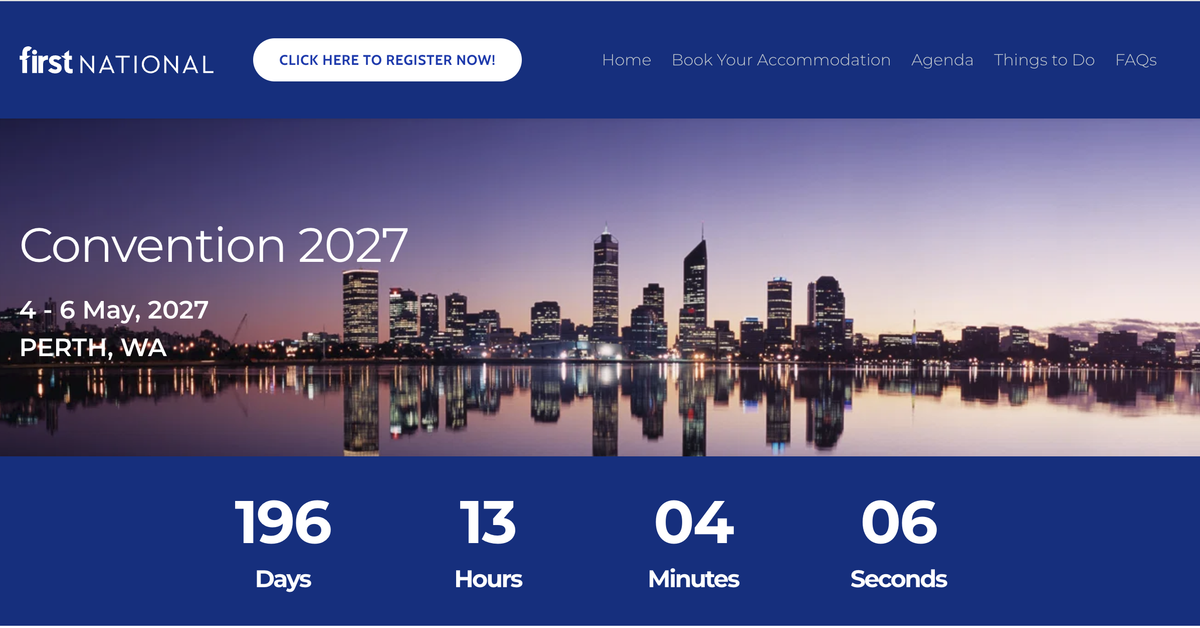
The Managing Editor of Elite Agent has been confirmed as a keynote speaker for First National Convention 2027 in Perth, 4–6 May, bringing her perspective on how artificial intelligence is changing the way real estate professionals work.
Rather than locking the presentation around today's technology, Samantha will work with First National in the lead-up to Convention to shape a session around ‘all things AI’ – wherever the technology has reached by May.
She'll deliver the keynote on Wednesday 5 May, followed by a workshop on Thursday 6 May, giving members an opportunity to move from the bigger picture into practical application.
For agents and businesses already experimenting with AI – and those wondering where to start – expect a timely look at what matters, what's useful and what the next wave of change could mean for real estate.
Save the dates: First National Convention 2027, Perth, 4–6 May.
Priority: AU/NZ, High, National
👓 2 minute read

Estate agencies across First National move money quickly, hold significant amounts of personal information and rely heavily on email for urgent instructions. That combination makes our industry an attractive target for cyber criminals.
According to new advice provided to First National by our insurance partner Marsh, the severity of cyber insurance claims in real estate increased 58% last year, pushing the average loss to $258,000. Business email compromise, payment diversion, ransomware and impersonation remain among the major threats.
Artificial intelligence is making some attacks harder to recognise. Criminals can increasingly imitate writing styles and create convincing messages that make a changed bank account or urgent settlement instruction appear legitimate. Marsh's advice is straightforward: unusual payment requests, account changes and identity confirmations should be independently verified.
That's why First National is launching Cyber Ready – Reduce. Prepare. Respond.
The initiative brings together new guidance from Marsh, practical resources on MyFN (formerly FN Central) and First National's Cyber Incident Response Plan, supported by an NSO webinar explaining exactly what happens if your office reports an incident.
Reduce
Marsh recommends a layered approach to prevention, including multi-factor authentication, strong password practices, system patching, secure remote access and monitoring for unusual mailbox activity. Any change to banking details, urgent transfer or unusual settlement instruction should have a strict call-back verification process rather than relying on the email thread.
Prepare
We've added a dedicated Cyber Breach Response Plan page to MyFN so principals and their teams can find the information they need before – and during – an incident.
Offices should know who they'll contact, have insurance details accessible if systems go down, check that their office landline in MyFN is current and establish an alternative secure email address for their principal.
Respond
NSO's Cyber Incident Response Plan establishes what happens from the moment an office reports a suspected incident.
The affected member office remains responsible for containing the threat and meeting its legal, regulatory and insurance obligations, while NSO helps coordinate specialist support, assesses the potential network risk and alerts other members where necessary.
The accompanying webinar takes principals and teams through the response process step by step – including securing accounts, protecting payments and trust money, preserving evidence, contacting insurers and considering privacy obligations.
The most important advice is also the simplest: report early and verify everything.
Visit Cyber Ready on MyFN
Visit Cyber Ready on FN Central
Priority: NSW, Medium
👓 1 minute read

NSW agents wanting a practical briefing on some of the biggest regulatory issues affecting their businesses can attend REINSW’s Critical Reforms Breakfast Briefings across the state.
The two-hour sessions cover contractor arrangements, privacy, residential tenancy compliance, underquoting reforms and changes affecting the use of AI in agencies. REINSW says NSW Fair Trading is actively targeting tenancy breaches, while maximum court-imposed underquoting penalties increase in November to $110,000 or three times the agent’s commission, whichever is greater.
The optional briefings run from 7:30 am to 9:30 am at each What’s the Future location. They are free with Class 1 and Class 2 CPD registrations, with separate registration required. Standalone attendance is also available – free for REINSW members and $25 for non-members.
👉 See NSW dates, locations and register
Priority: WA, Medium
👓 2 minute read

First National members in Perth are working in an increasingly divided market, with rental supply tightening again while the sales market gives buyers considerably more choice and time.
Rental availability fell below 2,000 properties for the first time since March, with 1,914 properties available on reiwa.com at the end of September – down 5.7% in a month and 8.8% over the year.
Rental demand of course remains strong. The median time to lease fell to just 14 days, while Perth’s median dwelling rent increased 3.4% during September to $750 per week. House rents were also $750, up 7.9% annually, while unit rents reached $700, up 4.5%.
For sales agents, however, conditions have shifted markedly. There were 7,812 properties for sale at the end of September – 184.6% more than a year earlier. REIWA attributes this not to a rush of vendors entering the market, but to new listings returning to more normal levels while properties take longer to sell.
That change is showing up in selling times. Houses took a median 26 days, compared with just eight days a year ago, while units took 23 days compared with nine days last September.
Prices are still well above year-ago levels – Perth’s $965,000 median house price is up 17.7%, while the $695,000 unit median is up 21.9% – but the direction underneath those annual figures has changed. REIWA says quarterly prices have declined and expects annual growth to slow further.
For our agents, the practical message is increasingly local: some well-located family homes are still attracting multiple offers, while properties aimed at investors and first home buyers are experiencing weaker enquiry and open home traffic. Selling a property with a tenant in place has also become more difficult.
Priority: NSW, High
👓 1 minute read

NSW agents will soon face much stricter requirements around advertised property prices, with vague descriptions such as ‘contact agent’, ‘expressions of interest’ and simply ‘for sale’ no longer sufficient.
Under the reforms, agents will be required to establish an estimated selling price based on evidence including comparable sales, and ensure that estimate remains reasonable as new information emerges during the campaign.
By the end of 2026, residential advertisements across websites, social media and email will also need to display a selling price or price range. Advertisements cannot indicate a price below the agent’s estimated selling price or, where applicable, the highest known bid from a registered auction bidder. Changes must be reflected in advertising within one business day.
The consequences for getting it wrong are also increasing sharply. Maximum penalties for underquoting will rise to $110,000 or three times the agent’s commission, significantly increasing the financial risk for agencies.
The reforms will also require a Statement of Information for all properties, as part of the NSW Government’s push for greater transparency around advertised price guides.
NSW principals and sales teams should review their appraisal, price-guide and advertising processes now rather than waiting for the new requirements to commence.