
From the Deputy Principal
Loving Masculinity: Strength, Service and Character
Recent events reported in the media have again highlighted the importance of conversations about respect, consent, responsibility and the formation of young men. While these incidents are deeply concerning, they also remind us why schools, families and communities must actively engage in shaping positive models of masculinity rather than assuming boys will develop them on their own.
In a world where terms such as toxic masculinity, manosphere and online influencers dominate public discussion, it is easy to focus solely on what is wrong with masculinity. Yet a recent article by Caitlin Humphrys, a Consent and Respectful Relationships Education Consultant with Catholic Education Queensland, challenges us to move beyond dismantling harmful stereotypes and ask a more important question:
What kind of men are we helping our boys become?
As Deputy Principal of an all-boys Catholic school, this question resonates deeply with me. It is also one of the reasons why I believe it is important that boys hear from both male and female voices throughout their education.
Over the past 25 years, I have had the privilege of teaching and leading boys at various stages of their development. Alongside my professional experience, I am also a mother of two daughters and one son. These experiences have given me a unique perspective on the opportunities and challenges facing young people today, and they reinforce the importance of staying informed about current research and social trends that influence how boys understand themselves and their place in the world.
Much of the public discourse focuses on the dangers of toxic masculinity and the growing influence of online spaces that promote dominance, entitlement and hostility towards others. These concerns are real and deserve our attention. However, Humphrys' article offers something refreshing and hopeful. Rather than simply telling boys what not to be, it presents a compelling vision of what healthy masculinity can look like.
The article argues that when harmful models of masculinity are dismantled without being replaced by positive alternatives, a void is created. Adolescents naturally seek identity, belonging and purpose. If families, schools and communities do not provide healthy models, other voices will gladly step in to fill the gap.
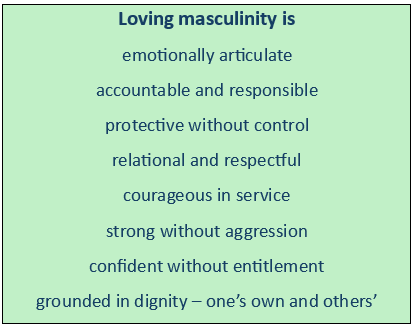
For Catholic schools, this challenge is particularly important. We have an opportunity to present boys with a vision of manhood grounded in dignity, compassion, courage and service. Humphrys describes this as ‘loving masculinity’ - a masculinity that uses power for others rather than over others.
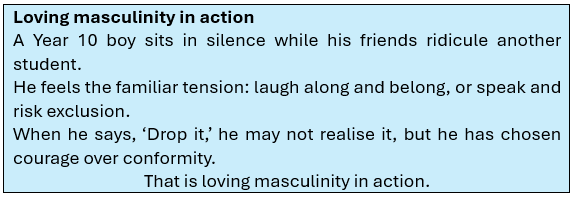
Importantly, this is not a call for boys to be less strong. Rather, it is a call for strength to be expressed in healthier and more meaningful ways. Real strength derives from humility, patience, empathy and self-control. It is the courage to stand up for someone being excluded. It is the confidence to show compassion. It is the maturity to admit mistakes and make amends. It is leadership expressed through service rather than status.
What I find most encouraging about Humphrys' article is its fundamentally strengths-based approach. Rather than framing boys as a problem to be solved, it recognises that most boys genuinely want to be good people. They want purpose. They want connection. They want to matter.
Our role as educators, parents and mentors is to provide them with a vision worthy of that desire. In a time when so many competing messages vie for the attention of young men, we must continue to engage thoughtfully with these issues. The conversation about masculinity cannot stop at identifying what is harmful. We must also articulate what is noble, life-giving and worthy of aspiration.
For our boys, that means helping them understand that true strength is not found in dominance or control. It is found in character. It is found in service. It is found in relationships built on dignity and respect.
Ultimately, the goal is not simply to raise successful young men, but to form good men: men who are courageous, compassionate, responsible and committed to the wellbeing of others. Such a vision of masculinity reflects the very best of who we aspire to be as a Catholic educational community and provides our boys with a clear sense of purpose, belonging and responsibility.
(Australian Catholics Winter Edition, 2026)
Ms Elizabeth Watson - Deputy Principal